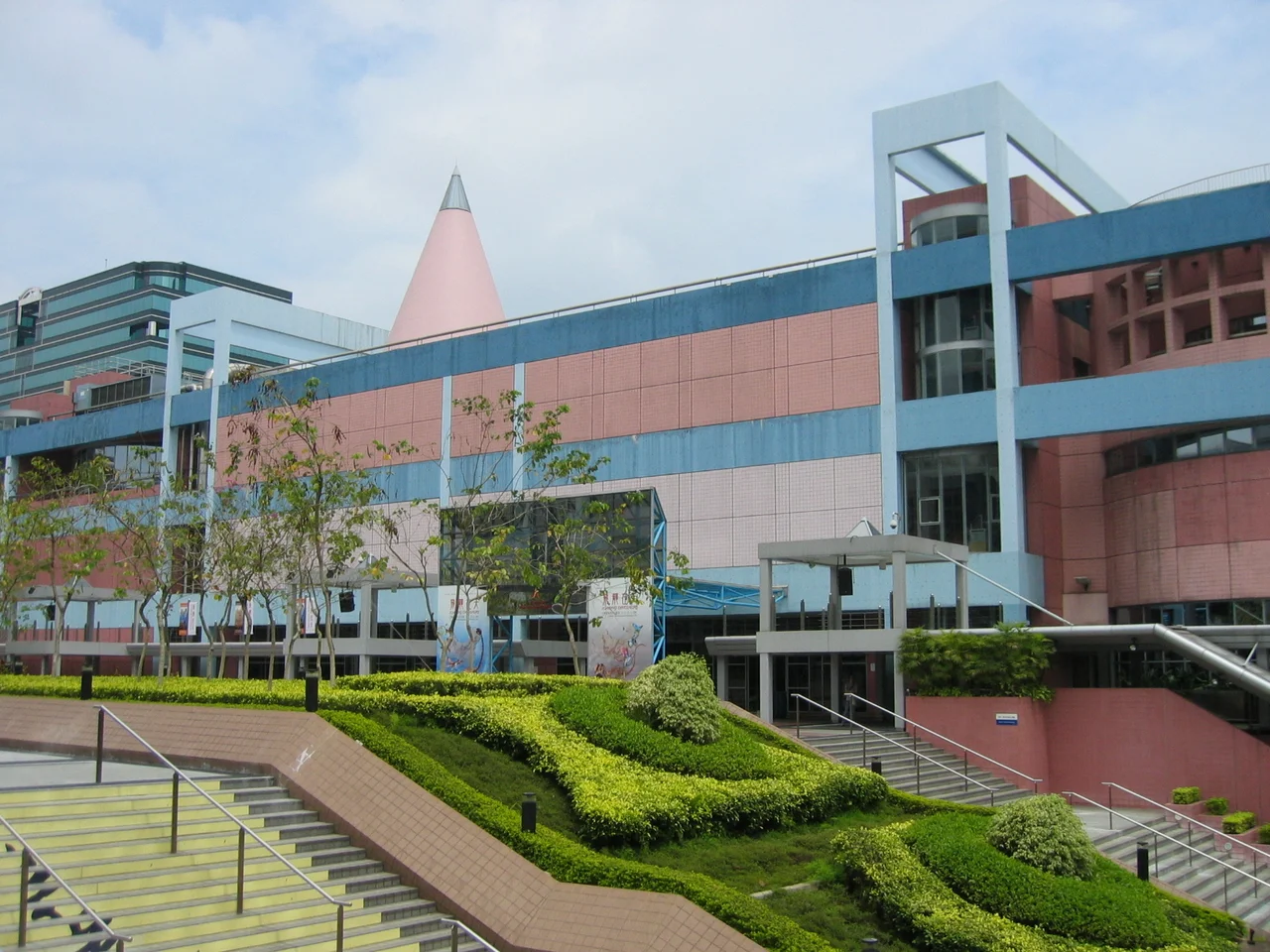

Hong Kong Science Museum
Suspended from the ceiling of the Hong Kong Science Museum's main hall is a Douglas DC-3 — Cathay Pacific's first airliner, a twin-engine propeller plane that launched the airline's Pacific routes in the 1940s. It hangs there, full-sized, above the heads of schoolchildren peering up at it. Below it, a 22-metre-tall twin-tower Energy Machine sends steel balls cascading through ramps, levers, and spirals — the largest kinetic sculpture of its type in the world. The museum opened in 1991 in Tsim Sha Tsui East, and from the start its principle was clear: science is not something you observe behind glass. You participate.
Conceived in the Urban Council Era
The Hong Kong Science Museum began as an idea inside the Urban Council in 1976, long before the land in Tsim Sha Tsui East had been reclaimed from the harbour. The council hired American planning firm E. Verner Johnson and Associates in 1984 to help shape the concept. Two years later it brought in Hong Kong architecture firm Palmer and Turner to design the building. Construction by Leighton Contractors began in March 1988 and completed in November 1990. The museum opened the following year in April 1991, one of a cluster of cultural institutions being built along the Kowloon waterfront as Hong Kong invested in its identity as an international city. Next door, the Hong Kong Museum of History would follow.
Five Hundred Exhibits, Seventy Percent Touchable
The permanent exhibition spans 18 galleries covering light, sound, motion, electricity and magnetism, mathematics, life science, geography, meteorology, transportation, communication, and more. About 500 exhibits fill the permanent area, and roughly 70 percent of them are participatory. Children can sit in a real stationary car and take a driving simulation that tests their ability to avoid accidents and manage fuel use. They can step inside a life-sized aircraft cockpit and watch footage of a flight over Hong Kong play on the screen in front of them. Museum staff perform live demonstrations daily. The emphasis on doing rather than reading reflects a particular philosophy: that the most durable way to understand a principle is to feel it work.
Dinosaurs and Biodiversity
In 2016, the Biodiversity Gallery opened on the ground floor, exploring the flora and fauna of different habitats, with a focus on Hong Kong's own ecological variety. Visitors can explore genetics, evolution, and microscopy at its hands-on stations. The Paleontology Gallery, which opened in 2023 under the name Extinction · Resilience, houses 80 to 100 fossils and replicas, anchored by an almost complete Deinonychus skeleton. Two dinosaur animatronics — a Tyrannosaurus rex and a Velociraptor — respond to visitors. The Jockey Club Environmental Conservation Gallery tackles climate change through games and interactive displays. The museum evolves: as of 2025 the second floor is under renovation as part of a broader permanent exhibition renewal project.
The Museum That Almost Moved
In late 2023, the Hong Kong government proposed relocating the Science Museum to Sha Tin, freeing the Tsim Sha Tsui site for a new institution that would, according to the proposal, showcase Chinese history, the Communist Party, and national achievements. The Culture, Sports and Tourism Bureau framed it as an opportunity to improve teenagers' understanding of China. The proposal generated strong public opposition, and by 2024 the government had quietly shelved the relocation — exploring alternative sites for the new national museum instead. The Science Museum stayed. The DC-3 still hangs from the ceiling in Tsim Sha Tsui. The Energy Machine still runs.
From the Air
The Hong Kong Science Museum is located at 22.3010°N, 114.1776°E in Tsim Sha Tsui East, Kowloon, at sea level on reclaimed land adjacent to Victoria Harbour. From the air at 2,500 feet, the museum complex is visible between the Hung Hom rail yards to the northeast and the dense retail and hotel towers of central Tsim Sha Tsui to the west. The Hong Kong Museum of History sits immediately to its north. Victoria Harbour lies to the south, with Hong Kong Island's skyline beyond it. Hong Kong International Airport (VHHH) is approximately 24 nautical miles to the west-southwest on Lantau Island.
Nearby Stories
- Lok Ma Chau Loop 2.3 km away
- Portas do Cerco 2.3 km away
- Kweilin Incident 17 km away
- Wanshan Archipelago Campaign 34 km away
- Nanxiong Formation 115 km away
- Battle of Nanpeng Island 148 km away
- Heyuan 169 km away
- Cape Maobitou 632 km away
Sources
- Hong Kong Science Museum - Wikipedia
- Energy Machine — Hong Kong Science Museum official page
- Visiting Betsy the DC-3 in Hong Kong — Trip.com
- Extinction · Resilience — Palaeontology Gallery, Hong Kong Science Museum
- Hong Kong Science Museum Biodiversity Gallery — Ecsite
- SCMP: Hong Kong considering Central location for national achievements museum after Science Museum relocation outcry