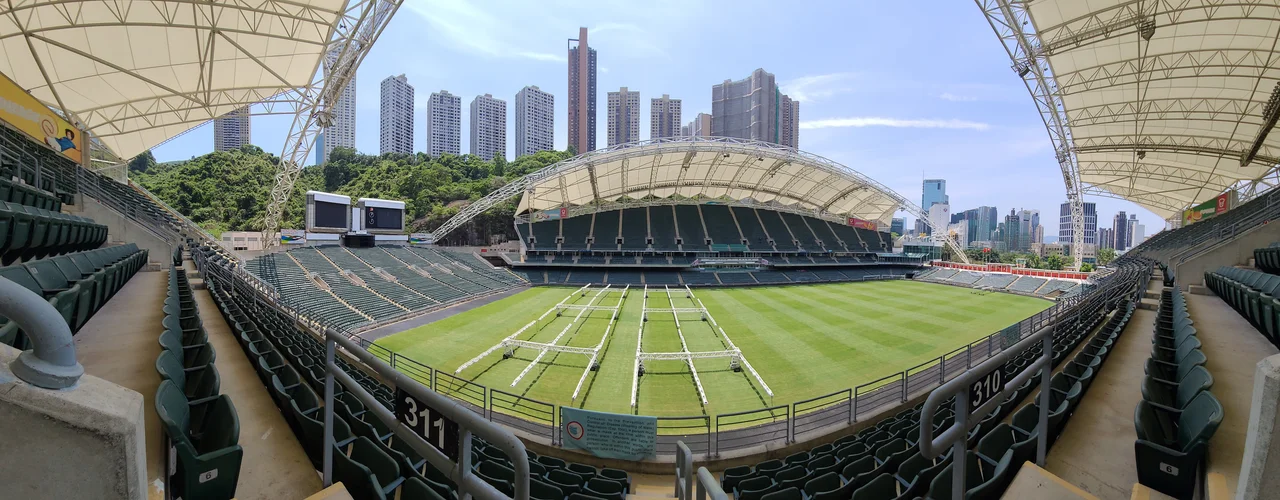

Hong Kong Stadium
The land at So Kon Po had a peculiar beginning. After a catastrophic fire at the Happy Valley Racecourse in 1918 killed hundreds of spectators, the site became a burial ground. Later the Hong Kong Government relocated the graves to Aberdeen, and the valley was eventually given over to sport. A U-shaped Government Stadium, with a capacity of 28,000, stood there by 1953. It worked, after a fashion. It was not enough.
The Wembley Experiment
In the early 1990s, the Royal Hong Kong Jockey Club pushed for a world-class reconstruction. The Government Stadium was demolished and replaced with a 40,000-seat rectangular arena. No running track was built — the valley was too narrow. The management contract went to Wembley International, a subsidiary of the famous London stadium operator, in March 1994. The first event after reconstruction was a Jean-Michel Jarre concert on 11 March 1994. Depeche Mode followed five days later. Alan Tam, the first local artist to play the venue, headlined three nights in April. Then reality arrived. The pitch, sand-based and poorly draining, deteriorated almost immediately. Before an exhibition match in July 1997, Manchester United manager Alex Ferguson was blunt: 'The pitch is cutting up. The surface is just sand-based and the turf doesn't hold well. Injuries can occur.' Noise complaints from residents in the surrounding tower blocks ended the stadium's concert ambitions by 1999.
A Diplomatic Bungee Jump and a Legal Bill
Wembley's tenure ended abruptly. On 24 May 1996, a Canadian named Paul G. Boyle illegally bungee-jumped from the stadium's roof. He was not arrested but received a lifetime ban from all Urban Council facilities. The pitch remained a festering dispute between Wembley and the stadium's owners, the Urban Council. On 26 May 1998, the Provisional Urban Council terminated Wembley's management contract. The courts later found that the termination had been wrongful. The Hong Kong government paid Wembley Plc more than HK$20 million in damages. The Leisure and Cultural Services Department assumed management after the Urban Council was disbanded. By 2015, the Jockey Club funded a complete retuiring: the old surface was removed, the irrigation and drainage systems replaced, and new turf laid. The pitch problems that had plagued the stadium for two decades were finally addressed.
The AFC Asian Cup, 1956
The stadium hosted the inaugural AFC Asian Cup in September 1956 — a four-team round-robin competition with no final, won by South Korea, with Hong Kong finishing third. It was a modest beginning for what became Asia's premier football championship. The stadium also hosted the AFC Women's Asian Cup four times: in 1975, 1981, 1986, and 1989. Every English Premier League club in the traditional Big Six — Arsenal, Chelsea, Liverpool, Manchester City, Manchester United, and Tottenham Hotspur — has played at Hong Kong Stadium. So have Real Madrid, Barcelona, Juventus, AC Milan, Atlético Madrid, and Paris Saint-Germain. On 8 August 2003, Luis Figo scored the first goal for Real Madrid from the penalty spot during a pre-season friendly against a Hong Kong select XI. Real Madrid won 4–2.
Sevens, Bledisloe, and the Lions
From 1982 to 2024, Hong Kong Stadium hosted the Hong Kong Sevens annually — the tournament that turned Hong Kong's spring into a global rugby fixture, drawing crowds who arrived in elaborate costumes and treated the event as much carnival as competition. The Rugby World Cup Sevens came twice: in 1997 and again in 2005. On 1 November 2008, the stadium became the first outside Australia and New Zealand to host a Bledisloe Cup test match, where the All Blacks beat the Wallabies 19–14. In 2010, 26,210 spectators watched the second Bledisloe Cup match in Hong Kong. On 1 June 2013, the British and Irish Lions played the Barbarians here. The stadium has hosted more Premier League Asia Trophy editions — four — than any other ground, including the 2007, 2011, 2013, and 2017 tournaments. In 2009, the Hong Kong football team defeated Japan in the East Asian Games final in front of more than 31,000 spectators, winning the city's first international football medal.
The Messi Controversy and After
On 4 February 2024, Hong Kong Stadium hosted a friendly between a Hong Kong League XI and Inter Miami CF. Lionel Messi, who had recently joined Inter Miami, did not play. The controversy spread quickly: the absence of a player many spectators had specifically come to see sparked anger that extended beyond Hong Kong, contributing to the cancellation of a planned Argentina friendly in mainland China. It was not the first time the stadium's events had generated political resonance — the city's fraught relationship with spectacle and expectation had always found its way here. The stadium today has a capacity of 40,000: 18,256 at the main level, 18,507 at the upper levels, 3,153 at executive level, and 57 wheelchair spaces. Since 1999, noise restrictions have prevented most concerts. The Saudi Super Cup arrived in 2025. The valley at So Kon Po keeps filling.
From the Air
Hong Kong Stadium sits at 22.272861°N, 114.188444°E in the Caroline Hill valley of Causeway Bay on Hong Kong Island. From the air, the stadium's rectangular roofed structure is visible in the narrow valley between the island's ridge and the harbor-facing urban grid. Approaching VHHH (Hong Kong International Airport) from the northeast, Causeway Bay's density resolves below the island's skyline. Best viewed below 4,000 feet in clear conditions. The nearest airport is VHHH, approximately 30 km to the northwest.
Nearby Stories
- Lok Ma Chau Loop 2.3 km away
- Portas do Cerco 2.3 km away
- Kweilin Incident 17 km away
- Wanshan Archipelago Campaign 34 km away
- Nanxiong Formation 115 km away
- Battle of Nanpeng Island 148 km away
- Heyuan 169 km away
- Cape Maobitou 632 km away
Sources
- Wikipedia – Happy Valley Racecourse fire
- setlist.fm – Jean-Michel Jarre at Hong Kong Stadium, 11 March 1994
- setlist.fm – Depeche Mode at Hong Kong Stadium, 16 March 1994
- Hong Kong Stadium - Wikipedia
- ESPN – Bledisloe Cup touches down in Hong Kong
- Wikipedia – 1956 AFC Asian Cup
- Wikipedia – Hong Kong v Inter Miami (Messi controversy)
- South China Morning Post – Real Madrid's 2003 trip to Hong Kong