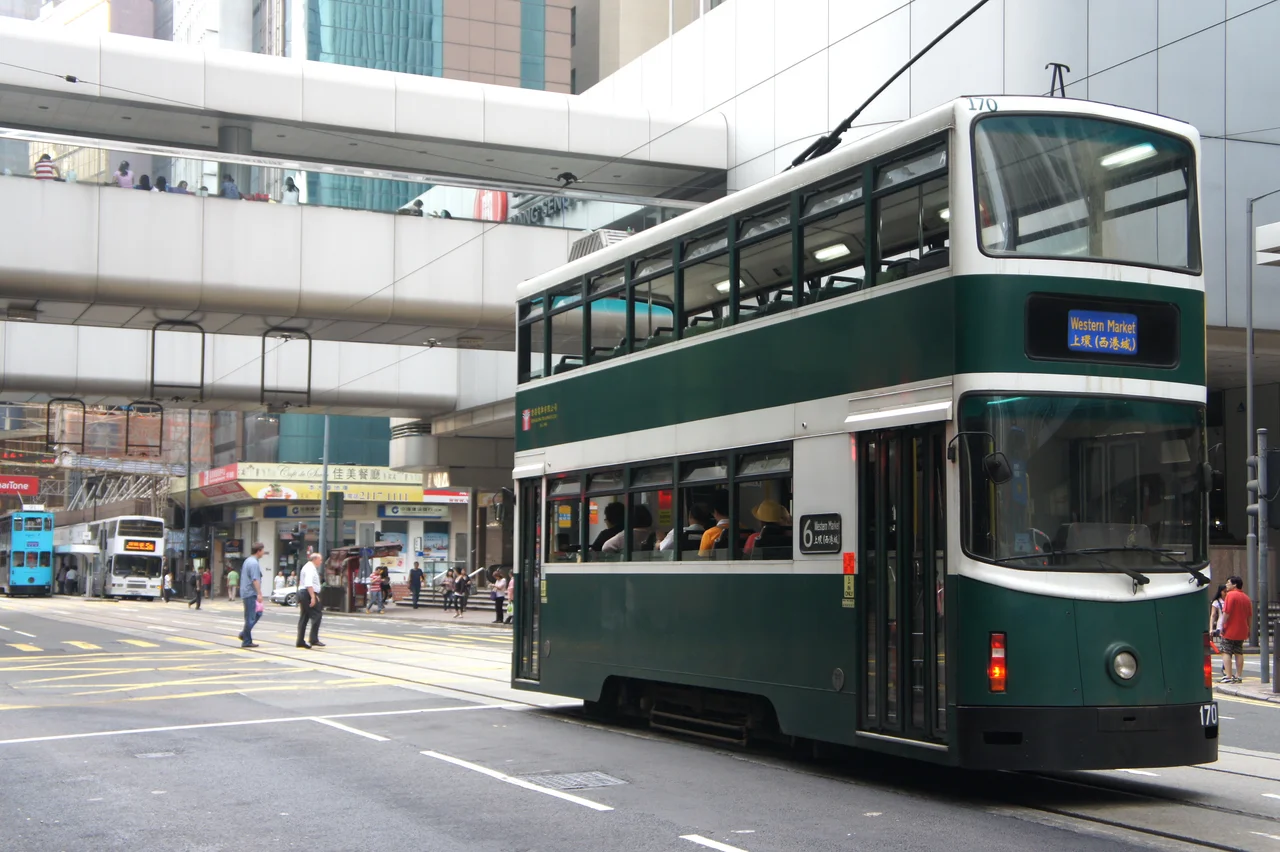

Hong Kong Tramways
Locals call them Ding Dings. The name comes from the double-bell ring the trams use to warn pedestrians — a sound that has echoed along the northern shore of Hong Kong Island since 30 July 1904, when regular service began with twenty-six single-deck cars assembled at the depot. The cars had been delivered from England in sections. Fares were ten cents for first class and five cents for third. One hundred and twenty years later, the adult fare is HK$3.30, and the Ding Ding is still running.
The Long Road to the First Tram
The proposal to build a tramway along Hong Kong Island came in 1881, when Hon. F. Bulkeley Johnson, with support from Ng Choy, put forward a bill for the construction of a tram system. The government published a preliminary Tramways Ordinance the following year, sketching out six tramlines. Then it lost interest. The Peak Tram, serving the wealthy residents of Victoria Peak, was the priority. The northern shore proposal sat dormant for two decades. By 1888, the island's population had grown from 173,475 to 215,800, and the case for mass transit became harder to ignore. The Tramways Ordinance finally passed on 23 May 1902. The Hong Kong Tramway Electric Company Limited was founded in London the same year. Track construction began in September 1903. Service commenced nine months later.
A Fleet That Never Stopped Growing
The original trams were single-deckers. By 1912, the system's growing ridership justified ten double-deckers with open tops and reversible seats on the upper deck. By 1913, canvas roofs were added for wet weather. The Happy Valley branch was extended. In 1950, the entire fleet was rebuilt in collaboration with Taikoo Dockyard. Class distinctions were abolished in 1972, simplifying boarding: passengers entered at the rear and paid as they left. Women began working as conductors in 1971; by 1976, when one-man operation was introduced, conductors were no longer needed and shifted to become motormen. In 2000, HKT introduced the 'Millennium' trams, designed and manufactured by its own engineering team. In 2021, the Guinness World Records certified the fleet as the largest operational double-decker tram fleet in service on Earth. The Ding Ding holds this record exclusively — no other tram system uses double-deckers exclusively.
Thirteen Kilometers, Flat Fare
The tram line runs 13 kilometers along the northern shore of Hong Kong Island, from Kennedy Town in the west to Shau Kei Wan in the east, with a branch looping through Happy Valley. The track length, including sidings and depots, totals 30 kilometers. During peak hours, a tram departs roughly every 90 seconds. Each car holds up to 115 passengers. The adult fare is HK$3.30 regardless of distance — a flat fare that makes the tram the cheapest form of public transport in the city. Elderly passengers pay HK$1.50; children HK$1.60. Monthly passes, available at three termini, cost HK$260. Passengers can pay by Octopus card, by credit card, or by depositing the exact fare in coins into the farebox. Children under three travel free. The system operates from 5:30 am to 12:30 am daily.
Riding the Upper Deck
The appeal of the tram to tourists is the view from above. On the upper deck, at roughly the second-floor height of a building, the street life of Des Voeux Road and Hennessy Road unfolds on either side: the tightly-packed shopfronts, the hawker stalls, the buses and taxis maneuvering around the tram's fixed tracks. The system's stops average 250 meters apart. Several are built on 'refuge islands' in the middle of the road — narrow platforms reached by pedestrian crossings, where passengers wait with the city flowing past them on both sides. Antique-style tramcar No. 68, with an open balcony and a historical exhibit on board, runs sightseeing tours between Western Market and Causeway Bay. Private charter is available on several trams, including No. 18, No. 28, No. 68, and No. 128, which was the first air-conditioned tram in the fleet. The whole route takes about an hour to travel end to end, and costs HK$3.30.
Survival and Record
The tram has survived repeated attempts to rationalize it out of existence. When the MTR's West Island Line opened in 2015, daily ridership dropped 10 percent to 180,000. Extensions to Chai Wan, Kowloon, and Tuen Mun were each proposed and declined over the decades. The tram was too slow for one era, too narrow for another, too limited in geography for a third. Yet the Whitty Street Depot in Shek Tong Tsui, the main operational base since 1989, holds more than 100 trams in its two-storey workshop, and the system keeps its schedule. RATP Dev, the French transit operator that now owns and operates the system, achieved the Guinness World Record in 2021 and organized ten fare-free days in 2022. In 2024, Hong Kong Tramways marked 120 years of continuous service — a record of civic persistence that few cities can match.
From the Air
Hong Kong Tramways operates along the northern shore of Hong Kong Island, centered approximately at 22.2883°N, 114.1377°E in the Sheung Wan and Central area. From the air approaching VHHH (Hong Kong International Airport) from the northwest, the tram route is traceable along the island's harbor-facing street grid: a thin corridor of traffic from Kennedy Town in the west to Causeway Bay and beyond. At 2,000–4,000 feet on clear days, the dense corridor of Des Voeux Road is visible as a continuous thread of urban activity along the waterfront. The island's MTR runs roughly parallel, underground.
Nearby Stories
- Lok Ma Chau Loop 2.3 km away
- Portas do Cerco 2.3 km away
- Kweilin Incident 17 km away
- Wanshan Archipelago Campaign 34 km away
- Nanxiong Formation 115 km away
- Battle of Nanpeng Island 148 km away
- Heyuan 169 km away
- Cape Maobitou 632 km away