
Hong Kong Zoological and Botanical Gardens
Admission is free. That detail matters, because everything else about the Hong Kong Zoological and Botanical Gardens is unexpectedly dense — more than 1,000 plant species, over 400 birds, 50 mammals, and 20 reptiles packed into 5.6 hectares on the northern slope of Victoria Peak. Founded in 1864 and opened to the public in 1871, it is the oldest park in Hong Kong. Generations of lovers came here on dates when it was still called Bing Tau Fa Yuen. Japanese occupiers renamed it Taisho Park during the 1941–45 occupation. A reservoir was built beneath its paths in 1931–33. The park absorbed each chapter of the city's history without losing its fundamental character: a green refuge pressed against the edge of one of the world's most vertical cities.
Stone Arches and Bronze Kings
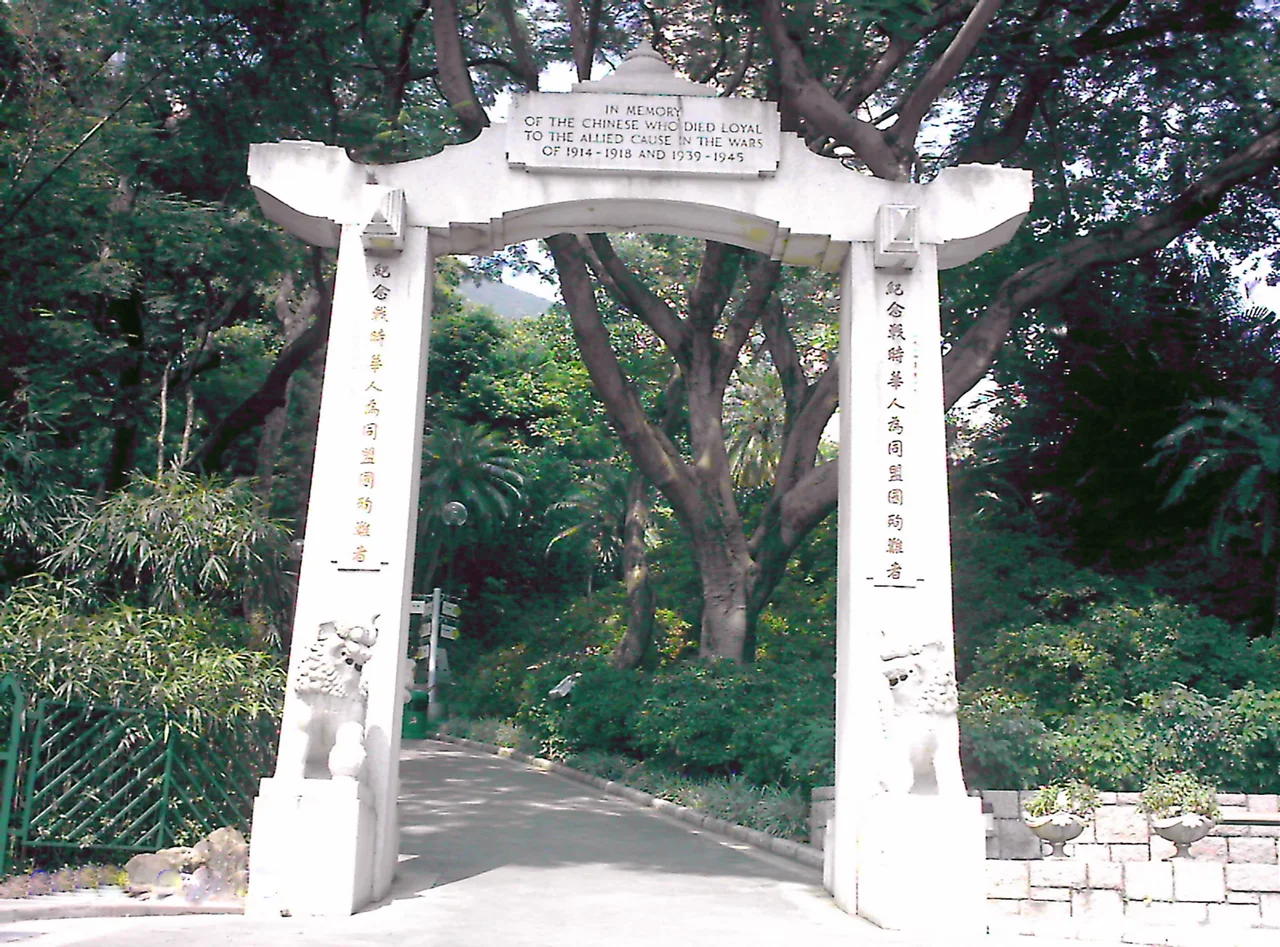
The southern entrance on Upper Albert Road frames two memorials that speak across different eras. A granite arch shaped like a traditional paifang gate, erected in 1928, carries an inscription dedicated to the Chinese who died assisting the Allies in the Wars of 1914–1918. The reference to the Second World War was added later, broadening its scope to honor those who died loyal to the Allied cause across both conflicts. Nearby stands a bronze statue of King George VI, installed to mark the 100th anniversary of British colonial rule over Hong Kong in 1941. These monuments were placed in a public garden, free to anyone who walked up Albert Road — not in a government building or a museum. The choice of setting says something about how the colonial administration understood commemoration: woven into daily life, available to everyone.
Gardens Within the Garden
The HKZBG divides its plant collection into themed enclosures, and the specificity of what grows in each reveals a serious botanical mission beneath the park's leisurely surface. The Camellia Garden holds more than 30 species, including three native to Hong Kong: Crapnell's camellia, Grantham's camellia, and Hong Kong camellia. The Bauhinia Garden grows eight species of bauhinia, anchored by the Hong Kong orchid tree — the flower on Hong Kong's flag. Five magnolia species populate another section: Chinese magnolia, Yulan, purple magnolia, saucer magnolia, and southern magnolia. The greenhouse shelters orchids, ferns, bromeliads, carnivorous plants, and vines. The Palm Garden runs to over 30 species across 22 genera. A bamboo section grows roughly ten times larger than any other plot. The Azalea Garden includes rare yellow azalea and Westland's rhododendron alongside four species native to Hong Kong. What sounds like a list is, in practice, a walk through the extraordinary plant diversity of tropical and subtropical Asia, compressed into a hillside in Central.
Primates, Pelicans, and a Jaguar
The gardens cannot keep giraffes — there is simply not enough space. What they can keep, and do, is a varied primate collection: yellow-cheeked gibbons, Bornean orangutans, ring-tailed lemurs, black-and-white ruffed lemurs, white-faced sakis, and cotton-top tamarins. In July 2011 the HKZBG recorded its first-ever successful breeding of Bornean orangutan twins. The bird collection is ambitious: over 100 avian species have reared young here, including red-crowned crane, peacock pheasant, and Bali mynah — all highly endangered in the wild. Large aviaries outside the greenhouse house wood ducks, flamingos, blue cranes, and scarlet ibis perched above a man-made waterfall. In the Education and Exhibition Centre, a taxidermy specimen of Siu Fa, a female jaguar who lived in Hong Kong for nearly 20 years, has been on display since 2009. The animals and the gardens share space not comfortably but earnestly, the institution doing what it can within its constraints. Jane Goodall, visiting in 2014, said the orangutans were "not in a good situation." The honest answer is that a 5.6-hectare hillside park in the middle of a dense city is doing something inherently difficult.
A Century and a Half of Continuity
The gardens marked their 150th anniversary in 2021, introducing a female Asian small-clawed otter and red-necked wallaby to mark the occasion. New bird-watching platforms were added; the avian population expanded with black-crowned cranes and great white pelicans. The celebration also came with difficult news: in 2024, twelve monkeys — including critically endangered cotton-top tamarins, white-faced sakis, and a De Brazza's monkey — died from melioidosis, a bacterial infection spread through contact with contaminated soil. No institution that keeps living animals escapes grief. What the HKZBG has maintained across 155 years is a commitment to free public access on a crowded island where open land is extraordinarily scarce. The pavilion at the center of the gardens was built in 1866 — older than almost every other structure visible from its benches — and it still stands.
From the Air
The Hong Kong Zoological and Botanical Gardens sit at approximately 22.278°N, 114.156°E, on the northern slope of Victoria Peak in the Central district of Hong Kong Island. Viewing altitude of 2,000–3,000 feet offers a clear sense of the park's position between the government buildings below and the green mass of the Peak above. The nearest major airport is Hong Kong International Airport (VHHH), located on Lantau Island roughly 34 km to the west-southwest. The former Kai Tak Airport site, visible as reclaimed land in Kowloon Bay, lies approximately 7 km to the northeast. In clear weather, the park's tree canopy is distinguishable against the dense urban fabric of Central, just south of Statue Square and the harbor.
Nearby Stories
- Lok Ma Chau Loop 2.3 km away
- Portas do Cerco 2.3 km away
- Kweilin Incident 17 km away
- Wanshan Archipelago Campaign 34 km away
- Nanxiong Formation 115 km away
- Battle of Nanpeng Island 148 km away
- Heyuan 169 km away
- Cape Maobitou 632 km away