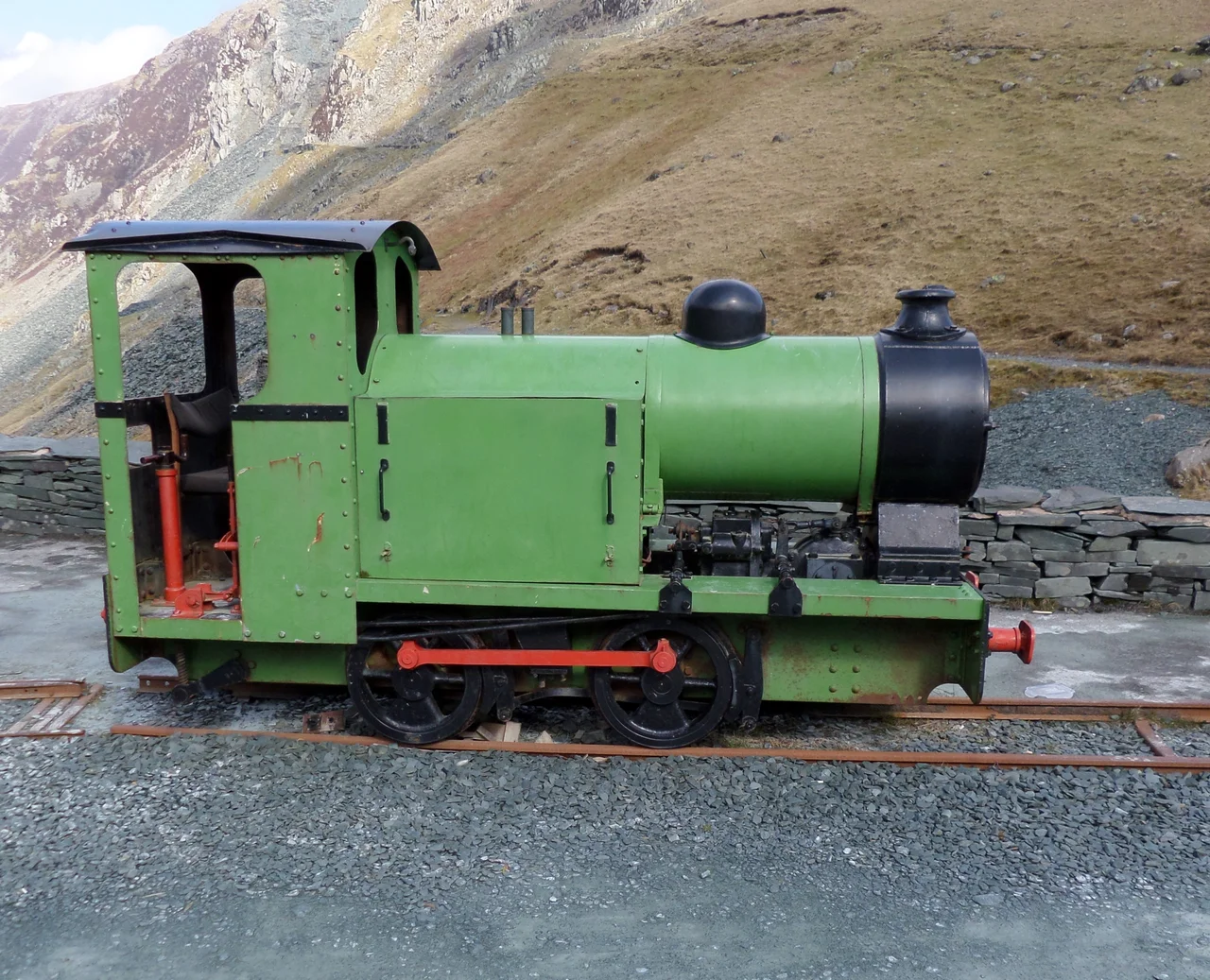

Honister Slate Mine
The slate at Honister is green, not the more familiar Welsh grey. It is called Westmorland green slate, and it has been cut from these crags above the head of Honister Pass since the late 17th century. Today it is the last working slate mine in England - one mine, one vein of stone, three and a half centuries of continuous production interrupted only by two world wars and a brief shutdown in the early 1990s. Honister has outlasted every other English slate operation, which is a quiet kind of survival. It has also outlasted a man who decided, against considerable odds, to reopen it.
Packhorse Trains and Self-Acting Inclines
By 1870, Honister's underground workings ran beneath Honister Crag, with intermediate operations across the valley at Yew Crags and smaller workings on Dubbs Moor. Packhorse teams pulled finished slate on sleds down steep paths to the top of Honister Pass - 'The Hause' - and from there into the valleys below. In 1879 the mine's new owners installed self-acting inclines: gravity-driven rail systems that let loaded slate descend while pulling empty wagons back up. The Dubbs Quarry incline raised slate from the workings, then sent it down into the valley. The capital outlay was substantial. The efficiency gain justified it. By 1888 annual production had reached 2,598 tons - a remarkable figure considering every ton had to come out by a system of hand-laid rails and inclined planes.
Two Wars and a Resurrection
Both world wars hit Honister hard. During the First, labour shortages forced the workings into care and maintenance. After 1918, production resumed, and by 1926 the mine had a new Resident Director, Robin Hoare, who electrified the works at the Hause with two Ruston four-cylinder diesel generators. A new Kimberley Mine opened from the Road End Level, served by a 600-foot powered incline. Plans drawn up in the 1890s to drive a level through to the Dubbs Quarries got 100 metres in before being shelved in favour of the more productive workings under Honister Crag. The Second World War shut the mine entirely from 1943 to 1945. Production continued through the 1950s and 1960s, though Yew Crag closed due to dangerous roof conditions. The slate kept coming.
Closure and a Man Who Would Not Accept It
In 1981 the Moore family bought the operation and invested heavily - rail-borne Rockershovels, battery locomotives, improved rolling stock. They sold to Alfred McAlpine in 1985. McAlpine ran the mine for four more years and then, in 1989, shut everything down. Care and maintenance only. For eight years Honister sat silent. In 1997 a local businessman named Mark Weir bought it and reopened it. He resumed small-scale slate production for roofing, and - crucially for the mine's survival - he turned the site into a tourist attraction. Underground tours showed visitors the workings. A visitor centre opened. In 2008 Honister installed England's first via ferrata, a fixed-cable cliff route using safety harnesses, and in 2011 it won Cumbria Tourism's award for best tourism experience in the Lake District. Weir had taken a closed mine and made it a working business again.
The Pilot Who Loved a Cliff
In March 2011, while filming a BBC documentary called Tales from the National Park, Mark Weir was killed in a helicopter crash. He had been trying to obtain planning permission for a proposed zip wire from the top of Fleetwith Pike down to the mine below - a project that had captured his imagination and the cameras' attention. At the time of his death he was also facing prosecution from Natural England over an unapproved extension to the via ferrata, which had damaged plants within the Honister Crag SSSI. The picture was complicated. Weir had pushed hard, sometimes past what regulators allowed, but he had pulled a derelict English industry back to life, and he had done it in a place most businesses would have written off. The 2012 zip wire application was refused. Permission was finally granted, six years later, in 2018. The mine continues to operate today - still producing Westmorland green slate, still running underground tours, still the last of its kind in England.
From the Air
Coordinates 54.5106 N, 3.19611 W. Honister Slate Mine sits at the south-east end of Honister Pass on the B5289, immediately below the dark scree face of Honister Crag. Identifiable from the air by spoil tips, the visitor complex at the head of the pass, and the cliff-side via ferrata route on Fleetwith Pike to the west. Recommended altitude 4,000-5,500 ft AGL. The site lies in the wettest catchment in the United Kingdom; orographic cloud forms rapidly on Honister Crag, Dale Head, and Fleetwith Pike. Nearest airports: Carlisle Lake District (EGNC) to the north-east, Blackpool (EGNH) to the south. Helicopter operations in the area should account for the 2011 fatal accident as a reminder of the demanding terrain.
Nearby Stories
- Lowther Castle 5.5 km away
- Black Combe 6.6 km away
- Levens Hall 6.8 km away
- Threave Castle 13 km away
- Ruthwell Cross 18 km away
- Raeberry Castle 24 km away
- RAF Spadeadam 24 km away
- Cashtal yn Ard 33 km away