
Honorary decrees for the Samians
Athens had just lost everything. In 405 BC the fleet that had ruled the Aegean was destroyed at Aegospotami, the city's empire collapsed, and its enemies tightened the siege that would end the long war. In that wreckage, one ally stayed loyal: the island of Samos. And so the Athenians did something that still survives in stone. On a tall slab of Pentelic marble, beneath a carved scene of two goddesses shaking hands, they inscribed a public decree granting the Samians citizenship. The marble is now in the Acropolis Museum, catalogued simply as 1333, but what it preserves is one of the oldest surviving documents of gratitude between two peoples.
Two Goddesses, One Handshake
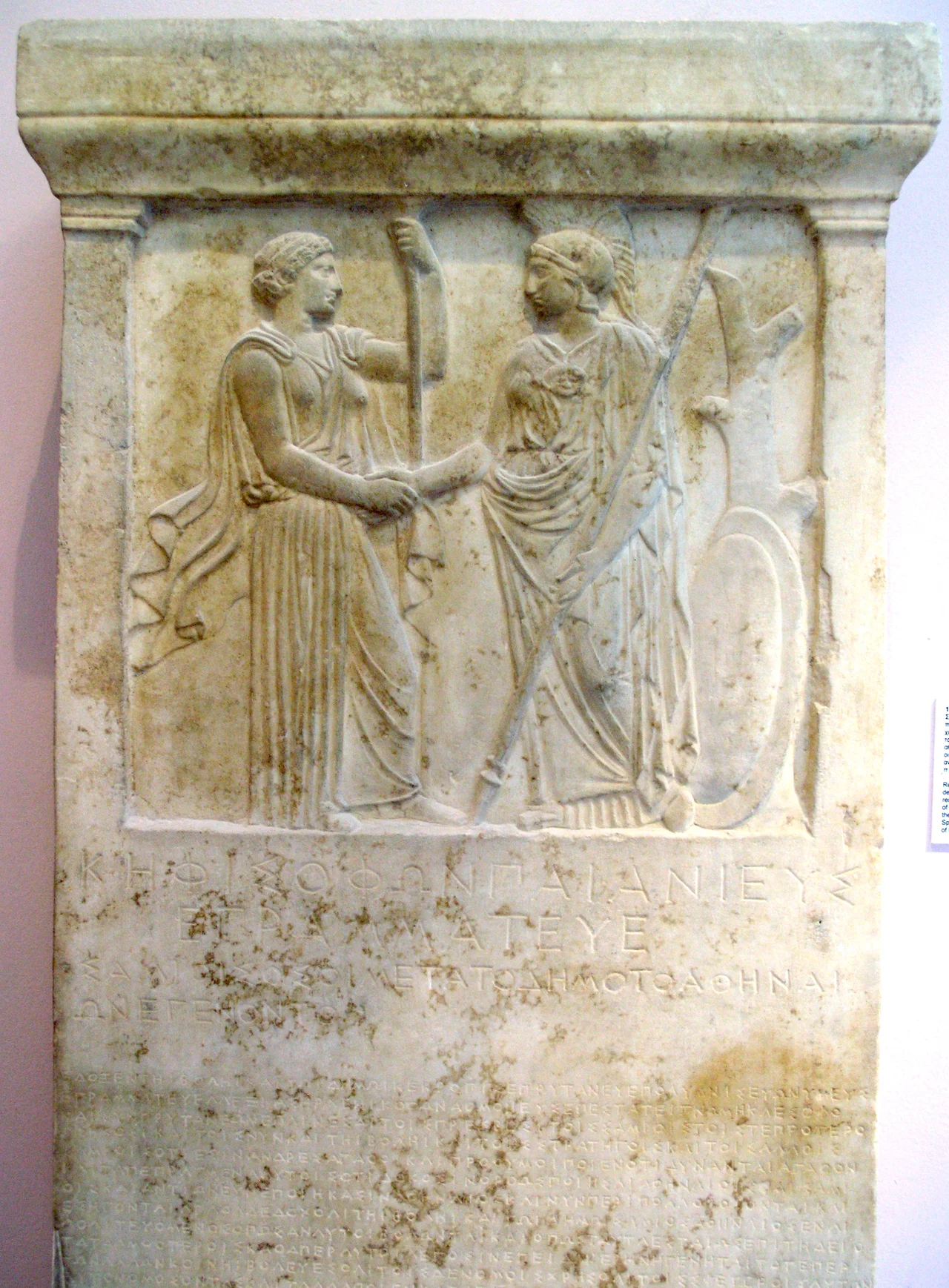
At the top of the stele, framed by slender pilasters and a horizontal cornice, stand two figures. On the right is Athena, helmeted patron of Athens. On the left is Hera, the great goddess of Samos, whose island temple was among the largest in the Greek world. Athena reaches out and clasps Hera's hand. The gesture is diplomacy made visible: not two cities signing a treaty, but their divine protectors joining hands as equals. The scholars Petersen and Collignon suggested the figure of Hera echoes a famous statue by the sculptor Alkamenes. Whatever its model, the handshake carries the whole meaning of the monument in a single image.
The Words Below
Beneath the relief, the marble carries three Athenian decrees passed by the Boule, the council, and the demos, the people. The carved Greek names a secretary, Kephisophon of Paiania, and addresses its honors plainly: "To the Samians who became allies of the Athenian People." The stele stands 1.65 meters tall and just over half a meter wide, quarried from the bluish marble of nearby Mount Pentelikon, the same stone that built the Parthenon. The three texts have been fully studied and translated, and they remain a vital source for understanding the chaotic final years of the Peloponnesian War, when alliances dissolved almost overnight.
Loyalty and Its Cost
The story behind the stone is harsh. After Aegospotami, the people of Samos drove out their own oligarchs and sent two envoys to Athens, offering to keep fighting at the side of a city that was clearly losing. Their reward came swiftly and cruelly: in 404 BC the Spartan commander Lysander besieged Samos, exiled its democrats, and installed an oligarchy in their place. The Samians who had risked everything for Athens lost their homes. It was only after democracy returned to Athens that the Athenians honored those exiles, carving into marble a debt they could no longer repay in any other way.
Reassembled Across Decades
The monument we see was pieced back together over many years. Two fragments turned up first, in 1876, among the ruins of the Theatre of Dionysus on the southern slope of the Acropolis. The largest and most important piece emerged in 1888, during the great excavations on the Acropolis itself. A fourth fragment was identified later and joined to the rest in 1903. The inscriptions confirm the timeline: the first decree dates to the archonship of Alexias in 405/4 BC, the last two to the archonship of Eucleides in 403/2 BC, the relief cut at the same time as those final texts. The carving froze a moment of gratitude that has now outlasted both cities' empires by twenty-four centuries.
From the Air
The Honorary Decrees for the Samians are displayed inside the Acropolis Museum at 37.9691 N, 23.7283 E, on the southern slope of the Acropolis in central Athens. From the air the museum is the large modern glass-and-concrete building just southeast of the Acropolis rock, with the Theatre of Dionysus, where two of the fragments were found, set into the slope immediately above it. Nearest airport is Athens International (LGAV), about 33 km to the east. The Acropolis and its surrounding archaeological park are the dominant landmark of the district and visible from a wide arc on clear days, which are common over Athens in summer.
Nearby Stories
- Great Sand Beach 5 km away
- Battle of Delium 7.7 km away
- Tower of Aliartos 9 km away
- HMHS Britannic 10 km away
- Saronic Gulf 15 km away
- Sousaki Volcano 17 km away
- Sanctuary of Apollo Maleatas 24 km away
- Skyros 66 km away