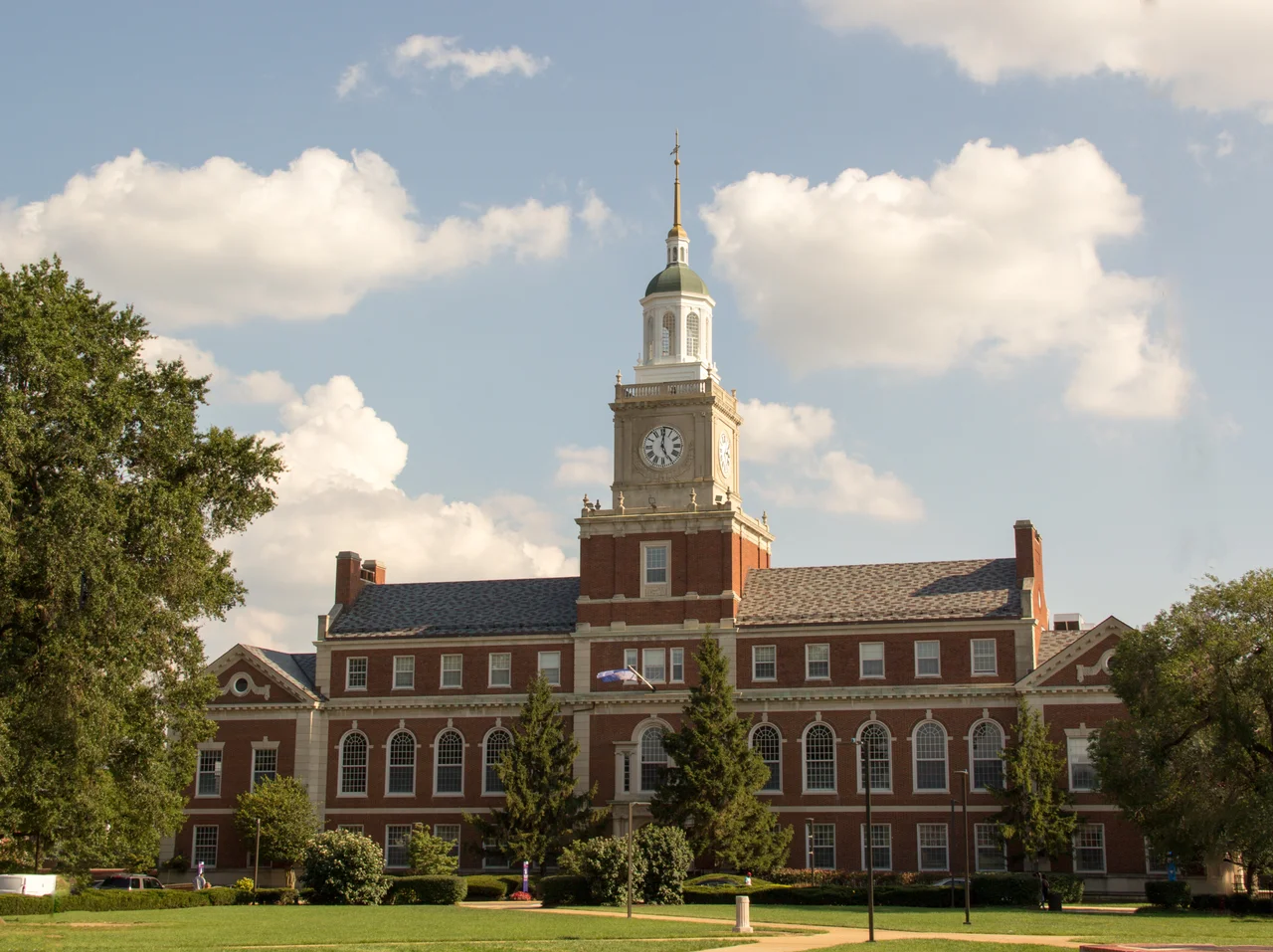

Howard University School of Law
Charles Hamilton Houston was thirty-five years old when he became dean of the Howard University School of Law in 1929. He had Harvard Law degrees, a stint editing the Harvard Law Review, and a private practice in Washington. He took the deanship at Howard because he believed that the strategy to dismantle American segregation would have to be designed by lawyers who themselves were Black. He spent the next six years transforming Howard Law from a part-time night school into a full-time accredited institution. He trained a generation of Black lawyers including Thurgood Marshall, Oliver Hill, Spottswood Robinson III, and James Nabrit Jr. The legal cases that ended segregated public education in the United States were drafted by Houston and his students. They worked out of an unremarkable brick building on the Howard University campus in northwest Washington.
Founding and Early Years
Howard University itself was chartered by Congress in 1867, two years after the end of the Civil War, as part of Reconstruction's effort to expand educational opportunity for newly emancipated Black Americans. The School of Law was established the following year, in 1868, originally as a night program meeting in rented rooms downtown. It was the first historically Black law school in the United States and one of the very few American law schools of any kind that admitted women from its founding. Charlotte E. Ray, who graduated from Howard Law in 1872, became the first Black woman admitted to the bar in the United States. She had applied to the school under the initials C. E. Ray to obscure her gender, an admission that even Howard's commitment to coeducation had its limits. She was admitted, and graduated, and was admitted to the D.C. bar. Mary Ann Shadd Cary, the abolitionist and journalist, started at Howard in 1869 but was barred from graduating on time because of her gender. She finally received her degree in 1883.
Houston's Reforms
Houston had a simple thesis: a lawyer was either a social engineer or a parasite on society. He came to Howard from a position as Justice Department special counsel and Howard part-time faculty. He demanded that Howard Law transform itself if it was going to produce the social engineers the country needed. The school became full-time. The curriculum became demanding. The faculty was reorganized. Houston himself taught constitutional law and litigation strategy. He cultivated relationships with the NAACP. He told his students that they would be expected to do for free what white lawyers got paid handsomely to do, because the cause demanded it. He pulled the school's accreditation back together in 1931. By the late 1930s Howard Law was producing graduates who could compete with any law school in the country. Houston resigned the deanship in 1935 to take a full-time position with the NAACP, where he served as the first special counsel and began the long campaign that culminated in Brown v. Board of Education almost twenty years later.
Marshall, Robinson, Hill, and Nabrit
Thurgood Marshall arrived at Howard Law in 1930 after the University of Maryland's law school refused his application on racial grounds. He graduated first in his class in 1933 and joined the NAACP shortly after. The litigation strategy he eventually executed was the strategy Houston had designed and taught at Howard. Marshall would argue Brown v. Board of Education before the Supreme Court in 1952 and 1953, and Bolling v. Sharpe (the companion case applying the same principle to D.C. schools) at the same time. James Nabrit Jr., a Howard Law faculty member, and George E. C. Hayes, another Howard alumnus, argued Bolling itself. The team prevailed. Marshall later became the first Black American Supreme Court justice in 1967. Spottswood Robinson III argued companion cases in the Brown package. Oliver Hill litigated the Virginia case. The civil rights revolution in American constitutional law was largely the product of one law school's faculty and students.
Pauli Murray's Bible
Pauli Murray graduated first in her class from Howard Law in 1944. She was the only woman in her graduating class. She had been rejected by Harvard Law on the explicit grounds of her sex. In 1950, while at the University of California at Berkeley working on a graduate law degree, she published States' Laws on Race and Color, a 746-page volume cataloguing every state segregation law in the country. Thurgood Marshall called it the bible of the civil rights movement. Marshall's NAACP team used it as a reference throughout the Brown litigation. Murray was a lawyer, an Episcopal priest (one of the first women ordained in that church), a poet, and a major figure in the emerging women's movement of the 1960s and 1970s, who along with Ruth Bader Ginsburg drafted the legal theory that would eventually make sex discrimination constitutionally suspect under the Fourteenth Amendment. She died in 1985. The Episcopal Church declared her a saint in 2012.
Today
Howard Law operates today from the same northwest Washington campus, though the law school occupies its own buildings on Van Ness Street NW rather than the main university grounds. It confers about 185 J.D. and LL.M. degrees a year to students from the United States, the Caribbean, Africa, Asia, and South America. The alumni include not only Marshall and Murray but L. Douglas Wilder (the first elected Black governor of any state), Andrew Young, Patricia Roberts Harris, and dozens of federal and state judges. Vice President Kamala Harris attended Howard University as an undergraduate (A.B. 1986) but earned her J.D. from UC Hastings College of the Law in 1989. Houston's portrait hangs in the moot court room. The school still teaches the courses he taught. The graduates still try to be the social engineers Houston demanded. The cases they take on still try to push American law toward what the Reconstruction Amendments promised but never quite delivered.
From the Air
Howard University School of Law is at 38.9477 degrees north, 77.0681 degrees west, on Van Ness Street NW in upper northwest Washington. Best viewed at 1,500 to 2,500 feet AGL with Rock Creek Park immediately east. Reagan National (KDCA) is six nautical miles south. The site lies inside the Washington Class B veil and just outside the P-56 prohibited area; overflight requires ATC coordination.
Nearby Stories
- Gunston Hall 1.1 km away
- 2023 Baltimore Shooting 4.9 km away
- Battle of Middleburg 6.6 km away
- Crownsville Hospital Center 10 km away
- Battle of Loudoun Heights 13 km away
- First Battle of Rappahannock Station 20 km away
- Howard County, Maryland 21 km away
- Harriet Tubman Underground Railroad 50 km away