
Hoxne Hoard
Eric Lawes was not looking for treasure. He was looking for a hammer that a friend had lost in a field in the Suffolk village of Hoxne. Lawes had a metal detector and thought he might find it quickly. What he found instead, in November 1992, was the Hoxne Hoard — the largest hoard of late Roman gold and silver ever discovered in Britain: 14,865 coins and almost 200 items of gold and silver tableware and jewelry, buried in a wooden box that had long since rotted into the earth. The hammer was also found, eventually. It is now in the British Museum alongside everything else.
What Was in the Ground
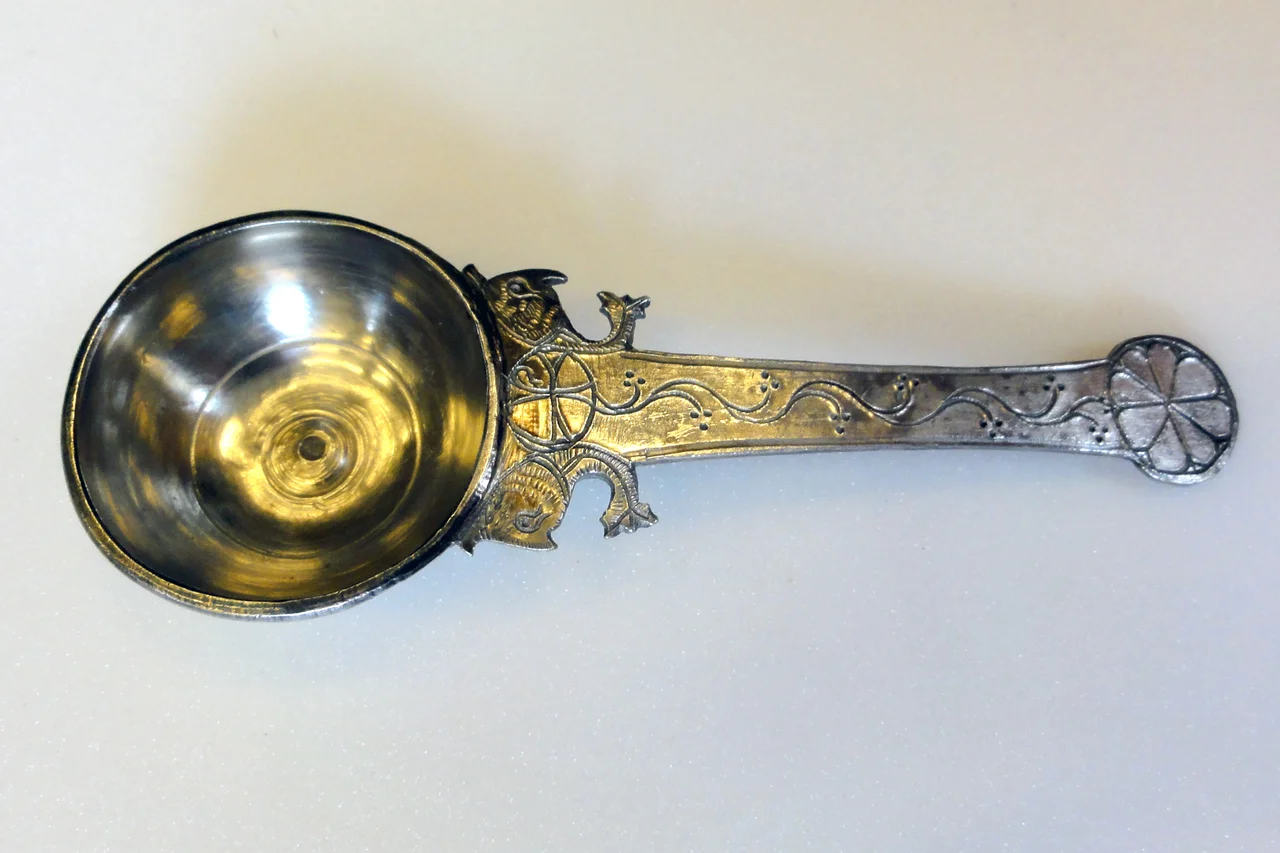
The Hoxne Hoard contains gold and silver objects of extraordinary quality from the late Roman period, buried sometime after 407 AD — the year the last Roman troops withdrew from Britain under the usurper Constantine III. Among the most celebrated objects is a gold body chain, over a meter long, worn across the shoulders and chest. There are silver spoons inscribed with personal names, including one marked 'Faustinus' — a name so common in Roman society that it cannot reliably identify the owner. There are silver pepper pots, one in the form of an empress, another in the shape of a hound chasing a hare. There are bracelets, necklaces, and hundreds of gold and silver coins from multiple emperors. An inscription on one object reads, in Latin: 'Use this in good health, lady Juliana, for many happy years.' The owner never returned for it.
The Setting: Hoxne and its Long History
Hoxne is a village in Suffolk with a layered past. Its name appears in medieval records as the site of Haegelisdun, where King Edmund of East Anglia was said to have been killed by Viking forces in 869 — a tradition associated with a great oak tree that stood in the village until it fell of its own weight in September 1848. A nearby Roman settlement at Scole, approximately 3.2 kilometers northwest, sat at the intersection of two Roman roads, one of which linked Colchester to London. That road — Pye Road, now the A140 — ran through territory that was genuinely prosperous in the late Roman period. The field where Lawes found the hoard showed evidence of Bronze Age clearance and subsequent agricultural use across millennia. Who buried the hoard, and why they never returned, is unknown. The most plausible explanation is that the upheaval of 407 AD — or the years of instability that followed — made retrieval impossible.
A Discovery That Changed the Law
The way the hoard was found and reported became as significant as the hoard itself. Eric Lawes behaved with unusual care: he stopped digging when he realized the scale of what he had uncovered, notified archaeologists, and allowed a professional excavation to recover the remaining objects properly. The Suffolk County Council archaeological team excavated the site in 1994, recovering additional items and contextual information that would otherwise have been lost. The British Museum purchased the hoard — at a cost that required contributions from the National Heritage Memorial Fund, the Art Fund, and the J. Paul Getty Trust, because the museum's own purchase fund was insufficient. The hoard's discovery contributed directly to the reform of English treasure law: the old system of common law for treasure trove, ill-suited to the era of metal detectors, was replaced by the Treasure Act 1996, which introduced a statutory framework with incentives for finders to report discoveries and protections for archaeological context.
How It Is Remembered
Items from the Hoxne Hoard went on display at the British Museum in September 1993, almost immediately after the treasure arrived. Much of the collection was exhibited at Ipswich Museum in 1994 and 1995. From 1997, the most important pieces went on permanent display in the Roman Britain gallery — Room 49 — alongside the roughly contemporary Thetford Hoard. The hoard was ranked third among British archaeological finds in a 2003 BBC Television documentary surveying Britain's top ten treasures. The 'Empress' pepper pot — a hollow gold figure of a seated woman with a hole in her head for dispensing pepper — was selected as item 40 in the 2010 BBC Radio 4 series A History of the World in 100 Objects. The pepper pot now stands in a gallery in London, a small gold woman about the length of a thumb, waiting in warmth for a Roman dinner that was never served.
From the Air
Located at 52.34°N, 1.19°E near the village of Hoxne in north Suffolk, approximately 22 miles north of Ipswich and 18 miles southwest of Norwich. The hoard's findspot is in an agricultural field east of the village. Norwich Airport (EGSH) is the nearest commercial airport, approximately 18 miles to the north-northeast. The village sits in gently rolling farmland in the Waveney valley. The Roman road known as Pye Road (now the A140) passes approximately 3 miles to the northwest.
Nearby Stories
- RAF Hethel 4.1 km away
- West Stow Anglo-Saxon Village 4.9 km away
- Castle Hedingham 8.1 km away
- Shotley Gate 8.5 km away
- RAF Marham 14 km away
- Four Days' Battle 52 km away
- Southern Bight 79 km away
- SS Elbe 113 km away