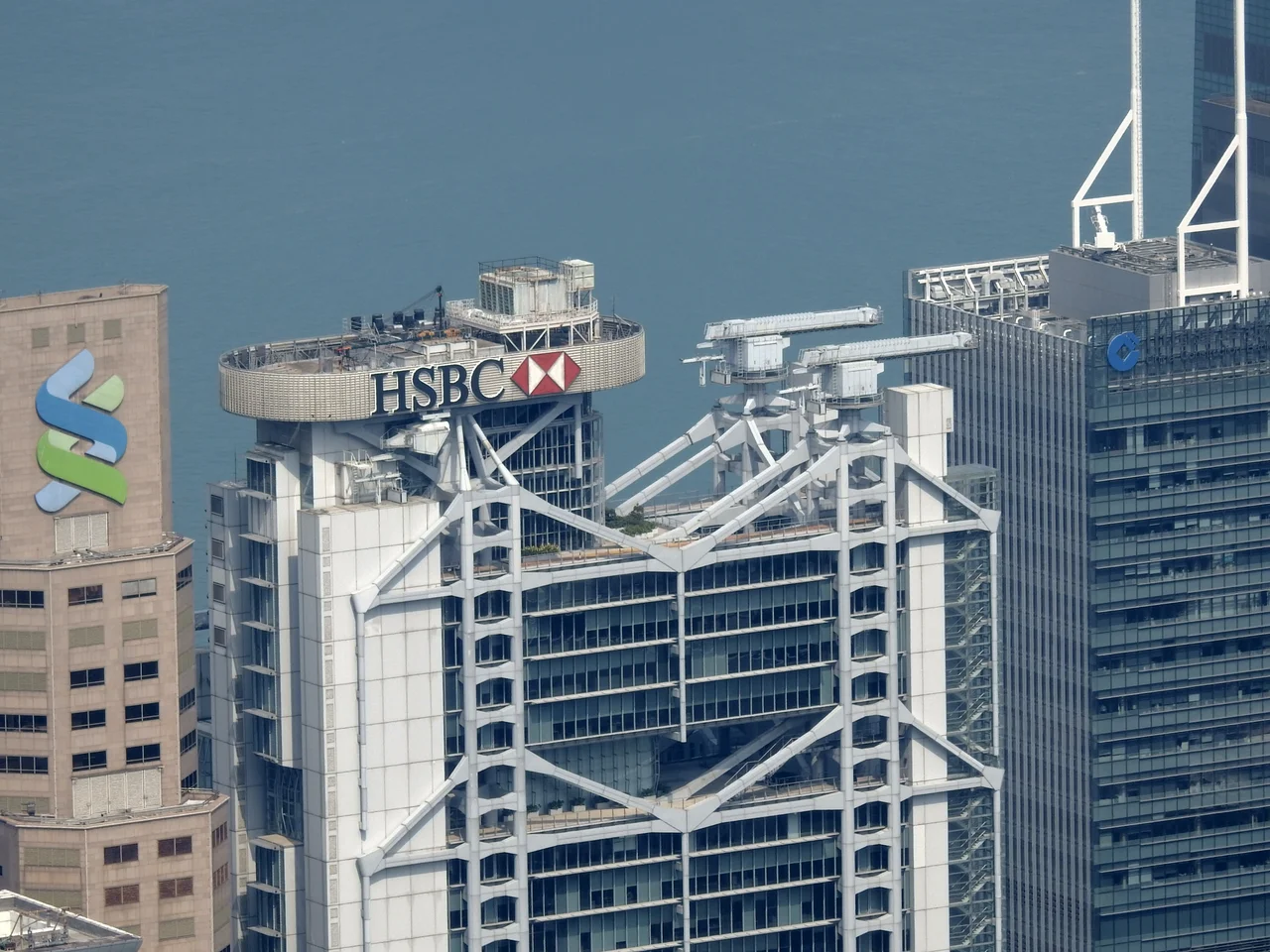

HSBC Building, Hong Kong
The steel modules were fabricated near Glasgow and shipped to Hong Kong. That detail — Scottish shipbuilders prefabricating the bones of a Hong Kong bank — captures something essential about Norman Foster's design for the HSBC headquarters. Completed on 18 November 1985 and officially opened on 7 April 1986, the building cost approximately HK$5.2 billion, equivalent to roughly US$668 million at the time, making it the most expensive building in the world when it was completed. The concept took seven years to move from drawing board to ribbon-cutting. About 30,000 tons of steel and 4,500 tons of aluminium went into the structure. The result stands 180 metres tall with 47 storeys and four basement levels at 1 Queen's Road Central — a building that has no internal supporting columns.
Four Buildings Before This One
The current HSBC building is the fourth structure to occupy this site. The first was Wardley House, leased for HKD 500 a month in 1864 and used as an HSBC office between 1865 and 1882. After raising a capital of HKD 5 million, the bank had opened its doors in 1865. Wardley House was demolished and replaced by a second building completed in 1886, notable for its division into two near-separate structures: one in Victorian style with colonnades and an octagonal dome facing Queen's Road, and an arcade on Des Voeux Road. That was demolished in 1934. The third building, opened in October 1935, was built in a mixed Art Deco and Stripped Classical style on land that had once belonged to the old City Hall. Upon completion it was the tallest building in Hong Kong and, the bank claimed, the largest building in the Far East and the tallest structure in Southeast Asia. It was also the first building in Asia to be fully air-conditioned. During the Japanese occupation from 1941 to 1945, it served as the government headquarters. The bank demolished it in 1984 to build what stands today.
A Structure With Nothing Inside
The defining characteristic of Foster's design is its absence of internal supporting structure. The building hangs from eight steel masts arranged in groups of four. From those masts, horizontal trusses suspend the floors — the loads travel outward to the perimeter rather than down through a central core. This approach opened the building's interior to dramatic unobstructed space and allowed the glass-floored atrium to flood with natural light from a giant mirror system that redirects sunlight from the south facade down into the heart of the building. The design was heavily inspired by the Douglas Gilling-designed Qantas International Centre in Sydney, now known as Suncorp Place. Civil and structural engineering was handled by Ove Arup and Partners; service design by J. Roger Preston and Partners. The John Lok / Wimpey Joint Venture handled construction. The visible expression of structure that Foster chose — all those masts and cross-braces on the exterior — became one of the defining images of high-tech architecture worldwide.
Feng Shui Wars and Rooftop Cranes
The HSBC building faces the open expanse of Statue Square, with no obstruction between it and Victoria Harbour. In feng shui, a direct view of water is associated with wealth and prosperity; the building is widely considered to have exceptionally good feng shui as a result. The Bank of China Tower, completed in 1989 across the square, generated controversy from the moment its design was revealed. Its angular geometry, critics argued, projected sharp edges like knife blades — one pointing toward the Government House, another toward the HSBC building. A series of misfortunes followed the Bank of China Tower's opening: the death of a Governor, economic turbulence. It is said that HSBC responded by installing two maintenance cranes on the roof, angled to point directly at the Bank of China Tower. Whether any of this affected the buildings' fortunes is unanswerable. That two of the world's major financial institutions were paying attention to the energetic relationships between their buildings speaks to how seriously these ideas are taken in Hong Kong.
Stephen and Stitt
Two bronze lions guard the entrance to the HSBC building, and they have names: Stephen and Stitt. Stephen is depicted roaring; Stitt is at rest. Both were commissioned for the third building, opened in 1935, and were modeled on lions originally cast for the HSBC Shanghai office in 1923. That earlier pair — sculpted by Henry Poole RA and cast by J W Singer and Sons in the English town of Frome — had become objects of veneration in Shanghai, with passersby stroking them for luck. The tradition transferred to Hong Kong. During World War II, the Japanese occupiers confiscated the lions and sent them to Japan to be melted down for the war effort. The war ended before this happened. An American sailor recognized the lions in a dockyard in Osaka in 1945. They were returned to Hong Kong and restored to their positions in October 1946. People still bring their children to touch the lions' paws and noses, hoping that good fortune might transfer. Copies of the Hong Kong lions now stand in London, Birmingham, and Shanghai. The originals have survived a world war and a transactional city's continuous reconstruction.
From the Air
The HSBC Main Building is located at approximately 22.280°N, 114.160°E on the south side of Statue Square in the Central district of Hong Kong Island. From the air at 2,000–3,500 feet, the building is recognizable by its exposed steel mast structure and the open plaza of Statue Square in front of it, with Victoria Harbour immediately to the north. The nearest major airport is Hong Kong International Airport (VHHH) on Lantau Island, approximately 34 km to the west. The Bank of China Tower, identifiable by its angular facets, stands immediately adjacent to the east. On clear days, both towers are visible from the Kowloon side of the harbor.
Nearby Stories
- Lok Ma Chau Loop 2.3 km away
- Portas do Cerco 2.3 km away
- Kweilin Incident 17 km away
- Wanshan Archipelago Campaign 34 km away
- Nanxiong Formation 115 km away
- Battle of Nanpeng Island 148 km away
- Heyuan 169 km away
- Cape Maobitou 632 km away