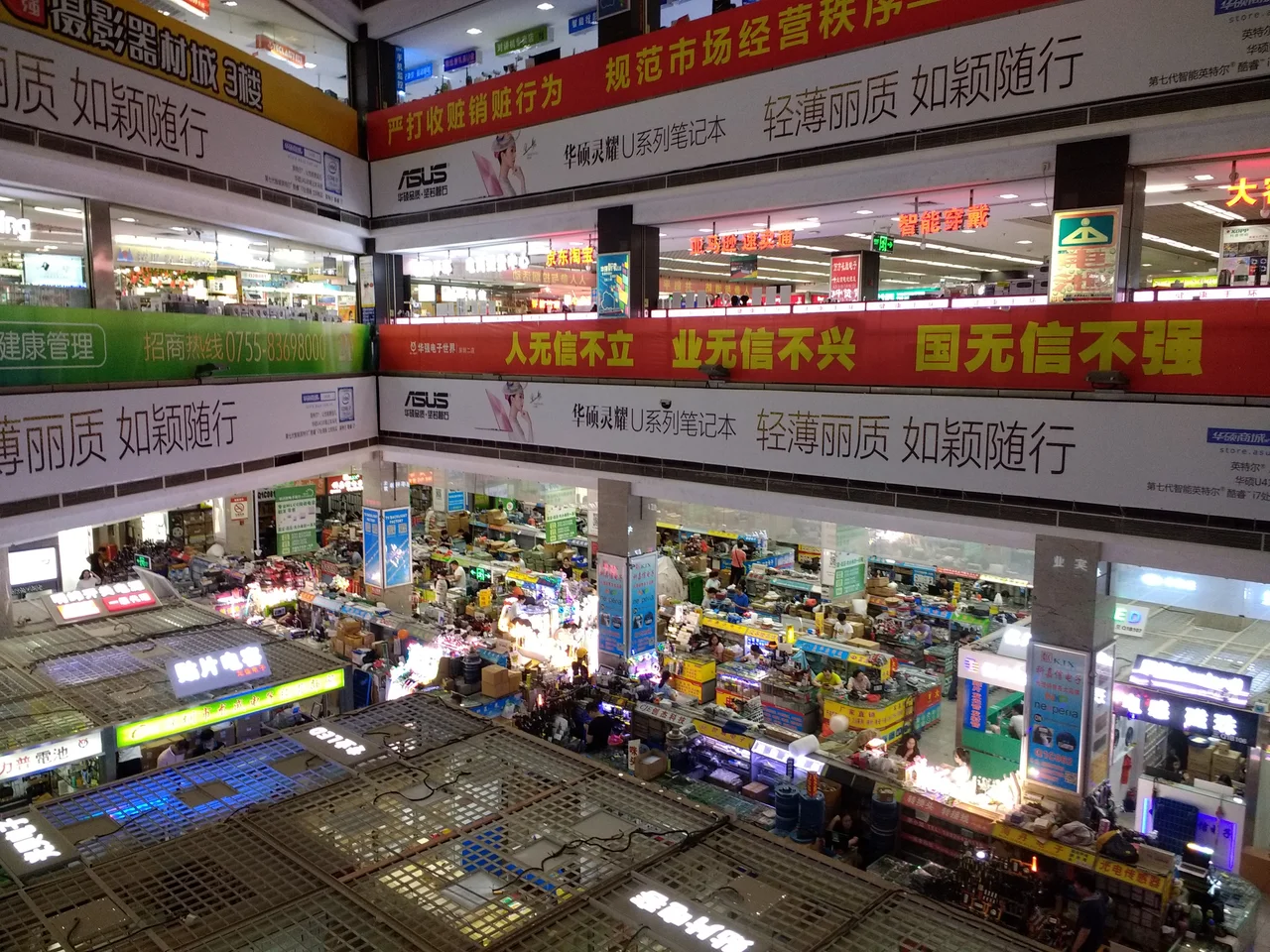

Huaqiangbei
Somewhere in Huaqiangbei there is a stall selling the exact component you need, and someone who knows where it is. That is the essential promise of this subdistrict in Shenzhen's Futian area: a density of electronic supply so complete that engineers from startups in Berlin, hardware hackers from New York, and procurement managers from Seoul all eventually make the pilgrimage. In 2020 alone, roughly 38,000 businesses operated within its boundaries. The district runs barely a kilometer north from Shennan Road to the Pavilion Hotel, but that single kilometer may contain more transistors per square meter than any other place on earth.
How Shenzhen Made Huaqiangbei
Huaqiangbei did not arrive fully formed. It grew alongside Shenzhen itself, the fishing village-turned-metropolis that China designated its first Special Economic Zone in 1980. As electronics manufacturing concentrated in the Pearl River Delta through the 1980s and 1990s, secondary markets for components, peripherals, and finished goods clustered here, in Futian District, where the geography of supply chains became geography in the literal sense: stall next to stall, floor above floor, building beside building, all of it organized around Huaqiang Road, the district's central pedestrian spine. The street-level energy is particular — not the gleaming calm of a consumer electronics store, but the focused, purposeful bustle of people who are here to find something specific, buy it in quantity, and leave.
The Malls Within the District
Huaqiangbei is not a single market but a constellation of them. Multiple large buildings — electronics malls, in the distinctive Chinese format of hundreds of individual vendor stalls leased within a single structure — line the main arteries and side streets. SEG Plaza anchors the southern end near Huaqiang Road Station; the interiors are dense with LED lighting and the particular smell of new plastic and solder. Vendors specialize — one floor for phone accessories, another for components, another for completed assemblies — and the cumulative effect is of a physical search engine for hardware. Cross streets Zhenzhong Road, Zhenhua Road, and Zhenxing Road feed into the main spine, and Huafa Road runs parallel to the east. Three Shenzhen Metro stations serve the district, with Huaqiang North and Huaxin stations connected by an underground passage.
Silicon Valley of Hardware
The nicknames that Huaqiangbei and Shenzhen have accumulated — China's Silicon Valley, the Silicon Valley of Hardware — reflect something real about how the place functions. Silicon Valley's original insight was geographic concentration: put engineers, capital, and fabrication close together and you accelerate everything. Huaqiangbei applies a related logic to physical manufacturing. Prototyping that would take weeks elsewhere can happen in days here, because the supply chain is not distributed across continents but compressed into a few square blocks. Entrepreneurs who arrived with a schematic and a budget could leave with a working prototype. The district's reputation among hardware developers is a function of that compression — the fact that iteration is cheap when you can walk to your component supplier.
A Market in Motion
Huaqiangbei does not stand still. The district that made its name on electronics components has been evolving with the broader consumer economy. A Reuters report from 2020 noted that cosmetics and beauty products were finding space in buildings that had once been exclusively electronics-focused — a sign of how retail gravity works when you have density and foot traffic and a metro system that deposits shoppers in three different entry points. The tree-lined streets with their wide footpaths still carry the character of a specialized district, and the electronics trade remains central, but Huaqiangbei's story is also one of a market continuously recalibrating to meet what buyers actually want. In that sense, it is very much a Shenzhen story: never quite finished, never quite the same as it was last year.
From the Air
Huaqiangbei lies at approximately 22.546°N, 114.087°E in Shenzhen's Futian District, near the geographic center of the city. From the air at 3,000–5,000 feet, the district appears as a dense commercial grid distinguishable by the large-footprint mall buildings clustered along the north-south axis of Huaqiang Road. The SEG Plaza tower is a useful visual reference at the southern anchor of the district. Shenzhen Bay (Deep Bay) is visible to the southwest, with Hong Kong's New Territories beyond it. The nearest airport is ZGSZ (Shenzhen Bao'an International), approximately 30 kilometers to the northwest along the Guangshen Expressway corridor. VHHH (Hong Kong International) lies roughly 40 kilometers to the southwest.
Nearby Stories
- Hong Kong Disneyland 4.1 km away
- Mount Guanyin (Dongguan) 7 km away
- 2024 Lixinsha Bridge Collapse 7.4 km away
- Portas do Cerco 12 km away
- Lotus Hill 15 km away
- Nanxiong Formation 78 km away
- Heyuan 130 km away
- Checheng Fu'an Temple 629 km away