.JPG)
Hull and East Riding Museum
Around 2000 BC, somewhere on the muddy north bank of the Humber, a Bronze Age boatbuilder selected the right oak planks and began stitching them together with yew withies. The boat that resulted, and the two others built like it nearby, are the oldest known sewn-plank boats in Europe. They lay buried in estuary mud for nearly four millennia, until river works in 1937 began turning them up. Part of one of those Ferriby Boats now sits in the Hull and East Riding Museum on High Street, alongside a 2,300-year-old log boat carved from a single oak, the best collection of late Roman mosaics in Britain, and a life-sized woolly mammoth that greets every visitor at the door.
A Corn Exchange Turned Museum
Number 36 High Street was originally a Georgian customs house, sized for the modest trade that came through Hull before the Industrial Revolution. By the mid-1850s the city had outgrown it, and civic leaders commissioned the architects Bellamy and Hardy to design a replacement: a grand Italianate corn exchange in pale ashlar stone, completed in 1856. For two decades it bustled with grain merchants until the Great Depression of British Agriculture in the late nineteenth century gutted the trade. The building fell silent, then was reopened in 1925 as the Museum of Commerce and Industry. German bombs damaged it in 1941 but spared its bones. It reopened in 1957 as the Archaeology and Transport Museum, took its present name in 1989, and was reconfigured between 1998 and 2003 as the centrepiece of Hull's Museums Quarter.
Mammoth at the Door
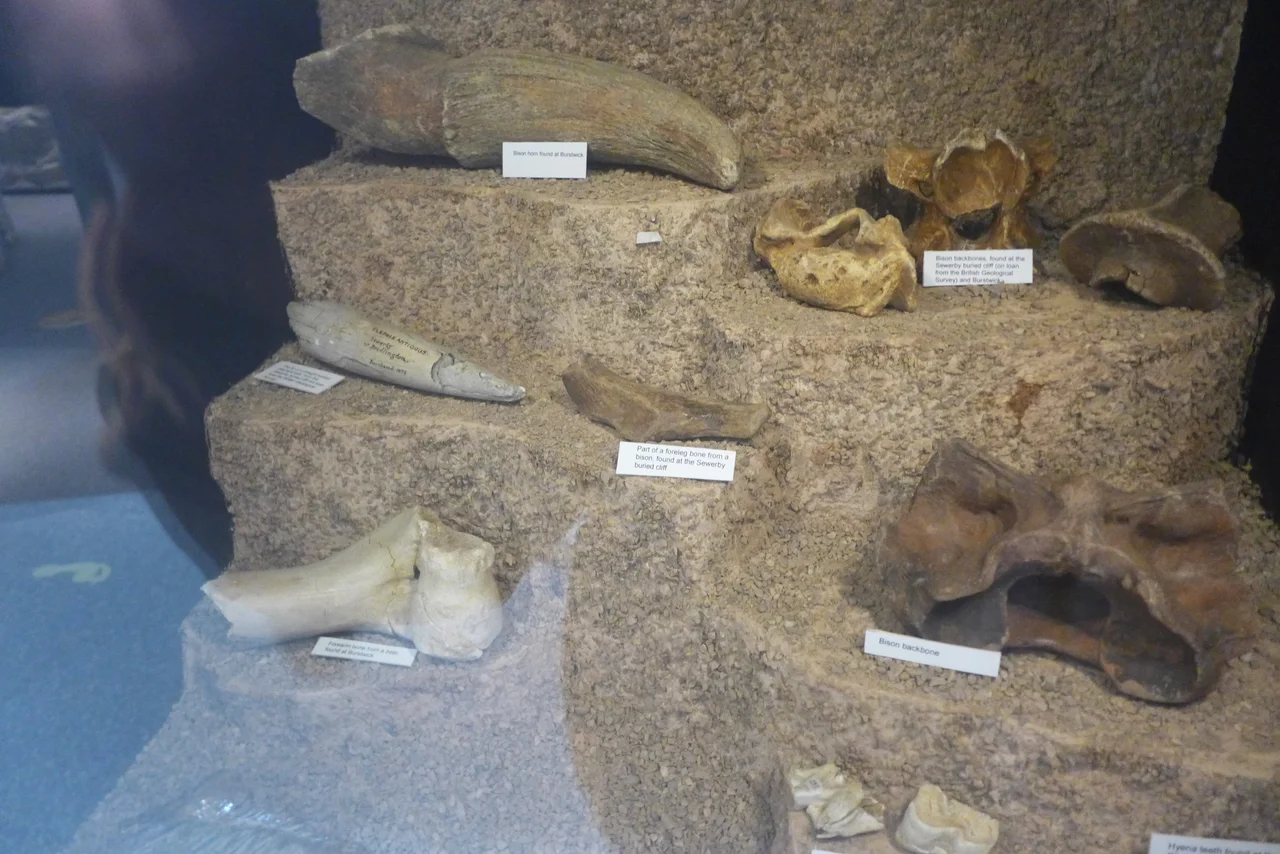
Visitors walking into the Fossils and Early Animals gallery encounter a full-size woolly mammoth model, surrounded by the actual remains of other Ice Age fauna recovered from the chalk and clay of East Yorkshire. Fossils sit out where children can touch them. Next door, the Prehistoric Man gallery presents a tableau of a Stone Age gatherer with explanations of early human diet and technology. Many of the stone tools, Bronze Age pottery, and wooden carvings on display were collected by John Robert Mortimer, the Yorkshire farmer who became one of Victorian Britain's most prolific amateur archaeologists, excavating barrows on the Wolds between the 1860s and his death in 1911. His collection forms the backbone of what the East Riding knows about its prehistoric inhabitants.
The Boat Lab
Two galleries deeper, the Boat Lab holds the Hasholme Logboat, 12.78 metres long and 1.4 metres wide, carved from a single oak tree around 300 BC. It is one of the largest Iron Age log boats ever found in Britain, recovered in 1984 from a field at Hasholme near the Humber. Next to it sits a section of one of the three Bronze Age Ferriby Boats, dated to roughly 2000 BC and built from oak planks sewn together with yew withies. They are the oldest known plank-built boats found anywhere in Europe outside Egypt. The Celtic Worlds gallery elsewhere reconstructs substantial parts of an Iron Age village, putting the boats in the context of the people who built them: farmers and fishers working a wetland landscape long before Hull was a city or even a name.
Roman Mosaics
The Roman gallery holds what the museum's curators believe, and most scholars agree, is the finest collection of late Roman mosaic floors on display anywhere in Britain. They came from villas at Rudston, Brantingham, and Harpham in the East Riding, and from Horkstow in north Lincolnshire just across the Humber. The Rudston Venus mosaic shows the goddess standing in a roundel, surrounded by panels of beasts: a leopard, a tigress, a bull. Roman provincial craftsmen working in the fourth century AD produced these floors for wealthy farmers and landowners in what was then a quiet corner of the empire. A reconstruction of part of Petuaria, the Roman settlement at modern Brough, gives a sense of how those landowners lived. Upstairs, the displays carry the story forward through the Saxons, the Vikings, and medieval Hull, finishing at the English Civil War.
From the Air
Located at 53.74 degrees N, 0.33 degrees W on High Street in the Old Town of Kingston upon Hull, part of the Museums Quarter alongside the Streetlife Museum and Wilberforce House. The Italianate stone building is in central Hull near the River Hull. Nearest airports: Humberside (EGNJ) about 9 nautical miles south, Leeds Bradford (EGNM) about 50 nautical miles west. The Humber Estuary lies a few hundred metres south of the museum. Best viewed at low altitude when approaching the city from over the Humber, with the cluster of historic Old Town buildings visible against the modern docks.
Nearby Stories
- Skipsea Castle 3.9 km away
- 2025 North Sea Ship Collision 4.8 km away
- Gainsborough, Lincolnshire 6.1 km away
- SM UC-47 9.7 km away
- Howden 12 km away
- Battle of Stamford Bridge 14 km away
- Battle of Winceby 28 km away
- HMS Cobra 50 km away