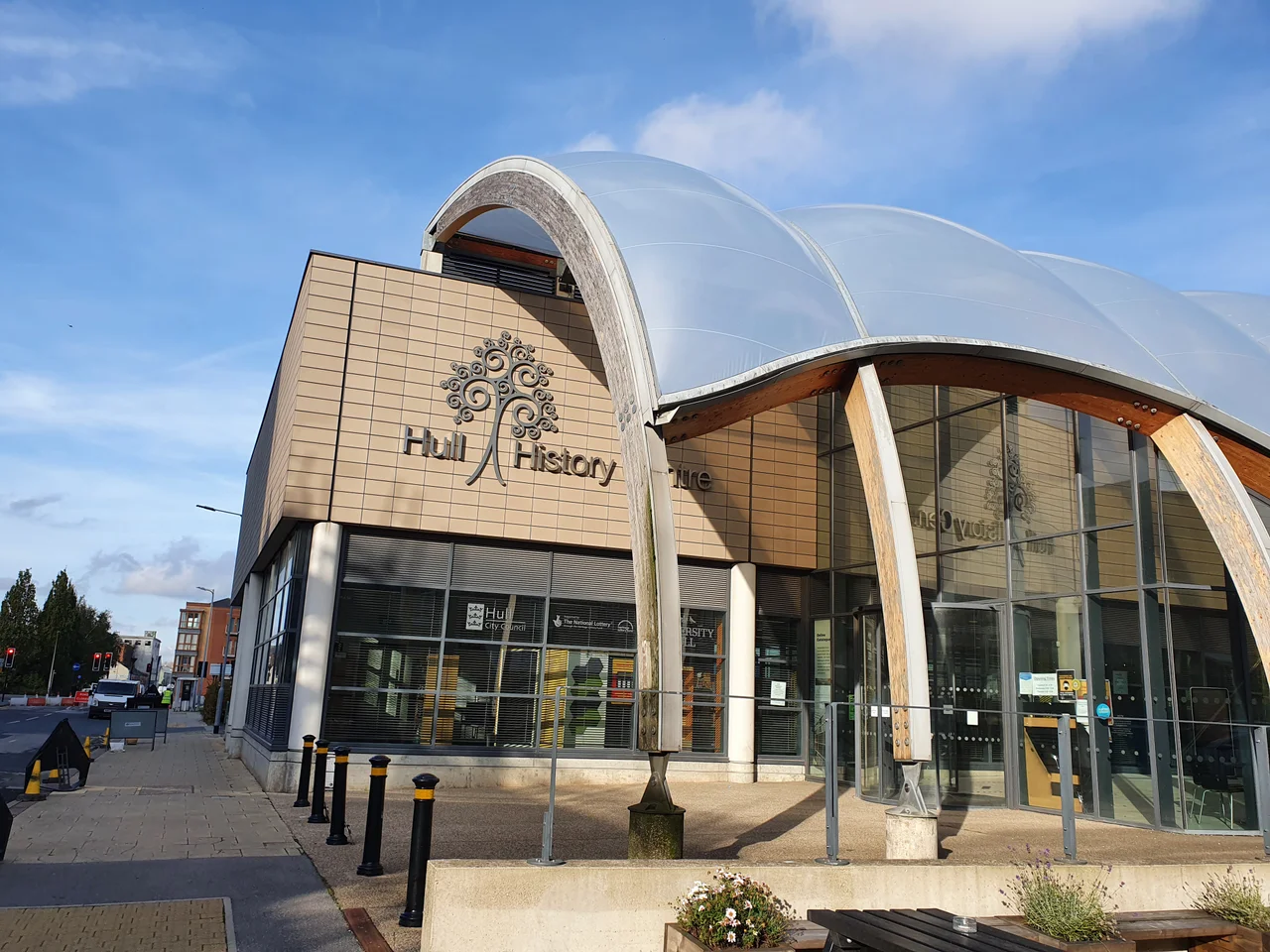

Hull History Centre
Stacked end to end, the documents in the Hull History Centre would cross the Humber Bridge four times. The figure is precise enough to make an archivist smile and vast enough to make a researcher despair. Inside this purpose-built repository on Worship Street are 225,000 catalogued items, from a royal charter issued by Edward I in 1299 to the personal papers of the poet Philip Larkin, who worked as Hull's university librarian for thirty years. When the centre opened on 25 January 2010, it made Hull the first city in the United Kingdom to unite local council and university archive collections under a single roof.
The Largest Lottery Grant
For most of the twentieth century, Hull's archival memory was scattered across three separate repositories: the University of Hull, the Local Studies Library, and the Hull City Archives. Researchers needing to follow a thread across all three had to make appointments at three different buildings on opposite sides of the city. In the early 2000s, the City Council and the university began discussing whether they could pool resources for a single purpose-built facility. The Heritage Lottery Fund made the dream possible with a 7.7-million-pound grant, the largest the fund had ever awarded to a UK archive project. Construction began in late 2007. On 25 January 2010 the doors opened to the public. The Pringle Richards Sharratt-designed building has an environmentally controlled repository on the upper floor and public reading rooms below, opening onto a new park.
Wilberforce and Wilberforce
The collection's deepest roots reach into Hull's most famous son. William Wilberforce, the Independent MP born in Hull in 1759 who led the parliamentary campaign that ended the British slave trade in 1807, generated a vast paper trail. Letters, speeches, drafts, and committee papers connected to his abolition work survive here, along with materials documenting the wider history of slavery and the campaigns against it. Andrew Marvell, the metaphysical poet born nearby in 1621 and Hull's MP for nearly two decades, has his own special collection. So does Winifred Holtby, the East Riding novelist who wrote South Riding before her death in 1935 at the age of 37. Amy Johnson, the aviator from Hull who in 1930 became the first woman to fly solo from England to Australia, has a collection devoted to her. These are not abstract historical figures here. They are constituents, neighbours, and former library users.
Larkin's Hull
Philip Larkin moved to Hull in 1955 as the new librarian of what was then the small University College of Hull. He stayed thirty years, until his death in 1985, transforming the university library and writing some of the best English poetry of the second half of the twentieth century. His papers are held here, alongside those of Douglas Dunn, who studied under Larkin and went on to become a major poet himself. The literary collection also includes the playwright Alan Plater, who co-founded the Humberside Theatre that became Hull Truck. Modern political papers cover the careers of John Prescott, the Hull East MP who served as Deputy Prime Minister from 1997 to 2007, Kevin McNamara, Austin Mitchell, Chris Mullin, and Patrick Wall. Records of pressure groups including Liberty (the civil liberties organisation formerly called the National Council for Civil Liberties) and the Union of Democratic Control sit alongside the personal correspondence of the city's MPs.
Ships, Trade, and Working Lives
Business records preserve the maritime history that made Hull. Ellerman's Wilson Line, once the largest privately owned shipping company in the world, kept its head office in Hull and its papers are here. Earle's Shipbuilding and Engineering Company built the steamers that crossed the North Sea between Hull and the Baltic. The Hull and East Riding Co-operative Society documented the daily commerce of working-class life. Trade union archives include the records of local branches and the personal papers of national figures like Julia Varley, the suffragist and trade unionist who began organising in Yorkshire mills. The royal charter of 1299, signed by Edward I, formally established Kingston upon Hull as a town. The Hull Daily Mail's archive runs continuously from 1885 to the present, the printed memory of a city that has changed almost beyond recognition since Wilberforce was a child here.
From the Air
Located at 53.75 degrees N, 0.34 degrees W on Worship Street in central Kingston upon Hull, just off Freetown Way. The modern archive building is part of the Old Town quarter, near the River Hull and the Queens Gardens. Nearest airports: Humberside (EGNJ) about 9 nautical miles south, Leeds Bradford (EGNM) about 50 nautical miles west. The Humber Bridge is visible 5 miles to the west, and the cluster of Hull's Old Town museums lies just south of the History Centre. Best viewed at low altitude on a clear day to see Hull's compact city centre laid out between the Humber Estuary and the M62 corridor.
Nearby Stories
- Skipsea Castle 3.9 km away
- 2025 North Sea Ship Collision 4.8 km away
- Gainsborough, Lincolnshire 6.1 km away
- SM UC-47 9.7 km away
- Howden 12 km away
- Battle of Stamford Bridge 14 km away
- Battle of Winceby 28 km away
- HMS Cobra 50 km away