.jpg)
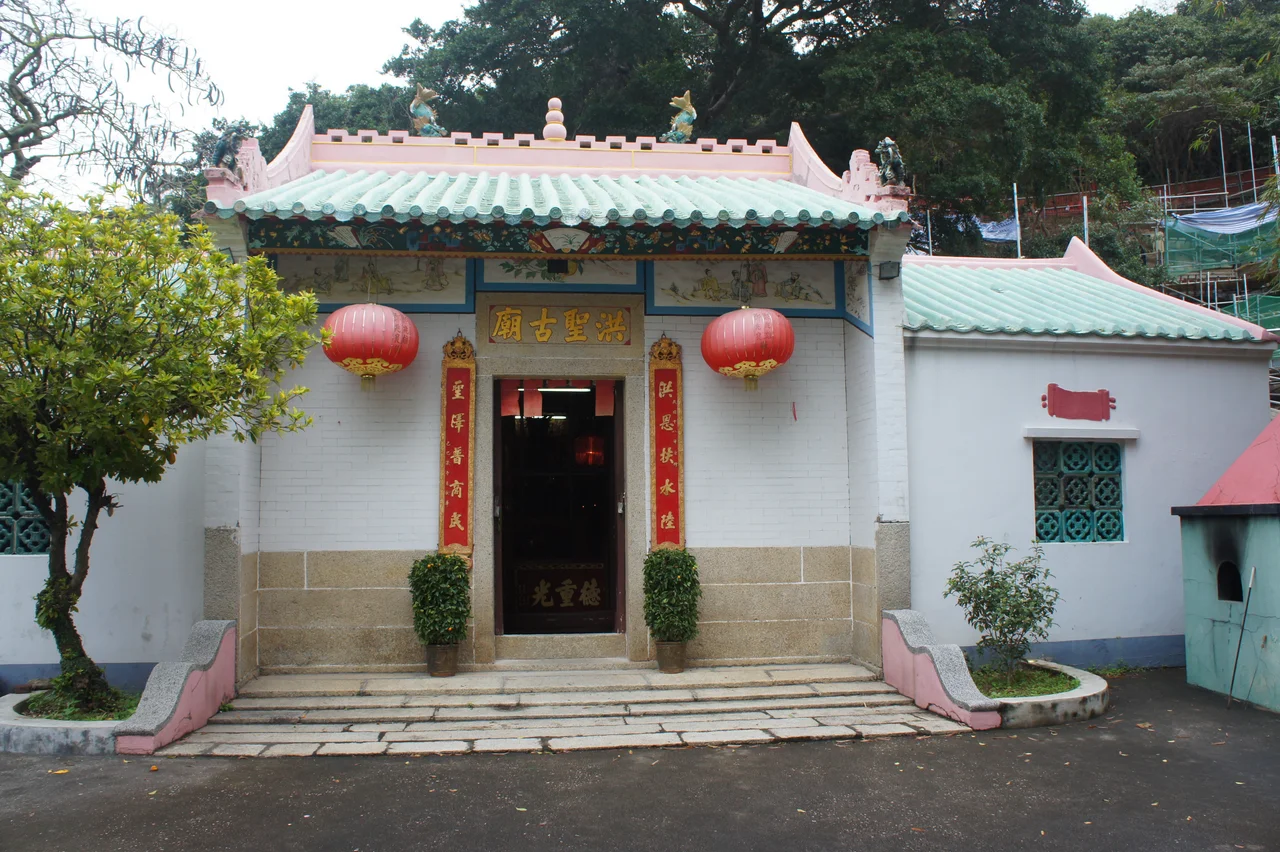
Hung Shing Temple
His full title is Hung Shing Tai Wong — Great King Hung Shing — and the reverence encoded in that name has outlasted dynasties, colonial rule, and the transformation of Hong Kong from a cluster of fishing villages into one of the world's great cities. Hung Shing was a Tang dynasty official whose meteorological skill supposedly allowed him to forecast weather with uncanny accuracy, making him a protector of fishermen and sailors. In death, he was deified. In Hong Kong, he is everywhere.
A God the Sea Made
The cult of Hung Shing spread south from the mainland during the centuries when Guangdong's fishing communities were building their livelihoods around the Pearl River Delta and South China Sea. For people whose survival depended on reading wind and tide, a divine weatherman was not a comfort — he was a necessity. Hung Shing temples were built close to water, facing the harbor or sea, their incense smoke drifting toward the waves. The temples served as both shrines and informal weather stations of the spirit, places where fishermen could offer prayers before setting out and give thanks upon returning. The relationship between the deity and his devotees was practical, rooted in the mortal stakes of maritime life.
Scattered Across the Archipelago
Hong Kong's Hung Shing temples are not concentrated in one district — they are dispersed across the territory like a constellation, each one anchored to its own community. Six temples stand on Lantau Island alone, reflecting the island's historically strong fishing culture. There is one in urban Kowloon and others scattered across the outlying islands and the New Territories. Several temples are listed under Hong Kong's historic building grading system, their architectural and cultural significance formally recognized by the government. The Hung Shing Temple at Kau Sai Chau, a declared monument, earned a UNESCO Asia Pacific Heritage Award for cultural heritage conservation — a rare international recognition for a small Chinese temple on a small Hong Kong island.
Festival Days
Each year on the 13th day of the second lunar month, communities gather to mark Hung Shing's birthday with festivals, lion dances, and offerings. The celebrations at the temples in Ap Lei Chau, Tai Kok Tsui, and Kau Sai Chau are among the most vibrant in the territory. These are not nostalgic performances staged for tourists — they are active religious observances, maintained by communities that have kept the tradition alive across generations. Fishing families who once lived by the South China Sea still return to these temples on festival days, joining newer residents and curious onlookers in an annual renewal of devotion that has continued, with modifications, for hundreds of years.
What Time Takes and What It Leaves
Not every Hung Shing temple survived. The temple at Mui Wo on Lantau Island — built during the Ming dynasty and repaired in 1843 — has completely disappeared, leaving only the historical record of its existence. Urban development, land reclamation, and the sheer pace of Hong Kong's growth have erased sacred sites that once anchored communities to place. What remains stands partly by accident and partly by the determined efforts of local preservation advocates and temple committees who understood that these structures carry memory that concrete cannot replace. Walking into a surviving Hung Shing temple today — past the carved ridge tiles, into the incense-thickened air — is to step briefly out of Hong Kong's relentless forward motion and into something much older.
The Wan Chai Temple
Among the most visible of Hong Kong's Hung Shing temples is the one in Wan Chai, standing on Queen's Road East — a quiet insistence on the sacred in one of the city's most densely commercial districts. The temple dates to the nineteenth century, when Wan Chai was still a waterfront neighborhood where fishing boats moored within sight of the altar. The harbor has long since been pushed back by reclamation, but the temple holds its ground. It is managed by the Chinese Temples Committee and remains an active place of worship. The smell of incense, the sound of prayers murmured against the background noise of the city — these have not changed.
From the Air
Hung Shing temples are distributed across Hong Kong at approximately 22.28°N, 114.17°E. Flying in from the east or west along Victoria Harbour at 2,000–3,000 feet on approach to Hong Kong International Airport (VHHH, to the west on Lantau Island), the density of urban development on Hong Kong Island and Kowloon is visible from the air, with Lamma Island and the outlying islands visible to the south. The temples themselves are too small to spot from altitude, but the harbors and fishing communities they served — particularly around Lamma, Lantau, and the New Territories coastline — read clearly from above.
Nearby Stories
- Lok Ma Chau Loop 2.3 km away
- Portas do Cerco 2.3 km away
- Kweilin Incident 17 km away
- Wanshan Archipelago Campaign 34 km away
- Nanxiong Formation 115 km away
- Battle of Nanpeng Island 148 km away
- Heyuan 169 km away
- Cape Maobitou 632 km away