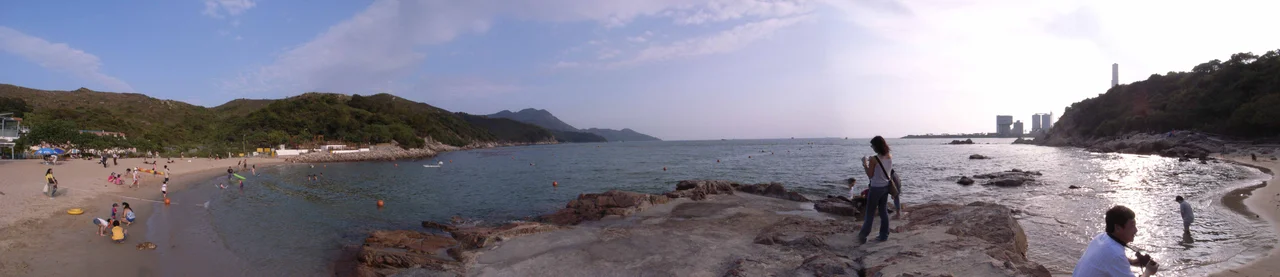

Hung Shing Yeh Beach
The power station is part of the view. Its two tall chimneys rise above the headland to the east of Hung Shing Yeh Beach, a visual incongruity that Lamma regulars have long since stopped noticing. What they come for is everything else: the arc of pale sand, the clear green water, the unhurried pace that Lamma Island has somehow preserved despite being a 30-minute ferry ride from Central. Hung Shing Yeh Beach is the most popular beach on the island, which on a summer weekend means it is busy — but by Hong Kong standards, never crowded.
Island at Its Own Speed
Lamma Island runs on a different clock than the rest of Hong Kong. There are no private cars on the island. The main villages — Yung Shue Wan and Sok Kwu Wan — are connected by footpaths rather than roads, and the walk between them passes through hillside scrub, past small temples, and along coastline that has changed little in decades. Hung Shing Yeh Beach sits roughly midway along this path, reachable in about thirty minutes on foot from the Yung Shue Wan ferry pier. The walk itself is part of the appeal: a descent through greenery that opens suddenly onto sand and water. The beach is named for a nearby temple dedicated to Hung Shing, the deity of the sea, whose protective presence is felt — at least symbolically — throughout Lamma's maritime communities.
The Shore That Received the Skyluck
On 11 March 1979, a Panamanian-flagged freighter called the Skyluck dropped anchor in Hong Kong waters with more than 2,600 Vietnamese refugees aboard — part of the vast wave of people fleeing Vietnam after the fall of Saigon. The colonial government, unwilling to accept more refugees, refused to let them land. After weeks of standoff, around 100 people could wait no longer. They jumped from the freighter and swam for Lamma Island. About half were picked up at sea by police. The rest — exhausted, soaked, frightened — reached the shore at Hung Shing Yeh Beach, where they were also captured by police and returned. The Skyluck incident became a symbol of Hong Kong's agonized, legally contested response to the refugee crisis. The beach where those swimmers came ashore looks unchanged today. Nothing marks the spot.
Built for the Weekend
The beach's facilities were completed by the Regional Council in 1997 and 1998, just as Hong Kong was making its transition from British colony to Special Administrative Region. The new structure brought changing rooms, toilets, a first aid room, a lifeguard lookout, a staff office, and waste treatment facilities to what had been a largely improvised recreational space. Nine BBQ pits were added, and a shark net was installed to protect swimmers — a standard feature at Hong Kong's managed beaches, given the occasional presence of sharks in surrounding waters. The Leisure and Cultural Services Department now manages the beach. On summer weekends, families from the mainland and Hong Kong alike spread towels on the sand, fire up the BBQ pits, and stay until the sun drops behind the hills.
Water, Light, and the Lamma Atmosphere
The beach faces roughly southwest, which means afternoon light arrives at an angle that turns the water from green to gold in the hours before sunset. The hills on either side cup the bay without quite enclosing it, giving a sense of openness unusual for Hong Kong's rocky coastline. Swimmers report the water as clear, particularly outside the summer months when rainfall increases turbidity. Snorkelers sometimes work the rocks at the bay's edges. The power station chimneys, prominent on the approach, recede in the mind once you are on the sand — they become background, part of Lamma's particular aesthetic of functional industrial infrastructure coexisting with natural beauty. The island has always been like this: working and leisured, ordinary and quietly remarkable, all at once.
From the Air
Hung Shing Yeh Beach sits on Lamma Island at approximately 22.22°N, 114.12°E, on the island's northwest coast. Flying southwestward from Hong Kong International Airport (VHHH on Lantau Island), Lamma Island appears clearly to the south of Hong Kong Island, separated by the Lamma Channel. At 1,500–2,500 feet, the distinct shape of the beach is visible as a pale arc against the green hillside. The Lamma Power Station — with its distinctive twin chimneys — is the most prominent visual landmark near the beach and serves as an excellent navigation reference. Sok Kwu Wan village and its typhoon shelter are visible on Lamma's opposite shore.
Nearby Stories
- Lok Ma Chau Loop 2.3 km away
- Portas do Cerco 2.3 km away
- Kweilin Incident 17 km away
- Wanshan Archipelago Campaign 34 km away
- Nanxiong Formation 115 km away
- Battle of Nanpeng Island 148 km away
- Heyuan 169 km away
- Cape Maobitou 632 km away