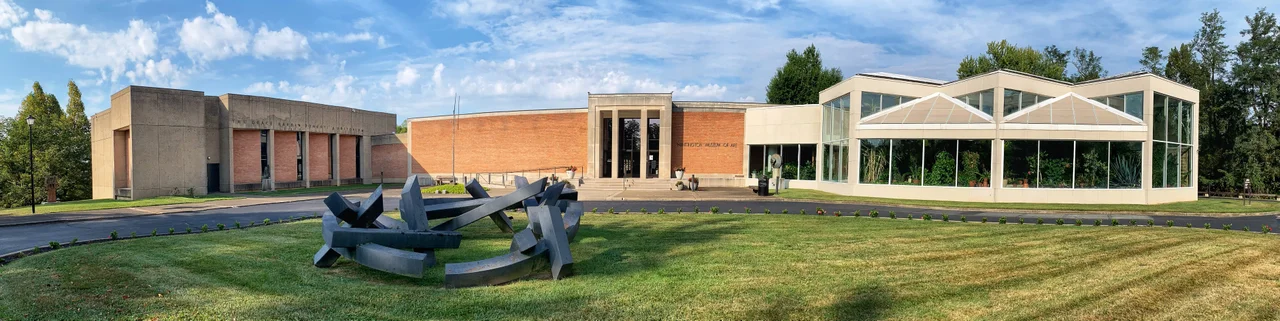

Huntington Museum of Art
Walter Gropius founded the Bauhaus in Weimar in 1919, shaping the trajectory of twentieth-century architecture and design. In the mid-1960s, near the end of his life, Gropius and his firm The Architects Collaborative were hired to design an addition to a small West Virginia art museum. The Huntington Museum of Art - then still called the Huntington Galleries - was an unusual commission for one of the world's most famous modernist architects. He took it anyway. The galleries, auditorium, library, and studios Gropius designed for Huntington still stand on the same fifty-two acres above Ritter Park where Herbert Fitzpatrick donated the original plot in the 1940s. The museum is now the largest art museum in West Virginia, and one of the more surprising Gropius commissions in the United States.
Fitzpatrick's Gift
Herbert Fitzpatrick was a Huntington resident with a substantial private art collection. In the late 1940s he donated both his collection and a 52-acre parcel of land in the Park Hills neighborhood above Ritter Park as the foundation for what would become the museum. The collection of over 400 objects included paintings, prints, sculpture, British silver, Asian decorative objects, and rugs - the kind of mixed fine and decorative arts collection that wealthy mid-twentieth-century Americans often assembled. The museum was organized in 1947 and officially opened on November 9, 1952, under the name The Huntington Galleries. In 1987 the institution was renamed the Huntington Museum of Art. The Fitzpatrick donation remains the foundation on which everything else has been built.
The Gropius Wing
In the mid-1960s, the Henry L. and Grace Rardin Doherty Foundation funded a major expansion that included the Grace Rardin Doherty Auditorium, the James D. Francis Art Library, large new galleries, and a second building containing three studios. The design work went to Walter Gropius and his firm The Architects Collaborative. Gropius was by then in his eighties, working on commissions around the world from Harvard's Graduate School of Design where he had taught. The Huntington galleries he designed are modernist in the disciplined Bauhaus tradition - clean lines, integrated indoor-outdoor relationships, careful natural lighting for the artwork. Two more studios were added in the mid-1970s, also following the Gropius vision. The combination of the original Fitzpatrick wing and the Gropius additions gives the museum an architectural depth unusual for a regional institution.
The Daywood and Beyond
In the late 1960s Ruth Woods Dayton donated the Daywood Collection - nearly 400 works of art with a strong focus on late nineteenth and early twentieth-century American art, especially American Impressionism. Dayton wanted the collection to stay in West Virginia for the benefit of state residents. The Huntington Museum was her chosen home. Works by Childe Hassam, Robert Henri, John Singer Sargent, Andrew Wyeth, and Andy Warhol entered the American collection. European holdings include Renoir, Picasso, Braque, Corot, and Millet. The Wilbur Myers Glass Collection adds hundreds of Victorian-era decorative glass pieces, including two rare Morgan vases that were featured on Antiques Roadshow in 2015. The Winslow Anderson Collection of Haitian Art reflects the Blenko Glass designer's regular travels to Haiti starting in 1948.
The Dean Firearms Collection
Herman P. Dean was a member of the museum's first board. His personal firearms collection - 212 historical weapons ranging from the earliest hand cannons to nineteenth-century rifles, with special focuses on firing mechanisms and the weapons of the American frontier including the Kentucky Rifle - was loaned for the museum's 1952 opening. He later gifted the collection in full. It now ranks as the third-largest firearms display on permanent exhibition in the United States, an unusual collection for an art museum and a measure of how the original museum board defined the scope of what the institution would collect. The Dean Collection sits alongside the Renoirs and the British silver, an unconventional combination that reflects the broad twentieth-century notion of what a museum should hold.
The Conservatory
The C. Fred Edwards Conservatory opened in 1996, the gift of local philanthropist Joan C. Edwards. It is the only tropical and subtropical plant conservatory in West Virginia or the surrounding tri-state region. The collection covers four main categories: orchids from around the world, agriculturally important plants like banana, cashew, chocolate, coffee, pineapple, pomegranate, sugar cane, and vanilla; fragrant plants including the famously pungent cadaver plant; and unusual plants like pitcher plants, turtle plants, and sensitive plants. Animals share the space - koi, poison dart frogs, axolotls, and a saltwater aquarium with coral. The conservatory is one of the museum's most popular attractions, particularly for visitors who came for the galleries and discovered the living collection as a surprise.
From the Air
Located at 38.393 degrees north, 82.434 degrees west, in the Park Hills neighborhood above Ritter Park in Huntington, West Virginia. Recommended viewing altitude 3,000 to 4,500 feet AGL for clear views of the museum's wooded 52-acre campus. Nearest airport is Tri-State (KHTS), about 4 nautical miles east-northeast. The museum sits on a hilltop south of downtown Huntington, identifiable from the air by the cluster of buildings amid mature trees, with Ritter Park's tennis facilities and gardens just to the north.
Nearby Stories
- Battle of Scary Creek 6 km away
- Portsmouth 7.2 km away
- Fred M. Vinson Museum and Welcome Center 14 km away
- Staats Mill Covered Bridge 24 km away
- Lake Tight 25 km away
- Battle of Blair Mountain 32 km away
- Lower Shawneetown 35 km away
- The Kentucky Meat Shower: When Flesh Fell From a Clear Sky 68 km away