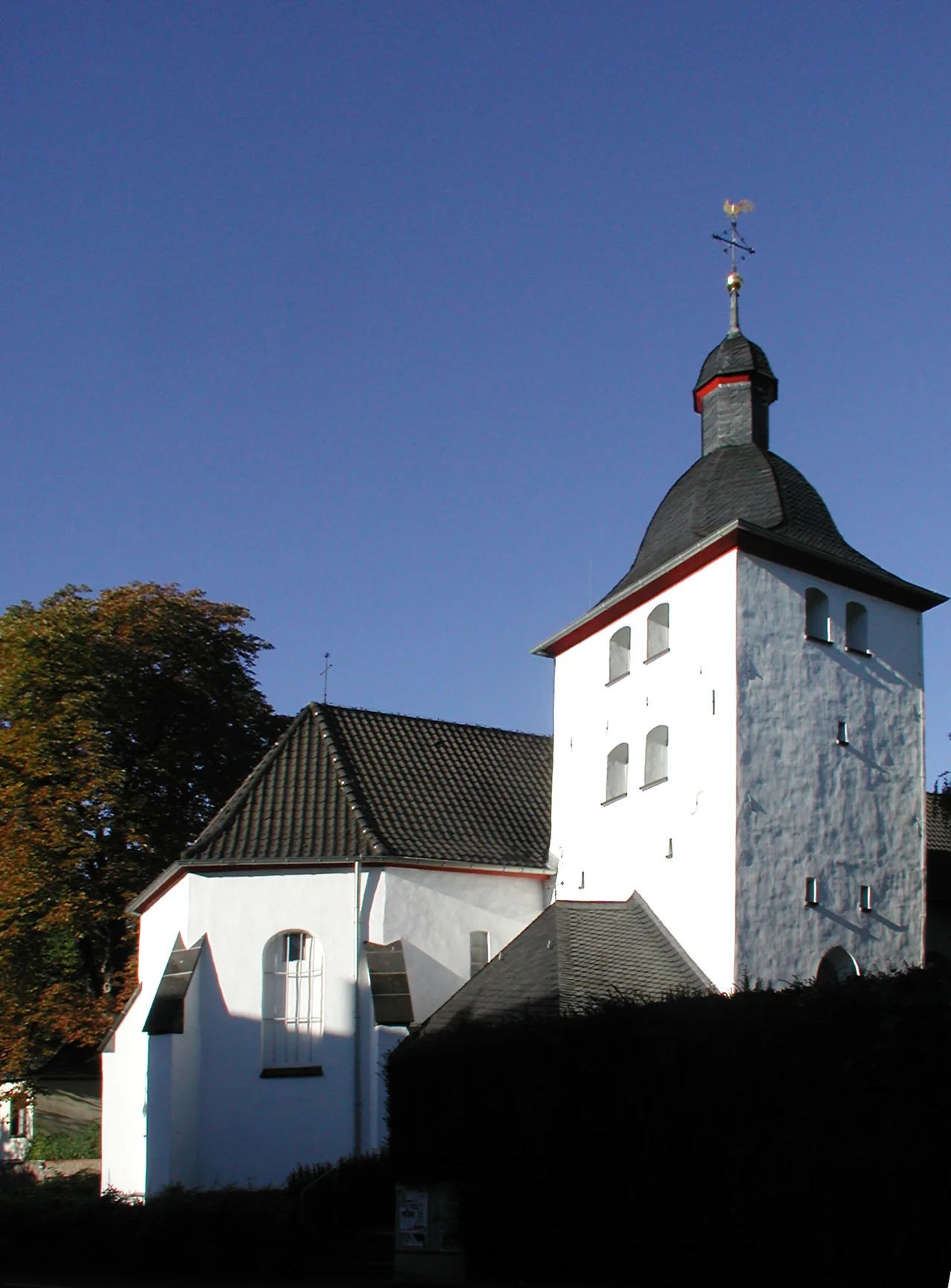

Hürth
Michael Schumacher was born in Hürth in 1969. Six years later, his brother Ralf followed. Between them the brothers would win seven Formula One drivers' championships, take ninety-one and six grand prix victories respectively, and be talked about for the rest of their lives. They both came from the same suburb of Cologne, a town of thirteen formerly independent villages stitched together in 1930 around a constellation of brown-coal mines and Roman aqueduct remnants. Hürth is the kind of place that is famous for who left it. It is also famous, quietly, for what stayed: a Roman water system still buried under the streets, a town hall that nearly belonged to Cologne, and Tower 93 of Facility 4101, a 75-meter electricity pylon that for thirty-three years had a public observation deck on it.
Thirteen Villages and a Map
Until 1930, Hürth was scattered. Berrenrath had been mentioned in records as far back as 922; Sielsdorf and Gleuel in 898; Hermülheim in 943; Kendenich in 941. Then on April 1 of that year, six rural communities were stitched together into one country community called Hürth. Konrad Adenauer, then the mayor of Cologne and later the first Chancellor of West Germany, had tried to grab the village of Efferen for his city. Cologne lost that argument, and Efferen joined Hürth instead in 1933, along with Stotzheim. The new municipality became the largest rural community in Germany until 1978, when continued growth in Efferen finally closed the open ground between Hürth and Cologne and Hürth was officially declared a suburb. By then it had thirteen districts, several lakes left behind by exhausted brown-coal pits, a shopping mall in the newly built Hürth-Mitte, and a generation of children who would carry its name into very different places.
Knapsack and the Brown Coal
Knapsack first appears in the historical record in 1566 and stayed small until 1900. Then industry arrived: Knapsack-Griesheim AG was established in 1906 (it would later become Hoechst AG), and the Goldenberg-Werk brown-coal power plant followed in 1913. The Rhenish lignite belt south and west of Cologne is one of the densest concentrations of brown coal in Europe, and Hürth sat on top of it. The mines reshaped the landscape, hollowing out the land and leaving lakes where the pits had been. They also reshaped the population. The resettlement of Berrenrath onto a now-exhausted brown-coal mine was decided in 1952 and completed in 1995. Between 1969 and 1979 about 4,000 people in Knapsack had to move for environmental reasons. The Schumacher brothers grew up in this geography of replanted villages, lake-pocked forest, and the heavy industry the town wove into its coat of arms: an eagle from the medieval knight Hurth von Schönecken, the cross of Cologne, and a cogwheel.
The Kart Track at Kerpen
Just west of Hürth, in neighboring Kerpen, sits a karting circuit that has trained more world-class drivers than any other in Germany. Michael and Ralf Schumacher started there as boys; their father Rolf managed the track. The Schumachers were not the only Formula One drivers Hürth produced. Wolfgang von Trips, born in Cologne in 1928, was leading the 1961 World Championship when he died at Monza in a crash that also killed fifteen spectators. The Italian press called him Graf Trips, count of crashes. His memory remains complicated; the deaths at Monza were both his loss and the loss of those he could not avoid hitting. Hürth's broader sports roster goes further: the cyclist Andre Greipel, multiple Tour de France stage winner; the cyclist Ralf Grabsch; the actor Paul Henckels; the opera singer Josef Metternich. The television journalist Anne Will went to school here.
The Tower with a View
Tower 93 of Facility 4101 is an electricity pylon. It carries four 380-kilovolt circuits on a steel lattice that rises 74.84 meters above the woods north of Bleibtreusee. In 1977, two years after it was built, someone installed a covered observation deck twenty-seven meters up, accessed by a staircase running through the center of the tower. It was, in all probability, the only public observation deck ever built on an electricity pylon anywhere. People climbed up and looked out over what used to be coal pits and is now lake water. The vandalism became a problem; pieces important to the pylon's integrity began to disappear. In 2010 the deck and the staircase were removed. A concrete plate between the tower's legs and an inverted-V pattern in the lattice are the only signs left that, for thirty-three years, you could ride a power-grid tower for the view.
Roman Water, Modern Television
Underneath all of this runs the Eifel Aqueduct, the Roman engineering work that brought drinking water from the Eifel hills to ancient Cologne. Sections of the aqueduct still survive in the Hürth subsoil, alongside springs and streams the Romans tapped before they built the bigger system. Above ground, Hürth has reinvented itself as a media town: RTL Television and other broadcasters run major studios here, and a generation of German talent shows have been recorded inside its production halls. The Bundessprachenamt, the federal language office that translates and trains for the German military and civil service, has been headquartered here since 1969. A suburb famous for racing drivers, broadcast pop stars, and Roman water plumbing makes a strange composite portrait, but Hürth is comfortable with it. Thirteen villages will give you that kind of variety.
From the Air
Coordinates 50.8775 N, 6.8761 E, about 6 km southwest of Cologne city centre, on the northeastern slope of the Kottenforst-Ville nature reserve. From the air, Hürth reads as a patchwork of suburban districts interspersed with lakes formed in former brown-coal pits, with stretches of forest. The Goldenberg-Werk power plant in Knapsack and the RTL television studios in Hürth-Mitte are useful landmarks. Recommended altitude 2,000-3,500 ft AGL. Nearest major airport: Cologne Bonn (EDDK / CGN), 8 nm east. Cologne Class C airspace extends overhead; expect approach and departure traffic for CGN.
Nearby Stories
- Diamond Interchange: How a Simple Idea Reshapes Towns Like Julich 2.8 km away
- Dusseldorf-Unterbach 6.1 km away
- Baumwollspinnerei Ermen & Engels 11 km away
- RAF Bruggen 15 km away
- Hagen Open-air Museum 21 km away
- Belgium 130 km away
- Marcinelle Mining Disaster 173 km away
- Zwingenberg Castle 178 km away