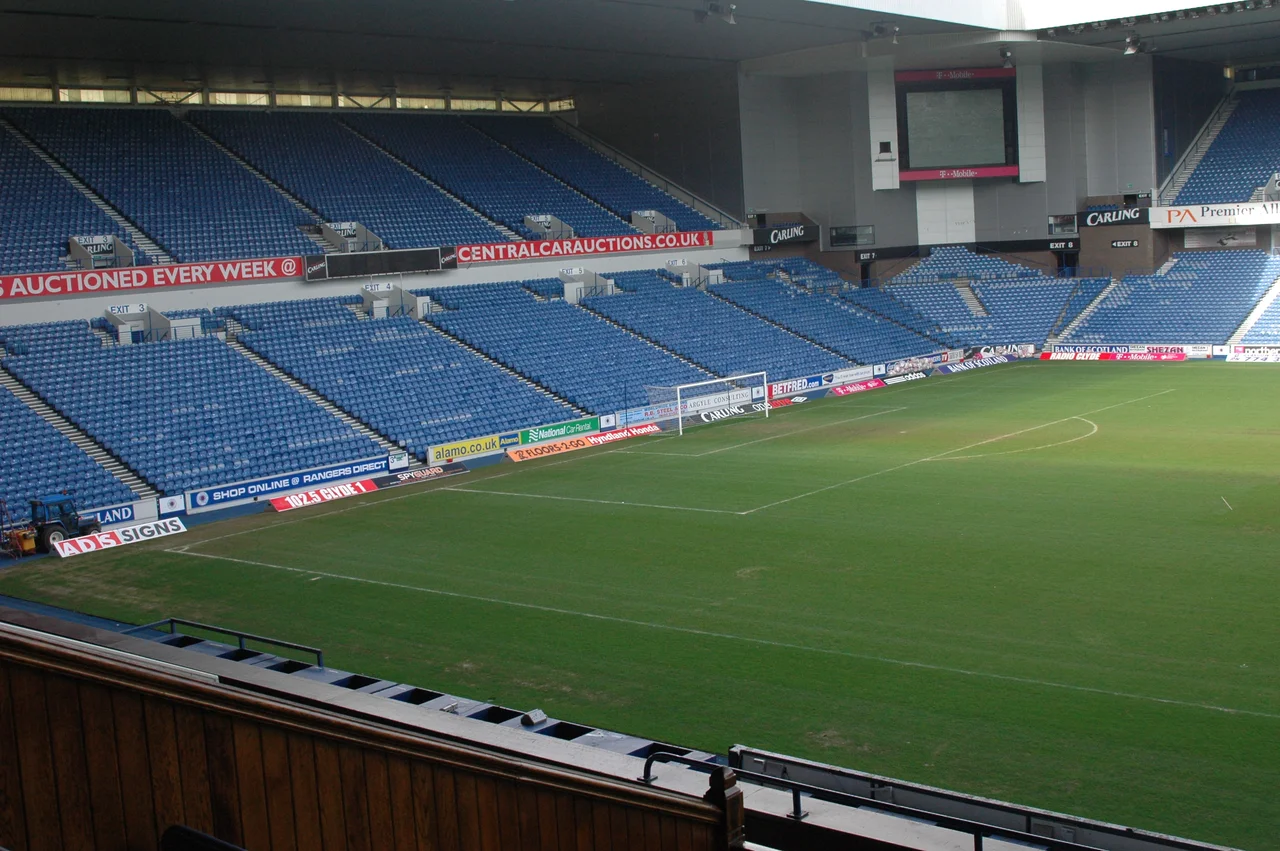

Ibrox Stadium
On the afternoon of 2 January 1971, Rangers and Celtic played their New Year Old Firm derby at Ibrox Park. Late in the second half, Celtic took the lead. Some fans began to drift toward the exits. Then, with the match almost over, Colin Stein equalised for Rangers, and the roar that followed reached the people leaving down Stairway 13 at the east end of the ground. What happened next is still debated in detail. What is certain is that a crush developed on the wooden-and-iron stairway, that people fell, that others fell over them, and that 66 people died of asphyxiation in the press of bodies on a Glasgow January afternoon. Most were young - teenagers, men in their twenties. Five were boys aged ten or eleven who had travelled together from Markinch, Fife.
The First Ibrox
Rangers Football Club played its first match in May 1872 on Glasgow Green. The club moved around several public pitches before settling at the first Ibrox Park in 1887. That ground hosted three Scotland international matches and the 1890 Scottish Cup Final. But on 5 April 1902, Scotland played England in front of 68,000 people, and a section of the wooden West Terrace collapsed. Twenty-five people died. More than 500 were injured. The match continued, with most spectators unaware of what had happened beneath their feet. After that first Ibrox disaster, Rangers built a new ground on an adjacent site. The architect was Archibald Leitch, the great stadium designer who shaped grounds across Britain. The new Ibrox opened in 1899, with vast banked earth terracing replacing the wooden structure that had failed. The Main Stand of 1928, originally seats of cast iron and oak, is now a Category B listed building.
Britain's Biggest Crowd
On 2 January 1939, the Old Firm derby drew 118,567 people through the Ibrox turnstiles. That figure remains the record attendance for any league match played in Britain - more than have ever paid to see a single English league fixture, more than have seen any Scottish league match before or since. The terraces of the period were vast banked earthworks, capable of holding crowds that modern stadiums cannot legally accommodate. Stairway 13, on the east side of the ground, was the natural exit toward Copland Road for fans heading back to the subway and the bus stops. It had already seen smaller crushes in 1961, 1967 and 1969 - warning signs the authorities did not fully heed.
After 1971
The 1971 disaster changed everything. Rangers commissioned the Miller Partnership to redesign the ground. The first phase began in 1978 with the demolition of the east terracing and the building of the Copland Road stand. Work continued through 1981, when the Govan Stand replaced the south terrace. The vast earth bowl of Archibald Leitch was gone, replaced by three rectangular all-seated stands - safer, smaller, structurally honest. Some fans complained the atmosphere had been lost in the gaps between the stands. When David Murray took control of Rangers in 1988, a third tier called the Club Deck was added above the 1928 Main Stand, funded by debentures sold to ordinary fans for between £1,000 and £1,650 each. The Club Deck opened in 1991 and the multicoloured seats were replaced with uniform blue in 1995. After the renovations were completed in 1997, the ground was officially renamed Ibrox Stadium.
The Stadium Now
Capacity today stands at 51,700, after a 2024 expansion added 600 general access seats and 30 disabled access seats in a new Copland Rear cantilever. Each stand has two tiers, except the Bill Struth Main Stand, which has three. The marble staircase to the boardroom and trophy room is still original. A statue of former manager Walter Smith, who won ten league championships and five Scottish Cups with Rangers, was unveiled outside the Copland Road Stand on 25 May 2024. The Govan Stand was renamed for Sandy Jardine in 2014 - Jardine won three league championships and five Scottish Cups with the club. Ibrox has hosted Scotland 18 times, the third-most of any ground. King George V and Queen Mary visited in September 1917 to thank Glasgow and Clydeside for their First World War effort. King George VI opened the 1938 Empire Exhibition here, broadcasting his speech live to the Empire. Frank Sinatra played in 1990. The 2014 Commonwealth Games rugby sevens were held here, attracting 171,000 across four sessions and setting a tournament record.
The Memorial
A bronze memorial outside the Bill Struth Main Stand lists the 66 names of the people who died on Stairway 13. Every year on 2 January, Rangers fans gather there. The youngest who died was Nigel Pickup, aged 9, from Liverpool. The five boys from Markinch are buried together in their home village. The memorial does not let the stadium forget what it has cost to bring people to football, and what families gave on a winter afternoon when they only meant to watch a match.
From the Air
Ibrox Stadium sits at 55.8531 N, 4.3092 W in the Ibrox district on the south side of the River Clyde, about a mile south-west of the SEC Centre and a similar distance east of the BAE Systems Govan shipyards. From altitude the stadium's rectangular four-stand layout is identifiable next to the M8 motorway, with junction 23 as the closest exit. Glasgow International Airport (EGPF) is 4 nautical miles west, and Glasgow Prestwick (EGPK) is 26 nautical miles south-west. Ibrox and Cessnock stations on the Glasgow Subway both serve the ground. The stadium is best viewed from 3,000-5,000 feet to see it in the context of Govan to the west, the Clyde to the north, and the city centre across the river.
Nearby Stories
- Mauchline 3.6 km away
- Shotts 4.2 km away
- HMS Ulysses (1917) 7.7 km away
- Rothesay Castle 8.8 km away
- Inchcailloch 10 km away
- Strachur 14 km away
- Battle of Dollar 16 km away
- Crawford Castle 16 km away