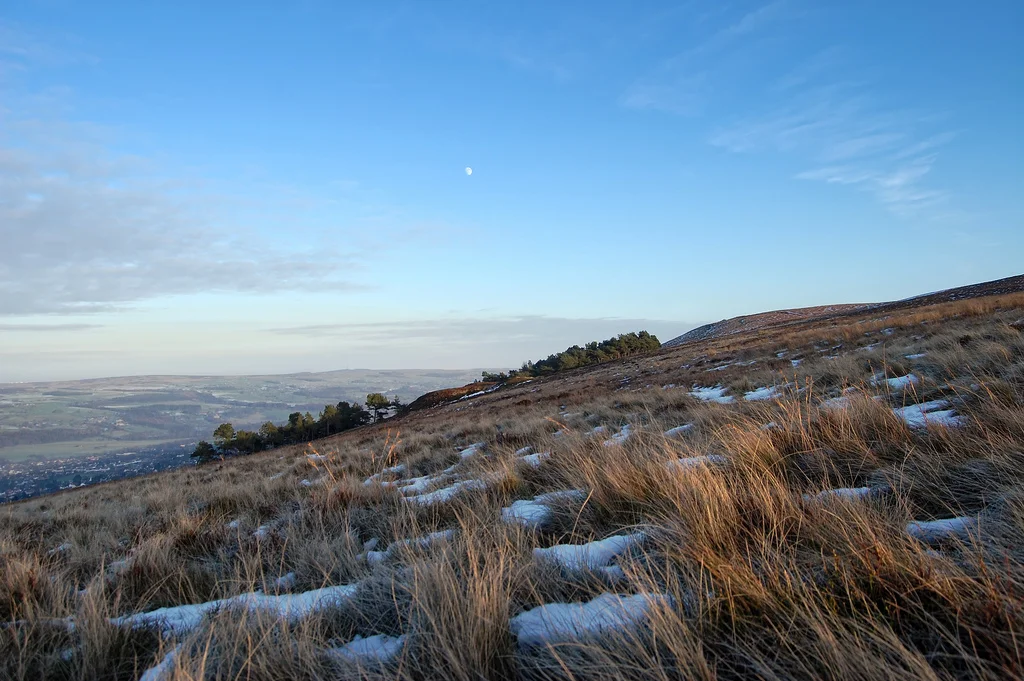

Ilkley Moor
Almost everyone in Yorkshire knows the warning. Go walking on Ilkley Moor without a hat, the old dialect song says, and tha'll catch thi death of cold; then the worms will eat thee, then the ducks will eat the worms, and finally we'll come along and eat the ducks. On Ilkla Moor Baht 'at is Yorkshire's unofficial county anthem, sung at rugby matches and brass band concerts and pub closing times. The moor it celebrates rises to 402 metres above sea level between the spa town of Ilkley and the mill town of Keighley, a wild stretch of heather and millstone grit that has been a public stage for human imagination for at least 4,500 years.
How a Moor Becomes Itself
The bones of Ilkley Moor are Carboniferous. Around 325 million years ago this was a swampy delta near sea level, fed by sluggish meandering rivers from the north, depositing layer on layer of sand and silt that hardened into millstone grit. Geological forces tilted the strata gently south-east and fractured them. Since then, more than a thousand metres of coal-bearing rocks have been worn off the top of the area by erosion. During the last ice age, glaciers smoothed the Wharfe valley below and left behind the rounded shoulders of the moor. The grit gives the soil its acidity, the heather its purple flush in late summer, the water its softness, and the rocky scars their dark colour.
The Cow and Calf
Where the moor falls steeply toward the village of Ben Rhydding, two great chunks of millstone grit sit on the lip of Ilkley Quarry: a large outcrop and a boulder lying close beside it, like a cow and her calf. The names stuck. Local legend insists a third stone, a bull, once stood with them but was quarried away during Ilkley's nineteenth-century spa-town boom. There is no physical evidence of any bull, but the story persists. A more colourful tradition says the Calf was split from the Cow when the giant Rombald, fleeing across the valley from his furious wife, stamped down on the rock as he leapt. The wife meanwhile dropped the stones she carried in her skirt, scattering them into the formation still called The Skirtful of Stones. The rocks are now one of the busier rock-climbing venues in Yorkshire.
The Carved Stones
Rombalds Moor, of which Ilkley Moor is part, has the second-highest concentration of ancient carved stones in Europe. The marks are mostly cup-and-ring patterns: small hollows pecked into earthfast boulders, sometimes ringed by concentric grooves, sometimes joined by trailing lines. Their meaning has been argued over for a century and a half. Most are thought to date from the late Neolithic or Bronze Age. The Badger Stone, the Nebstone, the Hanging Stones, and the Panorama Rocks carry the most elaborate designs. On Woodhouse Crag, the Swastika Stone, also known as a fylfot, bears a curved spiral pattern of great age; a twentieth-century replica was carved nearby so visitors can compare. A small stone circle on the moor's western flank, the Twelve Apostles, was put up around 2,500 BC and is still standing.
Modern Stewardship
Ilkley Moor today is part of the South Pennine Moors Site of Special Scientific Interest, Special Protection Area and Special Area of Conservation, recognised for its blanket bog, breeding curlew, and dwindling populations of merlin and golden plover. The Friends of Ilkley Moor was founded in 2008 to help preserve it. That same year, the City of Bradford Council leased out the moor's grouse-shooting rights, which proved deeply unpopular with walkers, conservationists, and many local residents. In January 2018, the council voted not to renew the lease, and the shoots ended that April. A more eccentric chapter of the moor's recent past is the 1987 Ilkley Moor Alien incident, in which retired police officer Philip Spencer reported seeing and photographing a small humanoid figure waving him off before a dome-topped craft shot away. The Daily Telegraph later listed it among the top ten British UFO incidents.
From the Air
Ilkley Moor stretches between 53.91 N, 1.82 W and the Wharfe valley to the north. Recommended viewing altitude 4,000 to 5,500 ft AGL for the full ridge; the Cow and Calf rocks are visible on the moor's northern lip, with the Twelve Apostles stone circle to the west. Nearest airport is Leeds Bradford (EGNM) about 10 nm south-east; Manchester (EGCC) about 33 nm south-west. The moor crests at 402 m (1,319 ft); maintain safe altitude with terrain plus wind allowances, and expect rapid cloud build-up off the Pennines.
Nearby Stories
- Battle of Seacroft Moor 3 km away
- RAF Topcliffe 7.4 km away
- Pretoria Pit Disaster 8.7 km away
- Lundhill Colliery Explosion 11 km away
- Forest of Bowland 12 km away
- Coverham Abbey 16 km away
- Macclesfield Canal 18 km away
- Leighton Hall, Lancashire 21 km away