
Internal Fire Museum of Power
Push open the door of the first hall and the noise hits you. A 1912 single-cylinder diesel engine, taller than a person, is running. The flywheel is taller still, turning steadily, and the connecting rod swings through its arc with a measured thud that you feel in the floorboards. The smell is hot oil and engine fumes. This is the oldest working diesel engine in Britain, built when Rudolf Diesel was still alive and refining his original air-blast injection design. At Internal Fire, near the village of Tan-y-groes in Ceredigion, more than two hundred tons of stationary engines have been collected, restored, and started up. Most of them still work.
Engines That Stayed Put
Stationary engines are the unglamorous workhorses of the industrial revolution. They were never built to move; they sat in pumphouses, generating stations, factories, and ships, providing power for whatever needed power. Diesel engines in particular dominated mid-20th century rural electrification and water supply in much of the world, running pumps and dynamos in places that grid power did not reach. The Internal Fire Museum specialises in the larger end of this scale: engines used for generating sets and pumping stations, machines designed to run continuously for decades at a stretch. Many of them came out of British or European factories built between 1890 and 1950, and when their working lives ended, most were scrapped. The few that escaped survive because somebody, somewhere, thought they were worth saving.
The Sulzer 1D25
The crown jewel of the diesel hall is a 1912 Sulzer single-cylinder air-blast injection diesel, designated the 1D25. It is one of the earliest survivors of Diesel's original design, in which compressed air is used to blast the fuel into the cylinder at the top of the compression stroke. Modern diesels use direct mechanical or common-rail fuel injection; air-blast injection was abandoned in the 1920s as too cumbersome. The 1D25 worked for decades, was retired, was rescued before scrapping, was transported to Wales, and was restored to running condition. It is now the oldest working diesel engine in the United Kingdom. The museum starts it up on event days. The flywheel takes some persuading at first, but once it is turning, the engine settles into the regular thud-thud-thud that early diesels were known for, an industrial heartbeat from the world before petrol pumps and motorways.
Hot Bulb and Hot Air
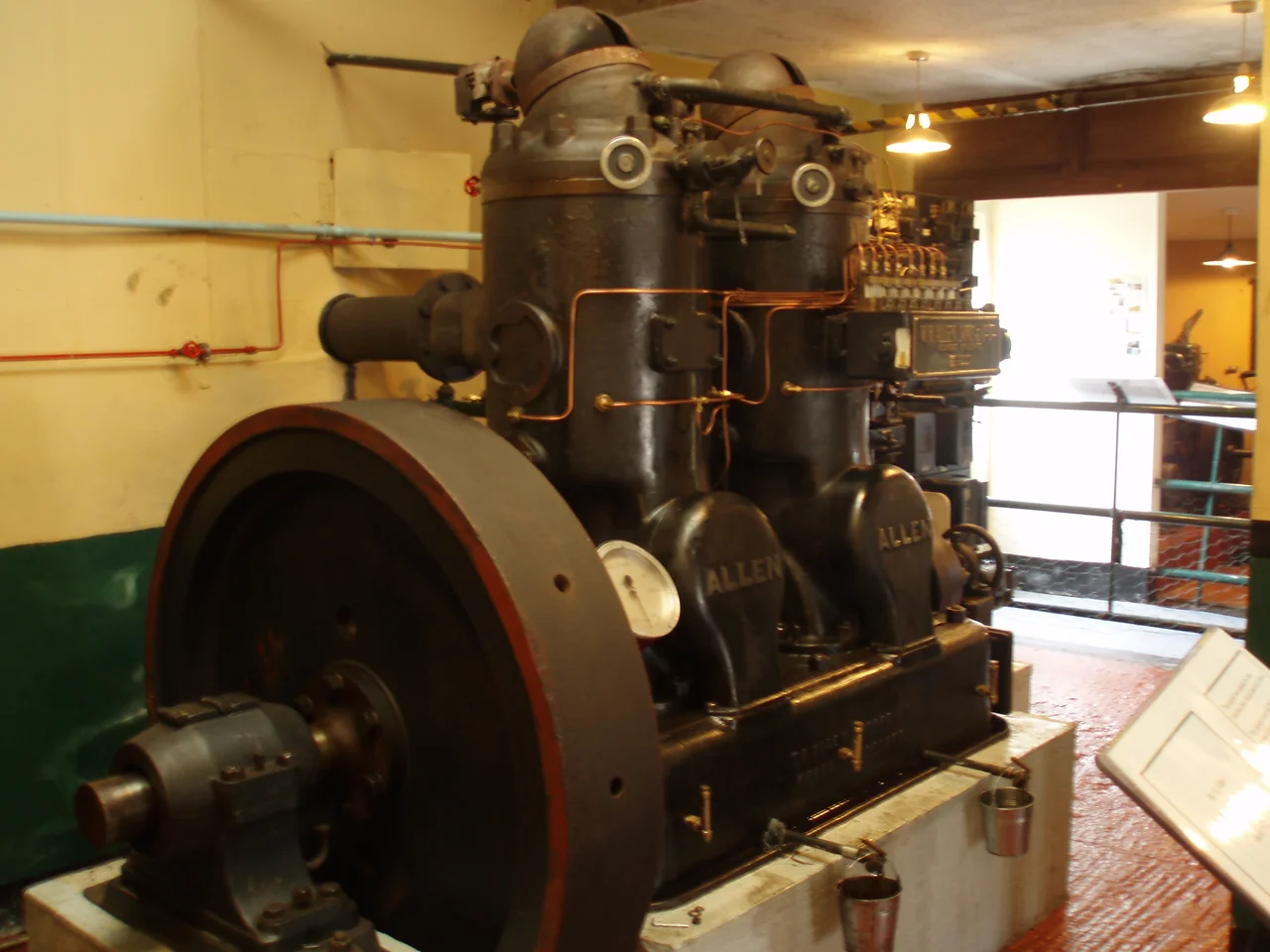
Beside the diesels are the hot-bulb engines, an even older class of internal combustion engine, in which a pre-heated bulb at the top of the cylinder ignites the fuel by contact with hot metal rather than by compression. Hot-bulb engines were quieter and more forgiving than early diesels, and they ran on almost anything: paraffin, vegetable oil, even crude oil. The museum has examples from Allen and several other British manufacturers, many of them rescued from farms and pumping stations across Wales and the Midlands. The hall has the working sound and smell of a small Victorian workshop, oil rags, brass fittings, and the metallic stink of warm castings. Engines are run on a rotating schedule so visitors will always see something at work.
The Pocket Power Station
In a separate hall stands one of the museum's strangest exhibits: a Bristol Proteus gas turbine generating set, the so-called Pocket Power Station. In the 1950s and 1960s the South Western Electricity Board, looking for peak-load capacity that could be brought online quickly during demand spikes, installed several remote-operated 2.7-megawatt generation sets powered by the Bristol Proteus aircraft gas turbine. The Proteus had originally been developed for the Bristol Britannia airliner; in turbine generating service it was designed to start within minutes when called on, generate full power for a few hours during a peak, and shut down again. Designed to run for ten years, many of these pocket power stations remained in service for forty. The museum's example was awarded an Engineering Heritage Award by the Institution of Mechanical Engineers in 2010.
The Steam Hall
The collection is not all internal combustion. The museum has been working since 2020 on a new steam hall to display a 1903 J & E Wood tandem compound steam engine of 500 horsepower, alongside an 1879 John Penn twin-cylinder oscillating paddle engine that originally drove the Empress, a Victorian river steamer. The collection also includes the only surviving Petter steam engine. In 2017 the museum took delivery of a 1901 Willans engine generating set, 140 brake horsepower, three cylinders, which had spent its working life from 1901 to 1957 generating electricity for the Maple and Co. furniture shop in London. After retirement it had been displayed at the original Willans factory in Rugby. When the factory closed, the engine went to Wales. It became the museum's second Engineering Heritage Award exhibit.
Why Engines Matter
There is something hypnotic about watching a hundred-year-old engine run. The mechanism is fully visible: piston, flywheel, governor, oil pump, the small priming tank and the high pressure injector that bring fuel and air together in the cylinder. You can see how it works. Modern engines are sealed inside computer-controlled engine management systems, and the people who service them rarely see the working metal. Here, the working metal is the point. The Internal Fire Museum is not on the main tourist routes; it is a few miles inland from the coast, in a corner of Ceredigion few visitors ever reach. But it holds the largest collection of running stationary engines in the country, and for anyone interested in the actual machines that powered the modern world, it is one of the most interesting places in west Wales.
From the Air
Located at 52.12 degrees north, 4.49 degrees west, near Tan-y-groes in inland Ceredigion, about 6 miles east of Cardigan. Cruise altitude 2,500-4,000 feet shows the rolling farmland between the Teifi valley and the coastal plateau. The MoD Aberporth danger area lies immediately west; check NOTAMs. Nearest airfield is Aberporth (MoD, EGUC); Haverfordwest (EGFE) to the south is the nearest civil alternate.
Nearby Stories
- RAF Haverfordwest 3.7 km away
- Great Western Railway in West Wales 7.7 km away
- West Wales 9.9 km away
- Fishguard Lifeboat Station 13 km away
- Battle of Mynydd Hyddgen 15 km away
- Strata Florida Abbey 18 km away
- Neath and Tennant Canal 21 km away
- HMS Tyler 44 km away