
International Bomber Command Centre
They were mostly very young. Some had lied about their age to get in; many would not live to see their twenty-fifth birthday. From the airfields scattered across Lincolnshire's flat eastern farmland, Bomber Command crews flew east into German flak by night and did not always come back. On a low rise above the city of Lincoln, a 102-foot spire of weathered steel now rises to the exact wingspan of an Avro Lancaster. Around it, 270 metal panels carry the engraved names of 57,871 men and women — every single airman, every ground crew member, every WAAF, every supporter who died serving with Bomber Command between 1939 and 1945. This is the International Bomber Command Centre, and it exists because for seventy years afterwards, no one had built them a home of their own.
A wingspan in steel
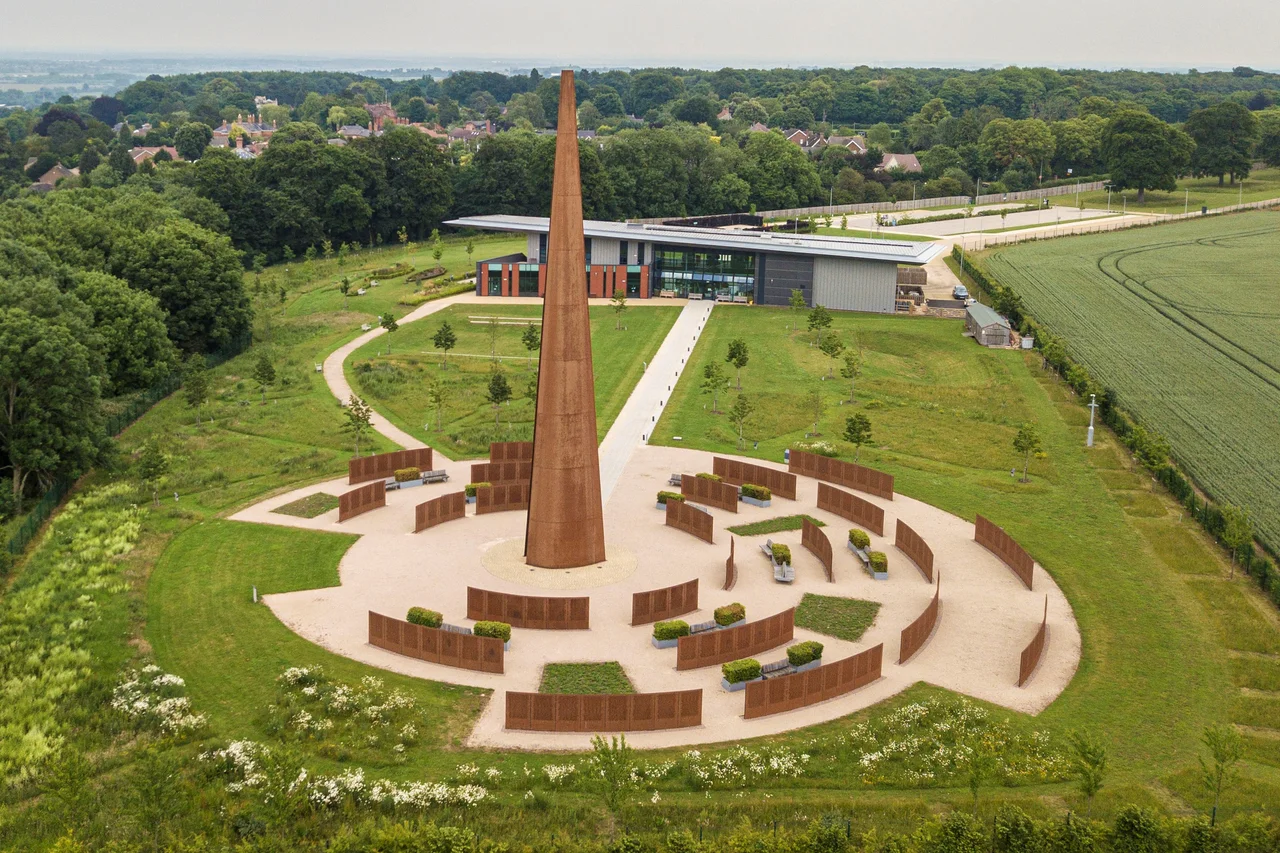
The Spire was raised on Canwick Hill on 10 May 2015, before the visitor centre was even built. It is five metres wide at the base — the width of a Lancaster's wing — and tapers upward in weathering steel that rusts to a deep, settled orange. Stand at its foot and look up: this is the silhouette your father, your grandfather, your great-uncle climbed into on Lincolnshire nights, sometimes for the last time. The site looks out over Lincoln Cathedral, a building the bomber crews used as a landmark to find their way home in the dark. The cathedral was sometimes the first thing they saw on return, and for many it was the last familiar shape they would ever see. The Centre sits just under two and a half miles from RAF Waddington, the Bomber Command station that suffered the heaviest losses of any in the force.
Recognition, remembrance, reconciliation
Bomber Command's losses were proportionally the worst of any major Allied force in the Second World War. Of roughly 125,000 aircrew who served, about 55,500 were killed — close to half. The casualty rate among operational aircrew approached that of junior infantry officers on the Western Front in 1916. They came from across the Commonwealth and beyond: Canadians, Australians, New Zealanders, South Africans, Rhodesians, Poles, Czechs, Free French, Caribbean volunteers. They averaged about twenty-two years old. Some were killed on their first operation, before they had ever seen a target. The Centre's three stated aims are recognition, remembrance, and reconciliation — and it is the third word that gives the place its particular gravity. The interpretation deliberately includes the perspective of those on the ground beneath the bombs: German civilians, forced labourers, the residents of cities that were burned. The IBCC does not lionise; it does not apologise either. It tells what happened.
The Digital Archive
Behind the Spire and the Walls is the Chadwick Centre — named for Roy Chadwick, the engineer who designed the Lancaster — and behind that, a quieter and stranger project. In partnership with the University of Lincoln, the IBCC has assembled a Digital Archive of more than 40,000 items: log books, letters home, photographs, telegrams, training notes, the small private papers of lives that never made it into formal history. There are 1,300 oral history interviews, many recorded with veterans now in their nineties, and many with the families of those who never came back. Much of the material had been sitting in attics and shoeboxes for decades. The archive holds the perspective of ground crew and air crew, of those who flew and those who waited, and crucially of civilians on both sides of the war. Walk into the reading room and you can pull up a German nurse's account, then a Canadian rear-gunner's last letter, then a fitter's diary from RAF Skellingthorpe — all from the same week in 1944.
Reading the Walls
The Walls of Names form a half-circle around the Spire. The panels are tall enough that you have to step back to read the upper rows, low enough at the bottom that you find yourself crouching. Names are grouped by squadron and date of loss, so a single panel can carry an entire crew — pilot, navigator, bomb aimer, wireless operator, flight engineer, two gunners — who took off together and were lost together on one night in 1943 or 1944. Families come from Canada, Australia, New Zealand, Poland, the Caribbean to find the name they have travelled thousands of miles for. Volunteers help them locate it. Some leave a poppy; some leave a photograph; some stand quietly for a long time. The Spire is tall enough to be seen from Lincoln's medieval centre across the valley. The cathedral the bombers used to navigate home looks back.
Visiting today
The Centre opened to the public at the end of January 2018, with a formal ceremony on 12 April that year as part of the RAF's centenary. The grounds are open daily and free to enter; the exhibition and Chadwick Centre charge a modest admission. There is a peace garden, a memorial wood with trees planted for individual crews, and a viewing point that takes in cathedral, city, and the Lincolnshire airfields beyond. Lancaster flypasts mark the annual remembrance services. The visitor centre is named after Roy Chadwick, who designed the aircraft that carried so many of the men whose names are on the walls outside, and who would never have imagined that this is what his work would one day commemorate.
From the Air
Located at 53.214°N, 0.531°W on Canwick Hill, just southeast of Lincoln city centre. The Memorial Spire is 102 feet (31 metres) tall and visible from several miles in clear weather. Lincoln Cathedral lies about 1.5 miles north-northwest across the Witham valley — the two structures are intentionally inter-visible. Nearest active airfields are RAF Waddington (EGXW), 2.5 miles southwest, and RAF Cranwell (EGYD), 14 miles south. Avoid Waddington's airspace; check NOTAMs for memorial flypast events around remembrance dates.
Nearby Stories
- Louth Navigation 2.9 km away
- Major Oak 3.6 km away
- Grantham Rail Accident 8 km away
- South Yorkshire Aircraft Museum 9.3 km away
- Gotham, Nottinghamshire 11 km away
- Alford Windmill 16 km away
- RAF Binbrook 21 km away
- Wisbech 29 km away