(cropped).jpg)
International Finance Centre (Hong Kong)
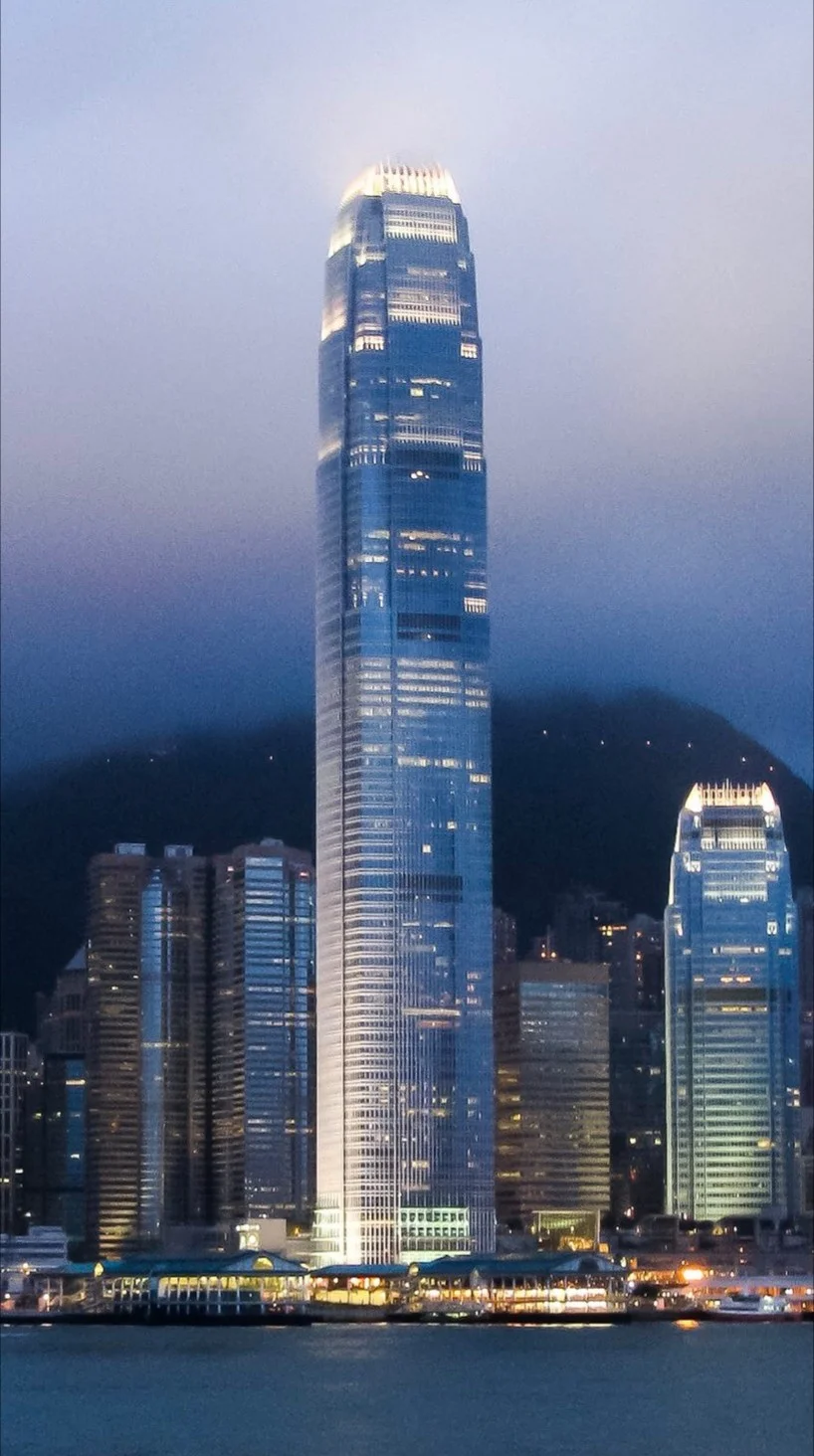
Batman jumped between them. In The Dark Knight, filmed partly in Hong Kong, the Caped Crusader leaps from 2 IFC to 1 IFC — a stunt that the filmmakers chose precisely because these two towers, rising above Victoria Harbour, project exactly the right combination of height, drama, and unmistakable urban identity. The International Finance Centre complex has that effect on people. It lodges in the eye. From the water, from the hills above Central, from Kowloon across the harbor, the towers are simply there, defining the skyline the way a few buildings in a few cities around the world manage to do.
Built Against the Current
Construction on 1 IFC began in the mid-1990s, when Hong Kong's economy was riding high on the last years of the colonial boom. By the time the tower opened in December 1998, the Asian financial crisis had crested and broken, wiping out fortunes and cooling property markets across the region. 1 IFC opened anyway, into a city that was absorbing a double shock: financial collapse and the uncertainty of the 1997 handover to China. The tower's 39 floors and 784,000 square feet filled with tenants including ING Bank and Sumitomo Mitsui Banking Corp. Its taller sibling, 2 IFC, was completed on 18 October 2003 — at the height of the SARS epidemic that had shuttered restaurants, emptied hotels, and put medical workers in intensive care wards across the city. Both towers were born into difficulty. Both filled up.
The Numbers
Two IFC stands 412 meters tall, making it the second-tallest building in Hong Kong. The entire IFC complex — both towers, the Four Seasons Hotel, and the IFC Mall — cost more than HK$50 billion to develop, including a record-setting HK$30 billion land premium. The Four Seasons alone is a 60-story, 206-meter oceanfront hotel with 399 guest suites and 519 serviced apartments. The IFC Mall covers 74,000 square meters across four floors, anchored by Lane Crawford and a cinema. It housed Hong Kong's first official Apple Store — a three-story flagship. In 2003, Financial Times, HSBC, and Cathay Pacific collaborated on an advertisement draped across more than 50 stories of 2 IFC's facade, covering 19,000 square meters — at the time the largest advertisement ever placed on a skyscraper.
The Address That Defines Finance
Despite a common practice allowing major tenants to rename the buildings they occupy, the owners of IFC declined every such offer. The towers keep their names. The tenant list at 2 IFC reads like a who's who of global finance: Blackstone Group, BNP Paribas, Citadel, UBS, Warburg Pincus, Silver Lake, Lazard, Nomura. The Hong Kong Monetary Authority occupies a prominent position in 2 IFC, anchoring the building's identity as the operational heart of Hong Kong's financial system. The address carries weight. Being at IFC is a statement about where a firm sees itself — a position on the harbor, above the city, at the center of Asian capital flows.
On Screen and In the Skyline
The IFC towers have appeared in multiple Hollywood productions, each time enlisted to stand for the same thing: maximum-stakes modernity. In Lara Croft: Tomb Raider — The Cradle of Life, the then-under-construction 2 IFC served as the backdrop for a leap from the building onto a ship far below in Kowloon Bay. Godzilla vs. Kong used the towers for an action sequence that required a skyline recognizable to global audiences. The films choose Hong Kong; they choose IFC. And from the opposite direction — from Kowloon on the Star Ferry, from the harbor promenade at night — the towers return the gaze. The light show that plays across the harbor at night, A Symphony of Lights, uses IFC as one of its primary canvases. The building is both private real estate and, at certain hours, a public spectacle.
From the Air
The IFC towers are located on the Central waterfront of Hong Kong Island at approximately 22.285°N, 114.159°E, directly on Victoria Harbour. They are among the most unmistakable landmarks visible from the air over Hong Kong. On approach to Hong Kong International Airport (VHHH) from the east, 2 IFC's 412-meter profile appears clearly above the skyline as the aircraft descends over the city. At 3,000–5,000 feet, both towers are visible in context with the full harbor, Kowloon Peninsula, and the surrounding hills. The Hong Kong-Zhuhai-Macau Bridge is visible to the west on clear days. Recommended viewing altitude: 2,000–4,000 feet on a clear day, approaching from the east over the harbor.
Nearby Stories
- Lok Ma Chau Loop 2.3 km away
- Portas do Cerco 2.3 km away
- Kweilin Incident 17 km away
- Wanshan Archipelago Campaign 34 km away
- Nanxiong Formation 115 km away
- Battle of Nanpeng Island 148 km away
- Heyuan 169 km away
- Cape Maobitou 632 km away