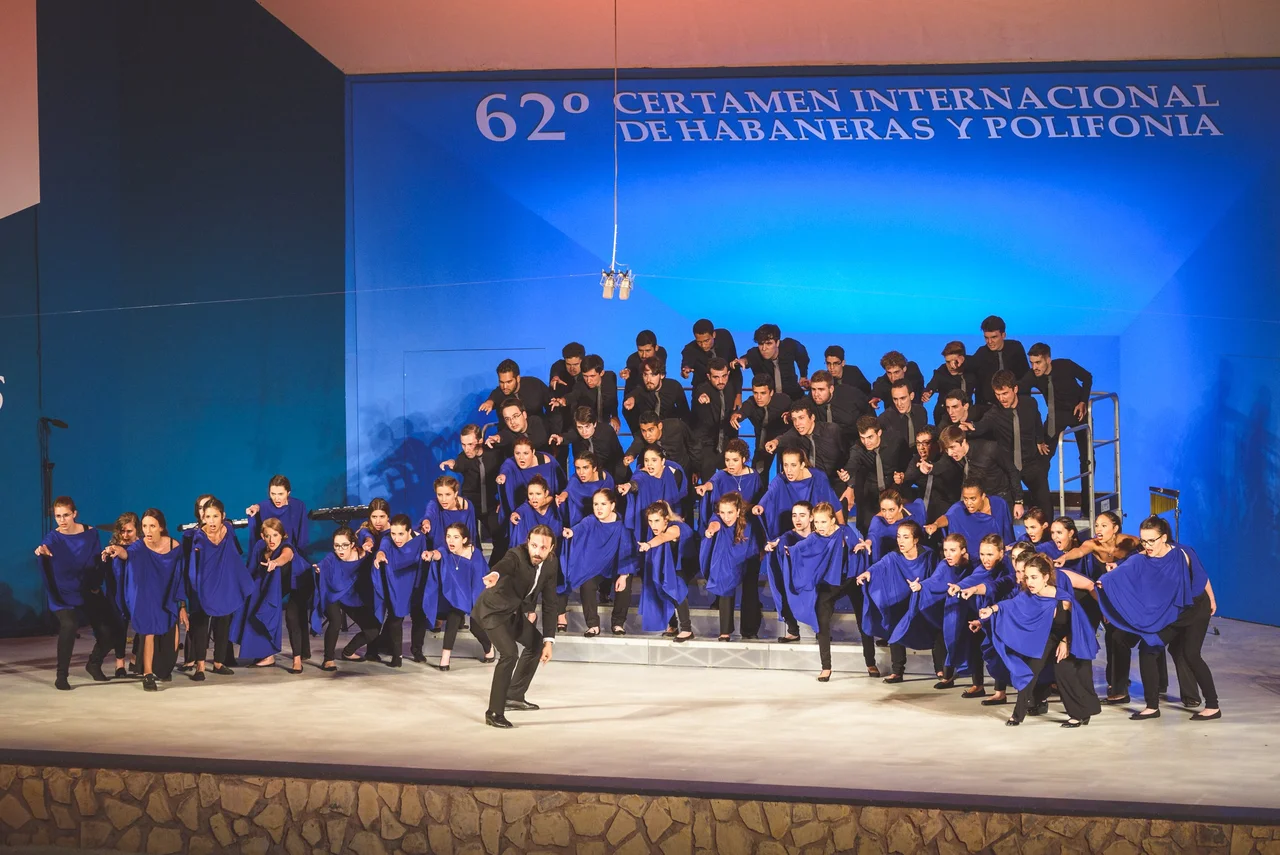

International Habaneras and Polyphony Contest of Torrevieja
The habanera is a Cuban song, born in Havana, named for the city itself. So why does the world's most celebrated habanera competition take place in a small salt town on the coast of Alicante, an ocean away from the Caribbean? The answer is written in salt. For generations, Torrevieja's sailors loaded their holds with salt harvested from the lagoons behind the town and carried it to Cuba, and when they came home they brought back the swaying, sea-rhythmed melodies they had heard in Havana's ports. What began as songs hummed on the docks has grown, since 1955, into the International Habaneras and Polyphony Contest, a week of choral music that draws voices from every continent.
A Song That Sailed Home
The habanera is a slow dance-song in duple time, a descendant of the contradanza that took shape in nineteenth-century Cuba and spread outward on the trade winds. Its gently rocking rhythm suggests exactly what carried it: the roll of a ship, the lap of harbor water. In the eighteenth and nineteenth centuries, commerce between Torrevieja and Cuba ran heavy and constant, salt going one way, sugar and rum and song coming the other. The sailors who made those crossings were not composers, but they were carriers. They memorized the tunes, brought them back to the taverns and quaysides of home, and planted a Caribbean music so firmly in this Mediterranean town that Torrevieja now claims the habanera as its own.
Singing on the Salt Grounds
The contest is staged where the salt itself once passed, at the Eras de la Sal, the old open-air grounds beside the harbor where salt was collected, weighed, and loaded onto ships from 1777 onward. Today the site is an open-air auditorium, its stage set almost at the water's edge, a monument to the salt workers standing nearby. On summer nights the choirs perform under the sky with the Mediterranean at their backs, the same sea the sailors crossed. Few concert halls can claim a setting so bound to the music performed inside it, where the venue, the town's fortune, and the song all trace back to the same white mineral drying in the lagoons.
One Week Every July
Held toward the end of July, the competition judges two things at once: the habaneras that give it its heart, and polyphony, the older art of many independent voices woven together. It started as a local affair in 1955 and steadily outgrew its origins, opening to choirs from around the world by 1990 and earning the honorary rank of Fiesta of International Tourist Interest in 1994. The winners come from everywhere. In 2023, the Kammerchor Manila, a choir from Quezon City in the Philippines, swept the board, taking first prize in both the habaneras and polyphony categories along with the overall and best-director awards. A Cuban song, sung in a Spanish salt town, mastered by singers from the Pacific.
Passing the Song Along
A tradition survives only if the young take it up, and Torrevieja plants that seed early. Since 1994, the town has also hosted the International Junior Contest of Habaneras each April, a stage set aside for children's and youth choirs before the grand summer gathering. Watching a hall of children learn to lean into the habanera's rolling rhythm, you see the whole strange journey compressed: a melody that crossed an ocean in the memory of homesick sailors, now handed down to voices that have never smelled the salt of Cuba, only the salt of home.
From the Air
Torrevieja sits at 37.978°N, 0.683°W on the southern Costa Blanca, roughly midway between Alicante and Murcia. From the air the town is unmistakable for the two vast salt lagoons at its back: Laguna Salada de Torrevieja, which often glows a striking pink from salt-loving microorganisms, and the greener Laguna de La Mata beside it. The Eras de la Sal auditorium lies on the seafront by the harbor. Recommended viewing altitude 3,000-6,000 ft AGL to frame the pink lagoon against the blue Mediterranean. Nearest airports are Alicante-Elche (LEAL), about 40 km north, and Región de Murcia International (LEMI), about 35 km southwest. Coastal haze can soften summer visibility; the lagoon color reads best under high midday sun.
Nearby Stories
- Murder of Miquel Grau 4.2 km away
- Fonda Milagros Nightclub Fire 8.8 km away
- Bajo de la Campana Phoenician Shipwreck 16 km away
- Battle of Helike 21 km away
- Mazarrón 31 km away
- Penyal d'Ifac Natural Park 36 km away
- La Muralla Roja 65 km away
- Battle of Mazagran 211 km away