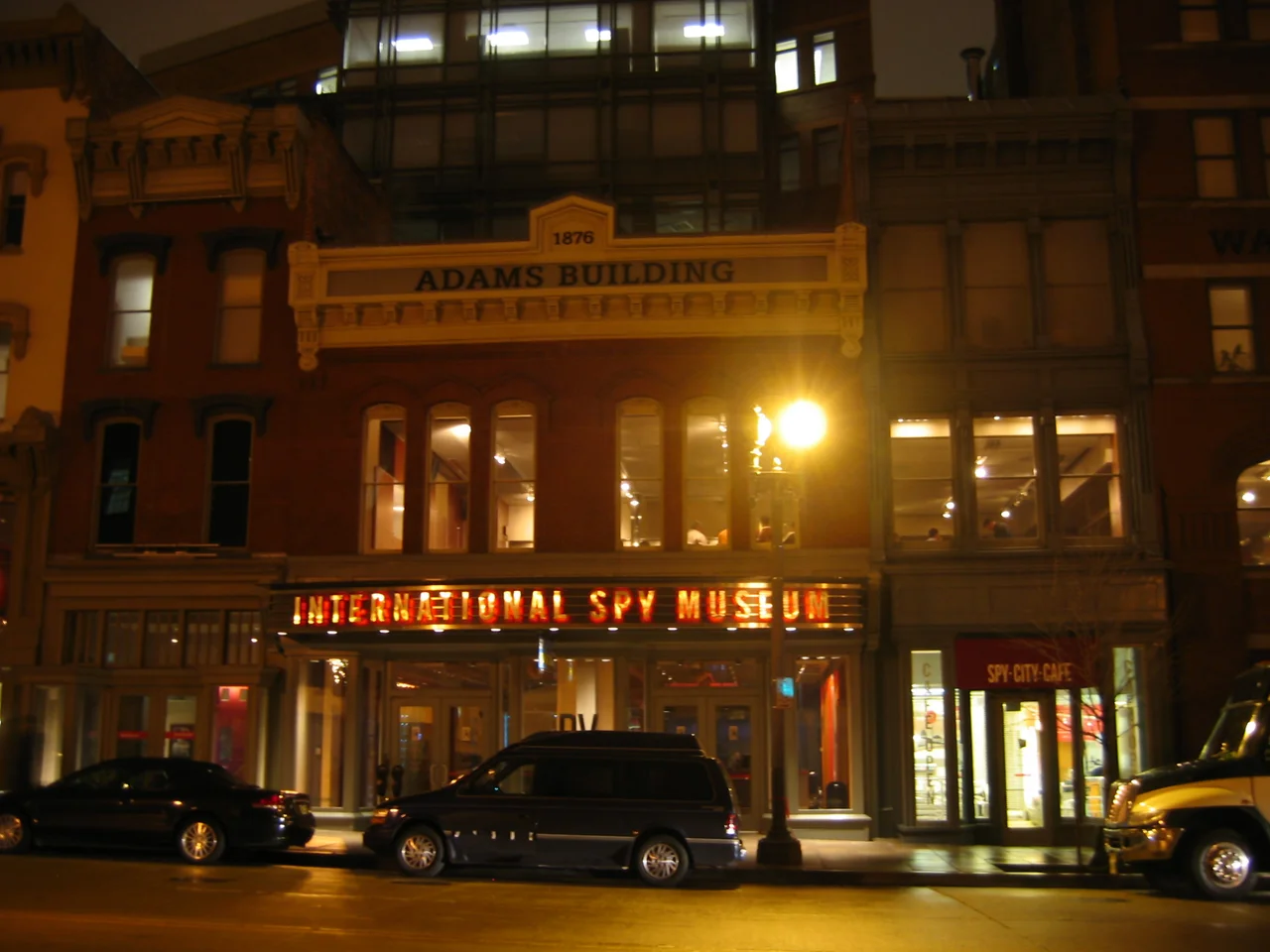

International Spy Museum
The U-2 came down in pieces. On May 1, 1960, the United States lost Francis Gary Powers and his reconnaissance plane over Sverdlovsk. The Soviets recovered the wreckage. The Cold War's most embarrassing moment for the United States happened seven days after a planned summit with Khrushchev, and the summit collapsed. Powers spent twenty-one months in a Soviet prison before being traded for KGB officer Rudolf Abel on the Glienicke Bridge in Berlin. Some of the actual wreckage of his U-2, recovered from Soviet archives after the end of the Cold War, now sits inside a glass case in the International Spy Museum at L'Enfant Plaza in Washington. So does the silver dollar he was given by the CIA. So does the suicide pin hidden in the coin, the device he chose not to use.
Milton Maltz's Idea
The International Spy Museum was the project of Milton Maltz, who had served as a Navy code-breaker during the Korean War and went on to found the Malrite Communications Group in 1956. Maltz pitched the idea of a museum devoted to the history of espionage in 1996, when no comparable institution existed anywhere in the world. The Central Intelligence Agency had a museum, but it was only open to cleared visitors at Langley. The KGB Museum in Moscow operated similarly. Maltz proposed something for the public, a museum that would treat espionage as a subject of historical study rather than an awkward truth governments preferred not to discuss. The original museum opened in 2002 in a building in the Penn Quarter neighborhood of Washington, half funded by Malrite and half by District of Columbia bonds. It was an immediate commercial success, drawing eight hundred thousand visitors a year.
The New Building
By 2015 the Penn Quarter location was too small for the growing collection and audience. The museum's board commissioned the British architectural firm Rogers Stirk Harbour and Partners (the firm of Richard Rogers, co-architect of the Pompidou Centre in Paris) to design a new building at L'Enfant Plaza, two blocks south of the National Mall. The new 140,000-square-foot building, finished in 2019, has a 145-seat theater, a rooftop terrace overlooking Washington, and a top-floor event space. The exterior is a glass and steel composition that contrasts visibly with the neoclassical federal buildings surrounding it. The museum converted to nonprofit status as part of the move. Admission is now charged, but the museum operates independently of any government and accepts no Smithsonian funding.
Seven Thousand Objects
The collection holds about seven thousand artifacts with roughly a thousand on display at any time. The story runs from the Bible's first recorded spies (Joshua's scouts in Jericho) through the Greek and Roman empires, the medieval period, Elizabethan England's Walsingham network, the American Revolution's Culper Ring, the Civil War, both World Wars, the Cold War, and the contemporary era. Featured objects include a four-rotor Japanese Enigma machine built by Germany for its Axis ally during World War II; the actual Bay of Pigs flag the 2506 Assault Brigade was meant to fly upon victory in 1961; a printing plate from Operation Bernhard, the Nazi counterfeit-British-banknotes plan; a KGB coat with a buttonhole camera; a 1949 Steineck ABC wristwatch camera that let an agent take photographs while pretending to check the time; and a Soviet-issued lipstick pistol that fires a single 4.5mm round, designed for female operatives in the 1960s.
Goldfinger's Aston Martin
The single most photographed object in the museum is the Aston Martin DB5 used in the 1964 film Goldfinger. The car, on permanent loan to the museum, was modified by Q Branch for the on-screen role with ejector seat, machine guns, oil slicks, and revolving license plates. The James Bond franchise gets a substantial gallery in the museum that treats it as a cultural artifact of espionage rather than just product placement. The cultural treatment is honest. The Bond films and novels shaped the public imagination of what intelligence work looked like more than any actual intelligence agency's recruitment effort ever did. The CIA has openly acknowledged that the post-1962 wave of applications to its officer training included people specifically inspired by the Bond films. The museum displays the original Ian Fleming typewriter, an Aston Martin DB5, and a Walther PPK.
Operation Gunnerside and Other Real Stories
Among the more solemn objects in the collection is a small vial of heavy water produced at Norway's Vemork hydroelectric plant during World War II. Heavy water is essential for the production of plutonium-based nuclear weapons, and the Vemork plant was the most productive heavy-water facility in Nazi-occupied Europe. In February 1943, nine Norwegian commandos (six parachuted in as the Gunnerside team, joining a three-man Swallow advance party) descended into the mountains above Vemork, skied across glaciers, descended into the gorge on ropes, infiltrated the plant, and destroyed the heavy-water cells with shaped charges. Every commando survived. Operation Gunnerside is considered one of the most successful sabotage operations in the history of espionage and arguably set back Nazi nuclear weapons research by months or longer. The vial in the museum case is heavy water actually produced at Vemork during the relevant period. It connects an everyday-looking liquid to a specific group of Norwegian skiers who probably saved the world from a Nazi atomic bomb.
From the Air
The International Spy Museum is at 38.8835 degrees north, 77.0246 degrees west, at 700 L'Enfant Plaza SW in southwest Washington. Best viewed at 1,500 to 2,500 feet AGL with the National Mall to the north and the Smithsonian Castle two blocks away. Reagan National (KDCA) is three nautical miles south. The site sits inside the P-56 prohibited area; viewing is from authorized riverside approaches.
Nearby Stories
- Gunston Hall 1.1 km away
- 2023 Baltimore Shooting 4.9 km away
- Battle of Middleburg 6.6 km away
- Crownsville Hospital Center 10 km away
- Battle of Loudoun Heights 13 km away
- First Battle of Rappahannock Station 20 km away
- Howard County, Maryland 21 km away
- Harriet Tubman Underground Railroad 50 km away