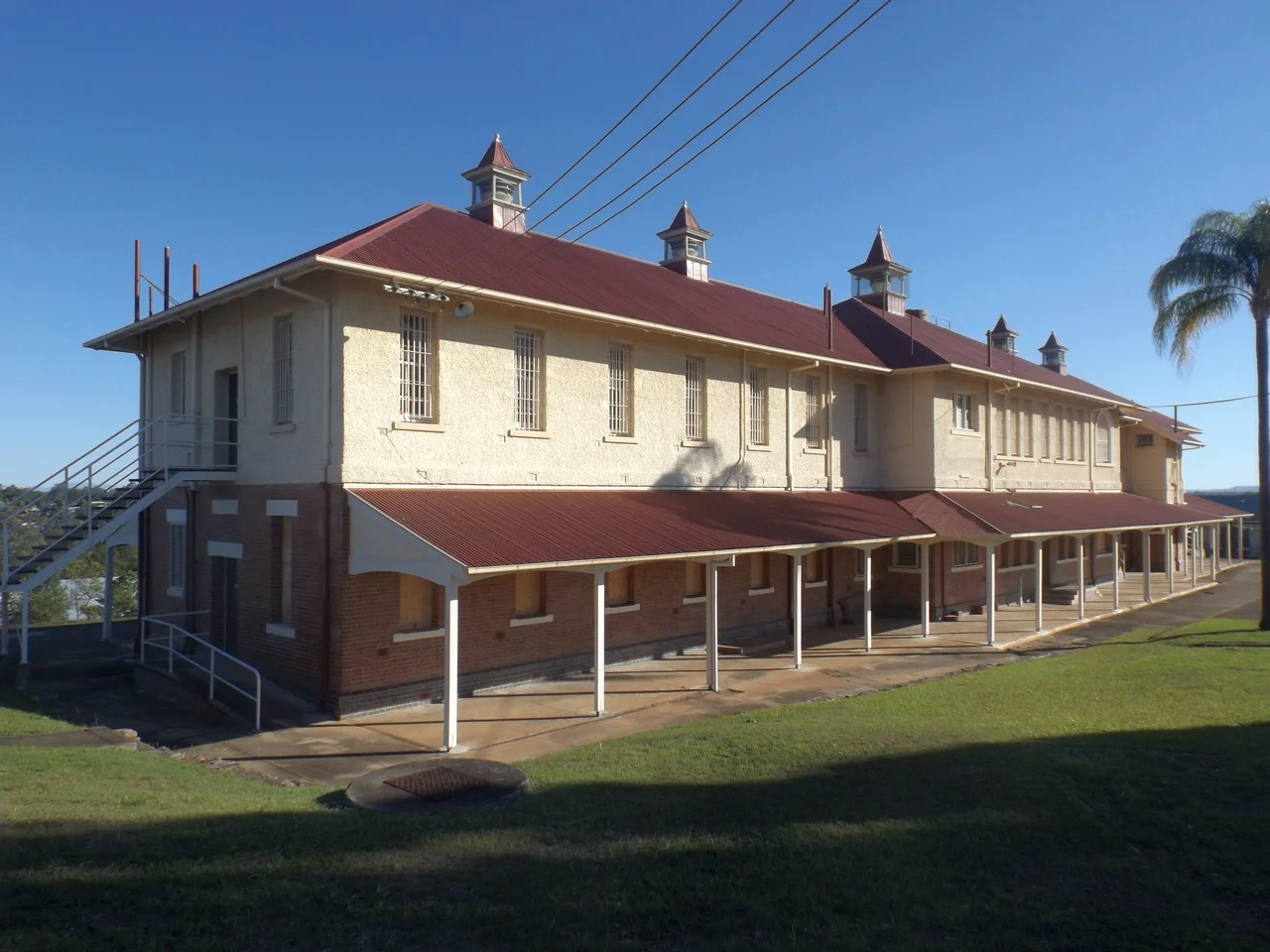

Ipswich Mental Hospital
In July 1878, fifty men were brought to a low timber pavilion on a ridge south of Ipswich and left there. They were the first of thousands. For the next hundred-odd years this hilltop - first called Sandy Gallop, later the Ipswich Mental Hospital, finally the Challinor Centre - would hold people the wider world preferred not to see. The architecture was designed to console them with views and gardens. The fences were sunk into the ground so the inmates could look out over the countryside and forget, for a moment, that they could not leave.
The Branch on the Hill
Sandy Gallop began in 1878 as an overflow ward, a branch of the larger Goodna asylum downriver, taking in mainly the chronic cases - the patients for whom Victorian medicine had run out of ideas. The first building was a single-storey structure of timber and masonry with three dormitories and two day rooms, set on 140 acres on the southern edge of town. It filled quickly. By the 1880s more than 100 people lived there; by 1920 the number had climbed toward 450. These were not abstractions on a register. They were Ipswich men and women, sons and daughters and parents, committed for conditions a later century would understand very differently - some genuinely unwell, others merely poor, elderly, or inconvenient to a society with few other places to put them. Once inside, most stayed for years, and a great many never left at all.
The Theory of Kindness
The hospital was built around an idea called 'moral treatment' - the then-progressive belief that pleasant surroundings could heal a troubled mind better than chains could. Of all Queensland's asylums, this was its most complete expression. Buildings were laid out on a radial grid following the ridgeline, each oriented outward to catch the best view of the surrounding hills. Light and fresh air drove the design; the handsome Blair Pavilion of 1908 hid its ventilation system inside elegant roof spires. And those sunken fences - ha-has, borrowed from English country estates - kept the boundary invisible from inside, so a patient gazing out saw only open country, not the wall that held them. It was confinement dressed as freedom, and the dressing was sincere.
The Children of Dagmar House
For most of its history the asylum made no distinction between mental illness and intellectual disability - both were simply filed under 'insane,' and children with disabilities were housed among adults with none of their needs in mind. That began, slowly, to change in 1933, when Queensland built its first purpose-made facility for such children here. Later named Dagmar House, it took in children with severe intellectual and physical disabilities, and from the mid-1930s the institution turned more and more toward caring for them. It was a genuine step forward for its time - and also the beginning of a long chapter in which Queensland's most vulnerable children grew up behind these walls, their stories only fully reckoned with decades later.
A Landmark, and an Ending
Through name after name - Ipswich Hospital for the Insane from 1910, Ipswich Mental Hospital from 1938, and Challinor Centre from 1968, the last honouring Dr Henry Challinor, a local doctor who left private practice for asylum work - the place loomed over the city, literally. It crowns one of the highest ridges in Ipswich; its great chimney and the bulk of Blair Pavilion break the southern skyline for miles, prominent on the horizon as you approach from the south. The Challinor Centre finally closed in 1998, ending more than a century of institutional life on the hill. The University of Queensland took the site as its Ipswich campus from that same year, and the buildings stand still - their grand vistas now looking out over a chapter of history Queensland is still learning to face honestly.
From the Air
The former Ipswich Mental Hospital, the Challinor Centre, sits at roughly 27.63 degrees south, 152.76 degrees east at 3 Parker Avenue, on one of the highest ridges in Ipswich, South East Queensland. From the air the campus is recognisable by its tall brick chimney and the bulk of Blair Pavilion breaking the southern skyline, set among mature trees and the open green of an adjoining golf course, with the Ipswich showgrounds nearby and the city centre and Bremer River to the north. Nearest major airport is Brisbane, YBBN, about 35 km northeast; RAAF Base Amberley, YAMB, lies roughly 10 km southwest - active military controlled airspace, so check NOTAMs and restrictions. Recommended viewing altitude 2,500 to 4,000 feet, clear of Amberley's zone. Clearest visibility in the dry winter months.
Nearby Stories
- 2010-2011 Queensland Floods 12 km away
- Surfers Paradise International Raceway 12 km away
- Brisbane Tramway Museum 18 km away
- Dreamworld 20 km away
- Glengallan Homestead 24 km away
- Moreton Island 31 km away
- Spicers Gap Road 37 km away
- Jondaryan Homestead 64 km away