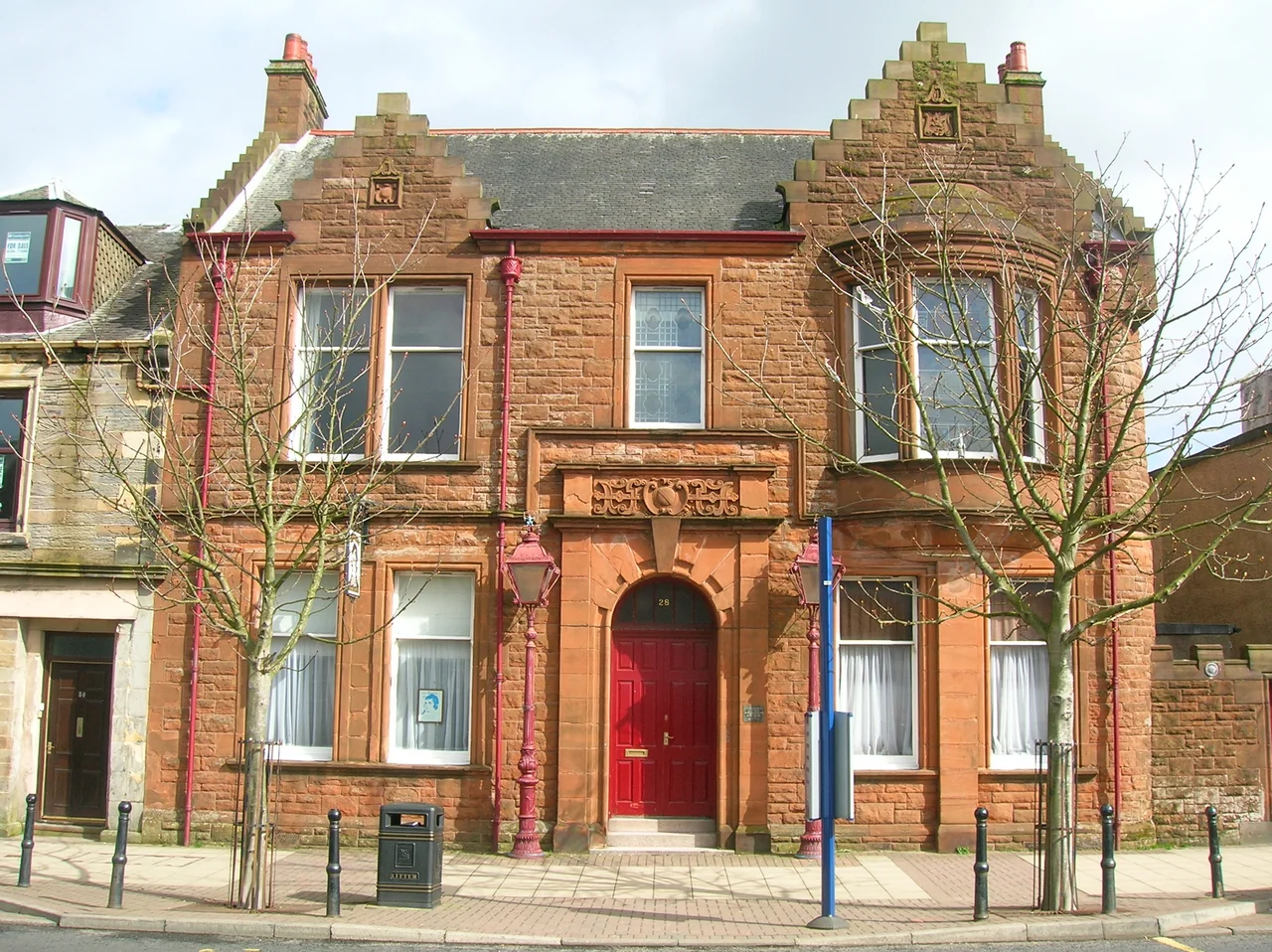

Irvine Burns Club
On 2 June 1826 - thirty years after Robert Burns's death - twelve men sat down in Milne's Inn in Irvine and agreed to form a society to commemorate the poet. Five of them had known Burns personally. Two had been close friends. The first president, Dr John Mackenzie, had attended Burns's dying father at Lochlea in 1784 and had married one of the famous "Mauchline Belles" before becoming personal physician to the Earl of Eglinton. The first vice-president, David Sillar, had been Burns's friend since their teenage years in Tarbolton. The minute they signed that day was modest. The institution they founded - now nearly two centuries old - holds six of the only known surviving manuscripts of the Kilmarnock Edition, the slim book that started everything.
Wellwood House
The club is no longer based at Milne's Inn - now the Crown Inn - but at Wellwood House on Eglinton Street, a sturdy Victorian villa with a story of its own. Alexander Paterson was a banker; his son John served on the Irvine Council from 1854 and was Provost from 1873 to 1878. John bought the previous house on this site in 1869. After his death the property passed to his widow Catherine, who in 1904 acquired the neighbouring lot and built the present house. The Paterson family bequeathed Wellwood to the Irvine Burns Club in 1955, subject to a life rent for their housekeeper Miss McLean. The club began using the ground floor in 1963 and became sole occupant in 1976. Today the building houses a museum, a Burns Room with unique murals, a large library, and a concert room. Admission is free; opening hours are regular. The councillor's chairs that John Mackenzie and David Sillar once sat in, donated in 1925 for the club's centenary, are still there.
Six Kilmarnock Manuscripts
The club's most precious possession is a set of six original folio manuscripts that Burns sent to John Wilson, printer of Kilmarnock, for the famous Kilmarnock Edition of *Poems, Chiefly in the Scottish Dialect*, published on 31 July 1786. The six are *The Twa Dogs*, *The Holy Fair*, *The Author's Earnest Cry and Prayer*, *The Address to the Deil*, *Scotch Drink*, and *The Cottar's Saturday Night* - seventeen folio sheets in all, seemingly the only surviving manuscripts from that landmark volume. The papers came down through a startlingly direct chain: from Burns to his friend Gavin Hamilton, lawyer in Mauchline and the poet's landlord at Mossgiel; from Hamilton to his relative Hamilton Robinson; from Robinson's widow to her second husband, the Burgher Kirk minister Alexander Campbell in Irvine; and in 1837 from Campbell to Patrick Blair, one of the club's founders. They are now inlaid in Dutch handmade paper, sealed between glass, and bound in six volumes of Levant Morocco leather. The club also owns one of two surviving sketches of Burns drawn from life by Alexander Nasmyth in 1786 at Roslin Castle, and two original letters from Burns to David Sillar written from Ellisland Farm in 1789 and 1790.
A Library of Two Thousand Books
The Wellwood library holds about 2,000 volumes covering Burns works and criticism, Burnsiana, Scottish history, Ayrshire history, the complete works of John Galt (a native of Irvine), the works of James Montgomery the hymn writer (also Irvine-born), and the works of Edgar Allan Poe, who attended school here briefly as a child. The local *Irvine Herald* records run back to 1870. The club has continued to receive acceptance letters from prominent admirers for nearly two centuries - from Winston Churchill, Margaret Thatcher, JM Barrie, Sir Alexander Fleming, Roger Bannister, Jack Nicklaus, Jackie Stewart, Bobby Lennox, Winnie Ewing, and each of the four First Ministers of the Scottish Parliament. Nineteenth-century literary giants like Dickens, Tennyson, Browning, Thackeray, and Longfellow also appear in the files, along with political figures including Disraeli, Garibaldi, and Balfour. In 1962 the Burns scholar John DeLancey Ferguson accepted an honorary membership. The library functions as both archive and active resource - school groups visit, researchers work the manuscripts, members give papers at monthly meetings.
Chairs, Cups, and Ceremonies
The club's collection includes the chair Burns used when visiting Templeton's bookshop in Irvine - donated in 2016 by the Gilroy family. Mrs Gilroy's account from 1930 said that Templeton's daughter, Mrs McGavin, had carefully kept the chair; when she died in 1881 it passed to her niece, and in 1909 the great-niece emigrated to Australia, taking the chair with her as a treasured family possession. "The chair that Burns always used to sit in," Mrs McGavin had told the Gilroy family, "and many a good laugh and joke he had in it." The annual Burns supper at Wellwood involves the ceremonial passing of two loving cups - one presented in 1869 by Sheffield citizens to mark the club's purchase of the birthplace of James Montgomery, the other a David Sillar family heirloom presented in 1964. The club meets monthly; the annual celebration and the wreath-laying at the Burns statue on Irvine Moor happen each January; Founders Day comes in June. Burns himself worked here in 1781 as a flax-dresser in a heckling shop near the Glasgow Vennel. The club exists because he was here once, and because the people who knew him refused to let the memory slide into legend without a fight.
From the Air
Coordinates 55.6175°N, 4.6687°W. The Irvine Burns Club at Wellwood House sits on Eglinton Street in the centre of Irvine, North Ayrshire - a former Royal Burgh on the Firth of Clyde. Recommended viewing altitude 1,500 to 2,500 feet AGL to take in the town centre, the River Irvine, and the harbour to the west. Nearest ICAO airports: Glasgow Prestwick (EGPK) about 8 nm south, Glasgow International (EGPF) about 22 nm north-east. Watch for typical Ayrshire weather - low cloud and rain showers can blow in quickly off the Firth of Clyde.
Nearby Stories
- Battle of Drumclog 2.2 km away
- Culzean Castle 3.3 km away
- Greenock 5.9 km away
- Lochranza 7.9 km away
- Battle of Kilsyth 16 km away
- Loch Fyne 19 km away
- Dunaverty Castle 25 km away
- Moniaive 27 km away