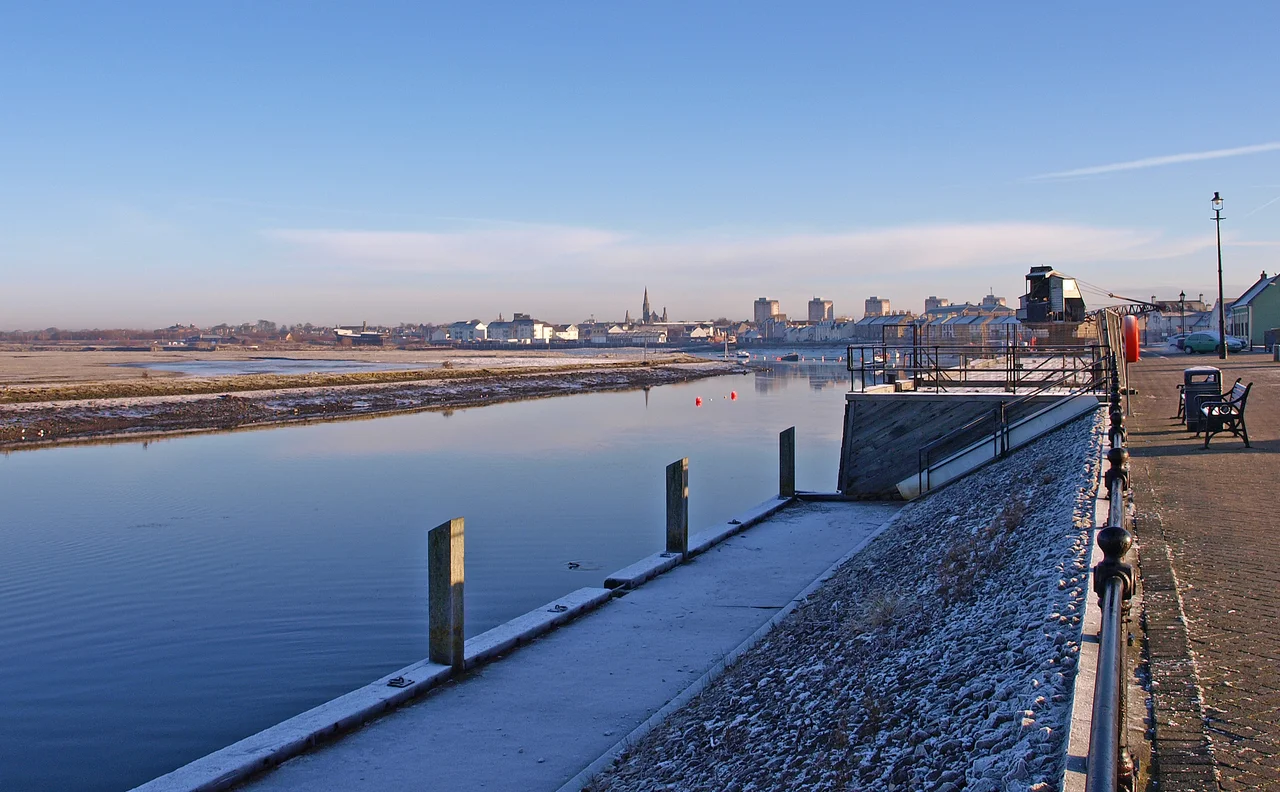

Irvine, North Ayrshire
Part of modern Irvine sits on top of Dreghorn, which may be the oldest continuously inhabited village in Europe. Archaeologists keep finding things here - flint chips, postholes, traces of habitation dating back to the first incursions of Mesolithic humans into Scotland. So when planners in 1966 designated Irvine as Scotland's fifth and final New Town, they were not exactly starting fresh. The town had been a Royal Burgh since 1372. The medieval parish had been a military headquarters and one of the earliest capitals of Scotland. The history runs deep enough that one local writer, A. J. Morton, has even argued that Irvine might be the legendary Evonium where the Stone of Destiny was kept before its move to Scone. New towns, in Scotland, are rarely as new as the planners would like them to be.
A Lost Medieval Capital
Irvine was the seat of the Military Headquarters of the Lord High Constable of Scotland - that is, Hugh de Morville, in the twelfth century - and at the time of David I, Robert II, and Robert III, it served as one of the earliest capitals of the Scottish kingdom. The town was granted its first Burgh Charter around 1249, entitling it to organise its own affairs. In 1296 the Scottish army was encamped at Knadgerhill outside Irvine when an English force arrived to engage them - but dissension among the Scottish leaders was so severe that no battle took place, and many of the Scots ended up changing sides and joining King Edward I. The Capitulation of Irvine became one of the low points of the early Wars of Independence; William Wallace himself, who knew this country well and was said to have fished in the River Irvine, may have been present. In 1372 a Royal Charter from Robert II settled a dispute with Ayr in Irvine's favour, confirming Royal Burgh status. The town has been a Royal Burgh, on paper or in spirit, ever since.
Burns and the Heckling Shop
In 1781, a 22-year-old farmer's son named Robert Burns came to Irvine to learn flax-dressing - the trade of preparing flax fibres for spinning into linen, done in a workshop called a heckling shop. He worked there for nine months, lodging in the Glasgow Vennel, using a bookshop in the town, and falling in with men who would urge him to publish his poetry. The episode did not end well. The shop caught fire. Burns wrote a letter to his father that was so depressed in tone that William Burnes travelled from Lochlie Farm in Tarbolton to check on him. But Irvine left its mark. Forty-five years later, in 1826, twelve men met at Milne's Inn to found the Irvine Burns Club - five of them personal friends of the poet. The club is one of the oldest continuously active Burns societies in the world, and Wellwood House on Eglinton Street now holds six of the only known surviving manuscripts of the Kilmarnock Edition - the slim 1786 volume that launched Burns into Scottish literary history.
Scotland's Last New Town
On a November day in 1966, Irvine was officially designated the fifth and final Scottish new town. The earlier four - East Kilbride, Glenrothes, Cumbernauld, Livingston - had been mostly newly built or grown from small villages. Irvine was different: an established Royal Burgh of more than thirty thousand people. The Irvine Development Corporation took over planning powers from the Royal Burgh Town Council, Kilwinning Town Council, and the Irvine Landward District Council. Much of the old town was redeveloped - sometimes controversially. The Magnum Leisure Centre, opened in 1976 at a cost of £3.2 million, was the largest leisure centre in Europe at completion; an estimated 25,000 people came to the opening, and it became one of Scotland's most popular leisure venues until it closed in 2016. The new town designation officially ended on 31 December 1996, returning full planning control to the local authority. The Irvine Bay Regeneration Company picked up some of the work from 2006, and the Bridgegate renovation project was completed in 2017.
Harbour, Marymass, and the Granny Stane
Irvine's harbour was once one of Scotland's most prominent ports after Glasgow. The Ayrshire Dockyard Company built ships here until just before the Second World War, and afterward refitted vessels and made fittings for liners including the QE2. ICI's Nobel Explosives plant had its own quay on the River Garnock. Most of that industry is gone now, but the Scottish Maritime Museum keeps the *Spartan*, one of the last surviving Clyde puffers, on display at the inner harbour. The harbour's distinctive 1906 tide-signalling tower, devised by harbourmaster Martin Boyd, used a daytime ball-and-pulley system and night-time lamps to mark the tidal level. The Granny Stane, a single boulder in the River Irvine, is either glacial debris or the last remaining stone of a vanished stone circle, saved from blasting in 1895 by popular protest. The town keeps Marymass, an August festival named for Mary Queen of Scots, who is said to have slept at Eglinton Castle and possibly at Seagate Castle in Irvine on her journey south. A stone inscribed MQ 1560, possibly commemorating the visit, has been found in the town. Burns, Wallace, Mary - the names attach themselves to Irvine, and refuse to let go.
People of Irvine
Nicola Sturgeon, the former First Minister of Scotland, was born in Irvine. So was Jack McConnell, an earlier First Minister. Edgar Allan Poe attended the Old Grammar School here briefly in 1815-16, his only Scottish childhood interlude. Simon Neil, lead singer of Biffy Clyro, was born in Irvine. Roddy Woomble of Idlewild was born here. Eddi Reader lived briefly in the town when her family relocated in 1976. The painter George Henry of the Glasgow School came from here. So did the twin sisters Agnes and Margaret Smith, born in 1843, who discovered the Sinaitic palimpsest - one of the earliest biblical manuscripts - in 1892. Ross Tollerton won the Victoria Cross at the First Battle of the Aisne in 1914. Footballer Billy Gilmour, born in 2001, plays for Napoli and Scotland. The list goes on - judges, writers, athletes, ministers. For a town that was officially "new" in 1966, Irvine has been producing remarkable people for a very long time.
From the Air
Coordinates 55.61°N, 4.67°W (approximate town centre). Irvine sits on the Firth of Clyde coast in North Ayrshire, about 25 miles south-west of Glasgow, with the River Irvine and Annick Water flowing through. Recommended viewing altitude 2,500 to 4,000 feet AGL to take in the town, the harbour and Scottish Maritime Museum at the river mouth, Eglinton Country Park to the north, and the line of the Firth of Clyde stretching west toward Arran. Nearest ICAO airports: Glasgow Prestwick (EGPK) about 7 nm to the south - so watch the Prestwick traffic pattern - and Glasgow International (EGPF) about 22 nm north-east. The Ayrshire coast is exposed to Atlantic weather, with rapidly changing cloud and rain conditions common throughout the year.
Nearby Stories
- Battle of Drumclog 2.2 km away
- Culzean Castle 3.3 km away
- Greenock 5.9 km away
- Lochranza 7.9 km away
- Battle of Kilsyth 16 km away
- Loch Fyne 19 km away
- Dunaverty Castle 25 km away
- Moniaive 27 km away