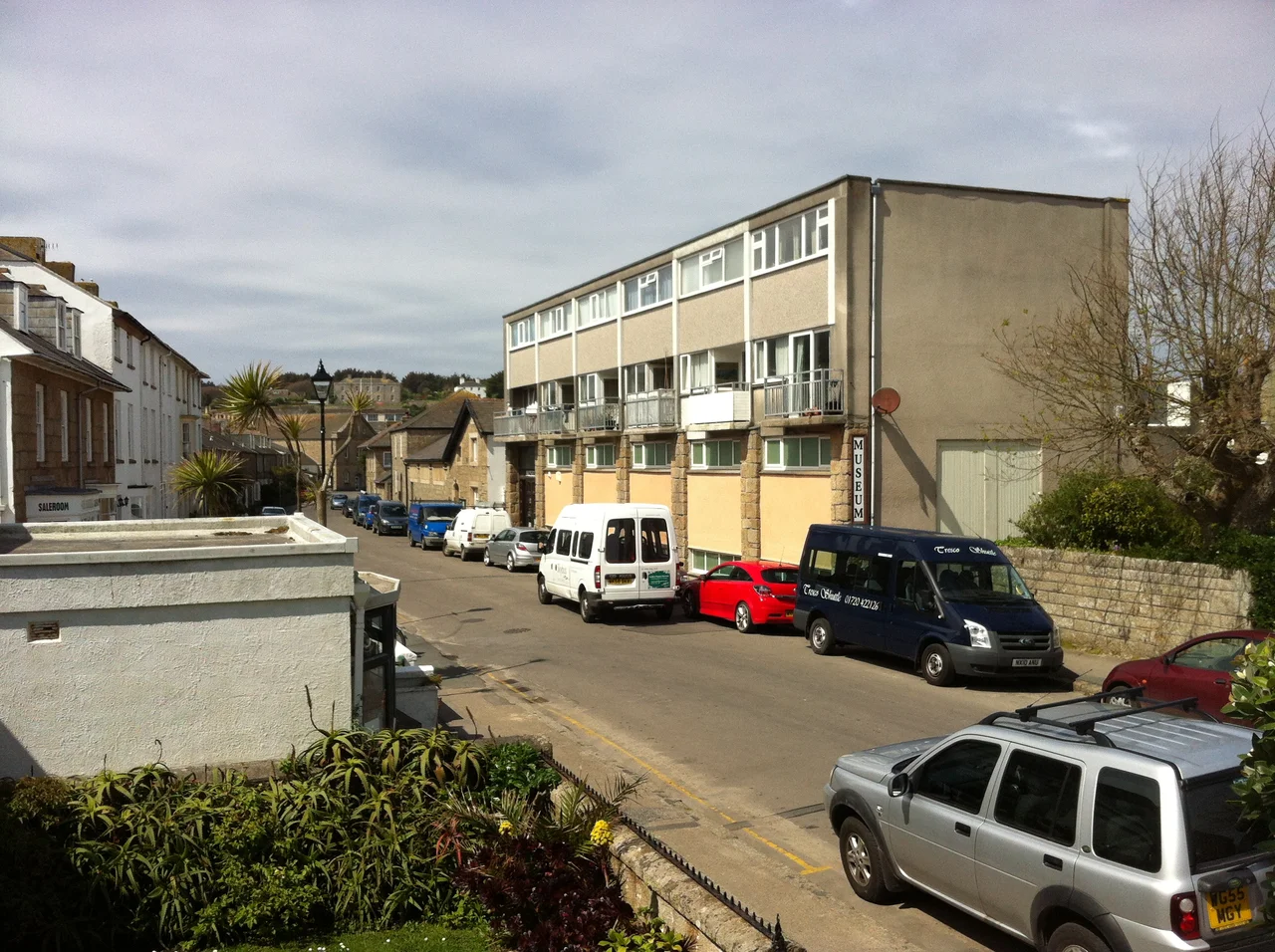

Isles of Scilly Museum
Atlantic storms made this museum. In 1962, heavy weather scoured the tiny uninhabited island of Nornour, on the eastern fringe of the Isles of Scilly, and washed out a collection of Romano-British artefacts that had lain undisturbed for some 1,800 years. A group of islanders, suddenly custodians of a small archaeological treasure, decided the finds needed somewhere to live. They opened a seasonal display in the Wesleyan Chapel in Hugh Town. By 1967 they had raised the money for a purpose-built museum on Church Street, with residential flats above. Queen Elizabeth II visited it on 8 August 1967, just three weeks after opening. The museum lasted on that site for half a century. Then, in 2019, the ceiling was condemned.
What the Storms Brought
Nornour is barely an island, a few hectares of granite rising out of the Eastern Isles. Yet the storms of 1962 exposed what is now understood to be a Romano-British shrine site, dense with brooches, coins, and votive figurines. The finds suggested that sailors and traders working the seas off Cornwall had been making offerings here for centuries, perhaps to placate the gods of these dangerous waters. The collection grew over the decades. The museum eventually acquired the Bryher Sword and Bryher Mirror, recovered from an Iron Age grave on the island of Bryher in 1999, an extraordinary pairing of weaponry and reflection that has divided archaeologists ever since: was the person buried with the sword a warrior, a woman, both, or someone whose identity refuses our easy modern categories?
A Diverse and Stubborn Collection
The museum has always described its holdings as extremely diverse. Material from many wrecks. A wildflower display in summer. Romano-British finds. Stuffed birds. Local art and much more. This is a profoundly Scillonian list, the kind of inventory you only assemble when you live on a small archipelago where everything that washes up, falls down, or grows where it shouldn't ends up in someone's collection. Run by the Isles of Scilly Museum Association, a registered charity, the institution has always operated on volunteer hours and grant money. The displays mixed the prehistoric with the lately deceased. A glass case of seabird specimens shared rooms with sword pommels and pottery shards from islets you cannot reach without a boat.
The Day the Ceiling Failed
In June 2019 the Council of the Isles of Scilly announced that an engineer had inspected the Church Street building and warned that the ceiling posed a risk to staff and visitors. The museum closed. By September, the council had decided the building was beyond practical and economic repair and would be demolished. The collection had to leave. Volunteers and curators moved the entire holdings into temporary storage, splitting between the 1889 Town Hall up on The Parade and the Porthmellon Enterprise Centre. The museum's curator Kate Hale told The Guardian in 2021 about the strange new existence of a museum without a building, taking the collection on the move, doing pop-up exhibits and online programmes.
A Town Hall Reborn
The plan now is to reopen the museum permanently inside the 1889 Town Hall, a Grade II listed neoclassical building of squared granite that sits on The Parade in the middle of Hugh Town. In December 2022, the National Lottery Heritage Fund made an initial grant towards developing the plans. In 2024 a further 4.6 million pound grant followed, enough to fund the major renovation. The renamed Isles of Scilly Cultural Centre and Museum is scheduled to have its full fit-out complete and the building fully open by spring 2026. The old council chamber, the parade ground floor, the stage that was condemned in 2017, all of it is being woven into a new home for the same diverse collection.
Why a Museum Matters Here
The Isles of Scilly carry an unusually deep archaeological record for an archipelago of their size. There are more Bronze Age entrance graves on these few square kilometres than anywhere else in the world. The seabed around the islands holds wreck after wreck, from the 1707 fleet of Cloudesley Shovell to the 1997 MV Cita. Every storm rearranges the evidence. Without a place to hold it, this material would scatter, get carried off by collectors, end up in mainland museums where the context is lost. The new Cultural Centre is an act of refusal: a small island community claiming the right to keep its own history at home, in a granite hall on a sandy isthmus, fewer than a thousand metres from where most of the artefacts came ashore.
Flight Context
Coordinates: 49.9147°N, 6.3154°W. The future museum occupies the Isles of Scilly Town Hall on The Parade, the small park at the centre of the Hugh Town isthmus. From the air at 2,000 feet, look for the slate-roofed civic block facing onto a green square between Town Beach to the north and Porthcressa to the south. St Mary's Airport (EGHE) sits one mile east. The museum is walking distance from the harbour quay, the parish church, and the lifeboat station.
From the Air
Coordinates: 49.9147°N, 6.3154°W. The future museum occupies the Isles of Scilly Town Hall on The Parade, the small park at the centre of the Hugh Town isthmus. From the air at 2,000 feet, look for the slate-roofed civic block facing onto a green square between Town Beach to the north and Porthcressa to the south. St Mary's Airport (EGHE) sits one mile east. The museum is walking distance from the harbour quay, the parish church, and the lifeboat station.
Nearby Stories
- Penlee Lifeboat Station 5.5 km away
- Black Swan Project 20 km away
- Tater Du Lighthouse 25 km away
- The Brisons 31 km away
- 1979 Fastnet Race 54 km away
- SM U-27 110 km away
- HMS Affray 149 km away
- Tower of Hercules 700 km away