
Penlee Lifeboat Station
By eight in the evening on Saturday 19 December 1981, the Solomon Browne was already in seas larger than her crew had ever seen. The wind was gusting at 90 knots - Force 12, off the top of the Beaufort scale - and rolling waves 60 feet high through Mount's Bay. The coaster MV Union Star had lost engine power eight miles east of Wolf Rock, drifting helpless towards the cliffs with a crew of five and three of the captain's family aboard. A helicopter from RNAS Culdrose had tried to lift them off and failed; the masts of the Union Star were whipping too wildly. So the Penlee lifeboat - 47 feet, wooden hull, eight volunteer crewmen - launched into the storm to do what only a lifeboat could do, which was come alongside and let people jump. At 9:21 pm the lifeboat radioed Falmouth Coastguard: "We've got four off." That was the last anyone heard from any of the sixteen people involved.
Before the Modern Station
The first lifeboat in Cornwall was bought for Penzance in 1803 but lay unused and was sold in 1812. A permanent lifeboat returned to Penzance in 1853 under the new Royal National Lifeboat Institution, and in 1908 the boat - the Watson-class Elizabeth and Blanche - was moved across Mount's Bay to Newlyn for better launching. By 1913 a purpose-built boathouse had been constructed at Penlee Point, between Newlyn and Mousehole on a cliff-edge slot just above the water. The slipway there could launch the boat at any state of tide, and the boathouse was set into the rock face below the coast road. Successive lifeboats served from this small white building on the cliff for sixty-eight years. The old "pulling and sailing" boats gave way to motor lifeboats in 1922, and Penlee built a quiet reputation for service in some of the most exposed waters around the British coast.
Trevelyan Richards and His Crew
The coxswain on 19 December 1981 was Trevelyan Richards, 56, a Mousehole man, second-generation lifeboatman. The seven who launched with him: Second Coxswain Stephen Madron, 35; Assistant Mechanic Nigel Brockman, 43; Emergency Mechanic John Blewett, 43; and crewmen Charles Greenhaugh (46, landlord of the Ship Inn at Mousehole), Kevin Smith (23), Barrie Torrie (33) and Gary Wallis (22). When the launch was called at 8:15 pm, more men volunteered than there were places aboard. Richards refused to take two from the same family. The Solomon Browne cleared the slipway around 8:18 pm in seas that would have broken any other small vessel just leaving harbour. By 8:53 pm she was alongside the Union Star, attempting to come close enough for jumps. Over the next half hour, in conditions described by other rescuers as the worst they had ever seen, the lifeboat made repeated approaches. Four people did get across. Then both vessels were lost. The Union Star was found capsized on the rocks west of Tater Du Lighthouse next morning. Wreckage of the Solomon Browne came ashore along the cliffs. Eight of the sixteen bodies were eventually recovered. Eight were not.
The Day After
Within twenty-four hours of the disaster, enough men from Mousehole had volunteered to form a new lifeboat crew. Some were widowers of the night before. Some were brothers and sons of the lost. They served the station continuously through the days of national mourning and the funerals that followed. Coxswain Richards was posthumously awarded the RNLI gold medal - the institution's highest decoration, given only for outstanding bravery, and the only gold medal the RNLI has ever awarded posthumously. The other seven crewmen each received a posthumous bronze medal, and the station itself was awarded a gold service plaque. The lights at Mousehole Christmas illuminations, switched on every December along the harbour, were turned off the night of the disaster and have been switched off again every 19 December since.
The Move to Newlyn
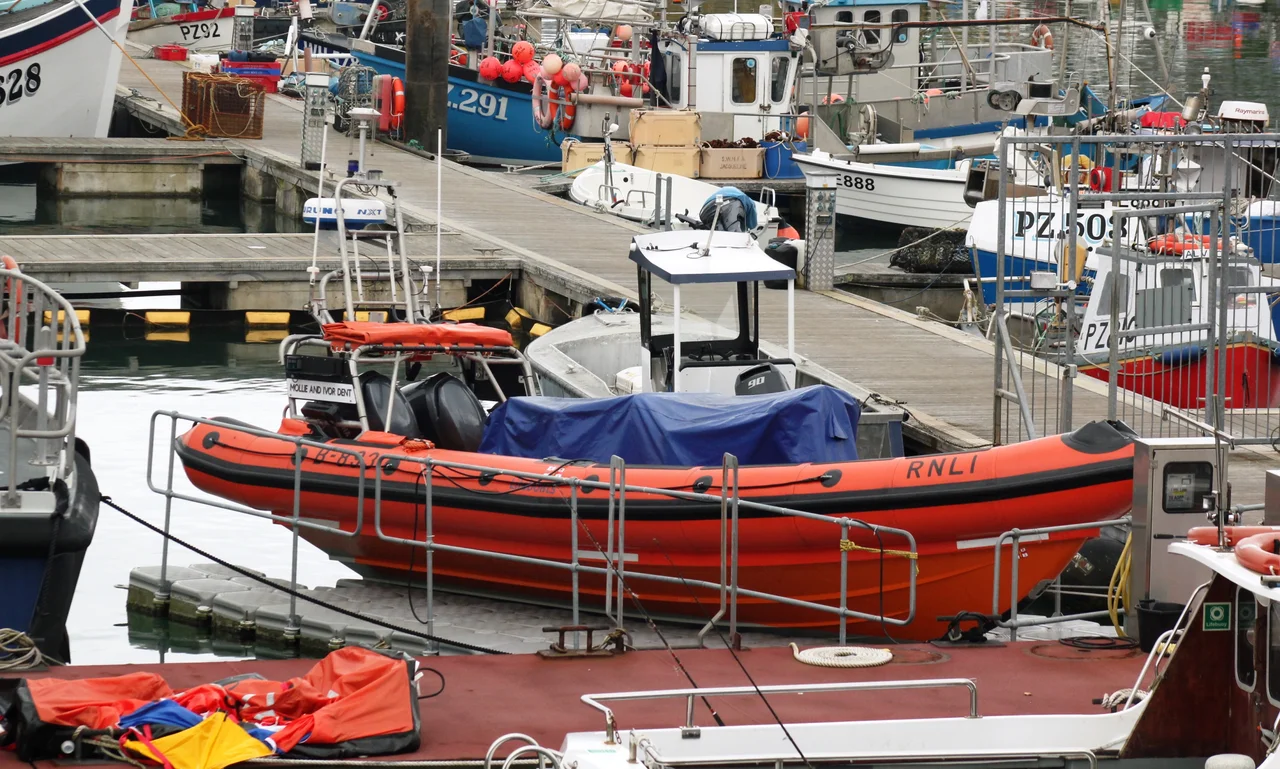
After 1981 the Penlee Point station remained in use for another two years while the RNLI planned its successor. In 1983 a new, larger, faster all-weather lifeboat called Mabel Alice was acquired, and a fresh station was built on the harbourside at Newlyn. The lifeboat there is kept afloat at a mooring rather than on a slipway, with crews boarding from a pontoon, which gives faster launching for the bigger modern boats. Despite the relocation, the station kept the Penlee name. The original Penlee Point boathouse has been preserved by the RNLI as a quiet memorial, with a small garden cut into the cliff on its north side. In 2023 the boathouse, slipway, garden and walls were collectively designated a Grade II listed building, the listing explicitly citing the association with the Solomon Browne. A new Newlyn station opened in 2019, replacing the 1983 building with modern facilities.
Other Services, Other Lives
The Penlee disaster overshadows everything, but the station's nearly two centuries of service include hundreds of other rescues. In April 1947, the lifeboat W and S put out into 30-foot seas to recover the crew of a vessel that had run aground after retirement at the end of the war; Coxswain Edwin Madron received the RNLI silver medal for that service, and was honoured a decade later on the BBC programme This Is Your Life. In January 1975, six years before the disaster, Trevelyan Richards himself had taken the Solomon Browne out into a Force 12 hurricane to search for the crew of the MV Lovat, drifting at 60 degrees of roll for nearly eight hours. He was awarded a bronze medal for that service. The Solomon Browne and the men of Mousehole had been doing this work for years before it became famous in a single night. Penlee continues today with the all-weather Severn-class lifeboat Ivan Ellen, in service since 2003, and an inshore B-class boat for closer work in Mount's Bay.
Mousehole in December
Visit Mousehole on any winter evening and the harbour Christmas lights are reflected in the water - lobster pots strung with bulbs, an angel hung from the breakwater, a Bible quoted in coloured lamps on the village hall. They run from early December into early January. They are switched off only on the night of 19 December, between 7 and 8 pm, in memory. The Penlee village hall and the Solomon Browne memorial garden at Penlee Point are both small places, not built for the volume of grief they carry. The lifeboat station at Newlyn is bigger, busier, the modern face of an institution founded in 1824 and run almost entirely on charitable donations. Eight men launched. Eight did not come home. The community absorbed the loss, formed a new crew the next day, and kept the boat going. Of all the things to know about Cornwall, this is among the most important.
From the Air
The original Penlee Point boathouse stands at 50.080 N, 5.541 W on the cliffs between Newlyn and Mousehole - now preserved as a listed memorial. The active lifeboat station moved in 1983 to Newlyn harbour at 50.104 N, 5.549 W. Best viewed at low altitude from over Mount's Bay; both sites are visible from the South West Coast Path. Land's End (EGHC) is 7 nm west-south-west. The memorial garden at Penlee Point is accessible by foot from the coast road. Approach respectfully, especially in mid to late December.
Nearby Stories
- Wadebridge 8.1 km away
- Caerhays Castle 8.1 km away
- Sevenstones Lightship 16 km away
- Battle off Lizard Point 20 km away
- MV Cita 22 km away
- Carnewas and Bedruthan Steps 30 km away
- 1979 Fastnet Race 71 km away
- HMS Affray 108 km away