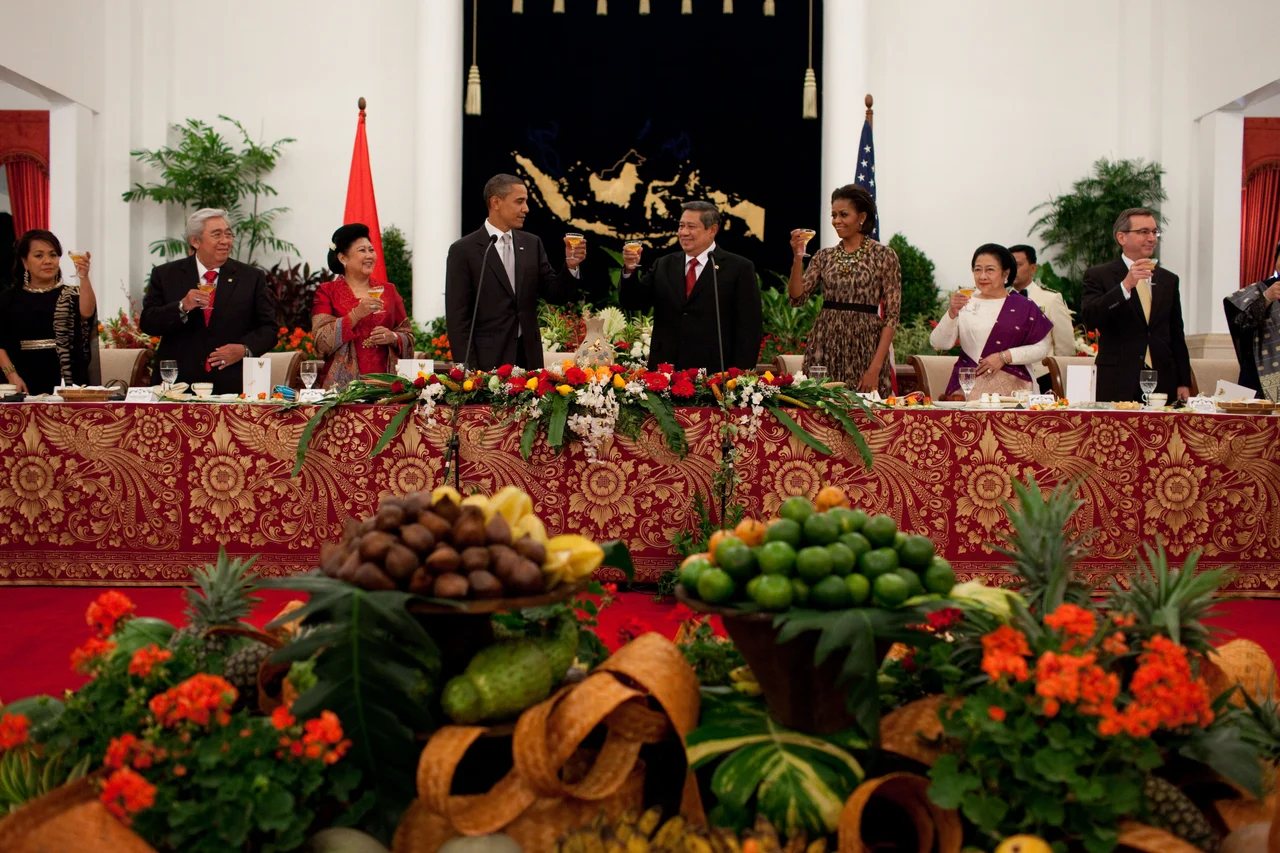

Istana Negara (Jakarta)
Jacob Andries van Braam built the house for himself. The Dutchman who would hold high colonial office between 1810 and 1819 began construction in 1796 on one of the most fashionable streets in Batavia's Bovenstad -- the uptown district where European wealth concentrated behind garden walls and columned porticos. He chose the Indies Empire style, the tropical adaptation of European neoclassicism that defined power architecture in the Dutch East Indies: high ceilings, deep verandas, whitewashed symmetry designed to project order in an equatorial climate. When the house was finally completed in 1804, Van Braam could not have known that he was building for everyone who would come after him -- British commissioners, Dutch governors-general, Japanese military commanders, and Indonesian presidents. The building at Veteran Street in Central Jakarta has changed names and masters repeatedly, but it has never stopped functioning as the seat of authority.
A House That Changed Hands
The building's first transfer set the pattern. When Britain took control of the Dutch East Indies during the Napoleonic upheaval, Van Braam's elegant residence was handed to Hugh Hope, the British commissioner. Van Braam himself was relegated to a smaller wing on the southern side, where he lived until his death. In 1821, the Dutch government acquired the property and designated it the official residence of the governor-general during stays in Batavia. It was formally christened the Hotel van den Gouverneur-Generaal -- the word 'hotel' carrying its older meaning of grand official residence. Godert van der Capellen became the first governor-general to officially occupy it in 1820, though many of his successors preferred the cooler highlands of Bogor, where the Paleis te Buitenzorg offered relief from Batavia's punishing humidity. The Jakarta palace was necessary rather than beloved -- the place where ceremony required presence.
Reshaping Authority
In 1848, the building underwent a transformation that said as much about politics as architecture. The second floor was removed entirely, and the ground-floor rooms facing Koningsplein -- the great square that would later become Merdeka Square -- were redesigned to be more open to the exterior. The effect was to make the palace more visible, more accessible to view, more consciously a symbol rather than merely a dwelling. By the 1860s, administrative needs had outgrown even this expanded structure. A new palace was planned in 1869 and completed in 1873, facing the square directly. Known first as Koningsplein Palace and later as Istana Merdeka -- the Freedom Palace -- this companion building created the presidential compound that exists today. Iron fencing went up around the perimeter in 1875, and additional houses were constructed for palace officials. Two buildings, one compound, one continuously functioning center of power.
Capitulation and Independence
The palace's most dramatic moments arrived in quick succession. On 8 March 1942, Governor-General Tjarda van Starkenborgh signed the Dutch capitulation to the Japanese army inside Istana Negara, ending three and a half centuries of European colonial rule in the archipelago. Under the Japanese occupation, the palace became the residence of the Saiko Shikikan, the supreme army commander. When Japan surrendered in 1945, the lion emblem of the Netherlands was pried from the front facade -- a small, physical act of decolonization. The building then witnessed the ratification of the Linggadjati Agreement on 25 March 1947, an early attempt at diplomatic resolution between the new Republic and the Dutch, and on 27 December 1949, it hosted the ceremony recognizing Indonesian sovereignty. Each event left no architectural mark, but the walls absorbed them all.
Ceremony Behind Closed Doors
Today Istana Negara functions as the ceremonial heart of the Indonesian presidency. The compound covers 68,000 square meters and includes Bina Graha, formerly the president's working office; Wisma Negara, the state guesthouse on the western side; and the offices of the Ministry of State Secretariat. The palace itself contains two principal audience halls connected by a corridor lined with paintings. The Ruang Upacara -- the Ceremonial Hall, once a colonial-era ballroom -- hosts ministerial appointments, the opening of national congresses, and state banquets. Javanese and Balinese gamelan sets stand in the room, ready for cultural performances that accompany formal occasions. The Ruang Jamuan, the Banquet Hall, seats 150 guests beneath a painting of Ratu Kidul, the mythical Queen of the Southern Sea, by Basoeki Abdullah. It is a distinctly Indonesian touch: a supernatural guardian watching over state dinners, her presence a reminder that power in this archipelago has never been entirely secular.
From the Air
Located at 6.17S, 106.82E on Veteran Street in Central Jakarta, the palace compound sits on the north side of Merdeka Square, directly across from the National Monument (Monas). The compound's 68,000 square meters of white colonial architecture and manicured grounds contrast sharply with the surrounding urban density. From the air, the palace is identifiable by its proximity to the 132-meter Monas obelisk -- look for the white neoclassical rooflines just north of the square. Nearest major airport is Soekarno-Hatta International Airport (WIII), approximately 25 km northwest. Halim Perdanakusuma International Airport (WIIH) is roughly 12 km southeast. Best viewed at moderate to low altitude where the colonial-era architecture and compound layout become visible.
Nearby Stories
- The King's Footprints in the River 2.8 km away
- Rawagede Massacre 6.4 km away
- The Cruiser That Wouldn't Stop Fighting 14 km away
- Four Minutes Over the Java Sea 14 km away
- The Scholar's Mosque 21 km away
- Through the Cidepong Hills 37 km away
- Ujung Kulon National Park 97 km away
- The Islands That Vanished from Sight 352 km away