
Sanctuary of Poseidon at Isthmia
Poseidon was the god of the sea and of earthquakes, and Isthmia sat on a fault line between two seas. The location was not coincidental. Ancient Greeks understood the geology of their world differently than we do, but they understood it: the ground at Isthmia shook, and the waters on either side of the thin Isthmus could punish sailors who displeased the god. Worshiping Poseidon here made deep practical sense. His sanctuary at Isthmia — on the territory of ancient Corinth, between the port of Lechaeum on the Gulf of Corinth and the port of Cenchreae on the Saronic Gulf — became one of the greatest religious and athletic centers in the Greek world. The Games held here were second in significance only to those at Olympia.
Before the Temples
Religious activity at Isthmia predates its famous sanctuary by centuries. In the Early Iron Age, worshippers left cup and bowl fragments on the southeast side of the central plateau — proto-geometric pottery fragments surrounded by the burnt bones of goats, sheep, and other animals offered to Poseidon. These were not grand ceremonies in marble temples; they were small fires and shared meals on a hillside between two bodies of water. By the late 8th century BC, the ritual space became more formal, with the construction of an altar and temenos walls defining a sacred precinct. Vessels of both cheap and luxurious materials were found here, suggesting that worship at Isthmia was genuinely communal — not restricted to the wealthy, though the quality differences in offerings hint at the social hierarchies that were present even in shared sacred space.
Temple and Stadium
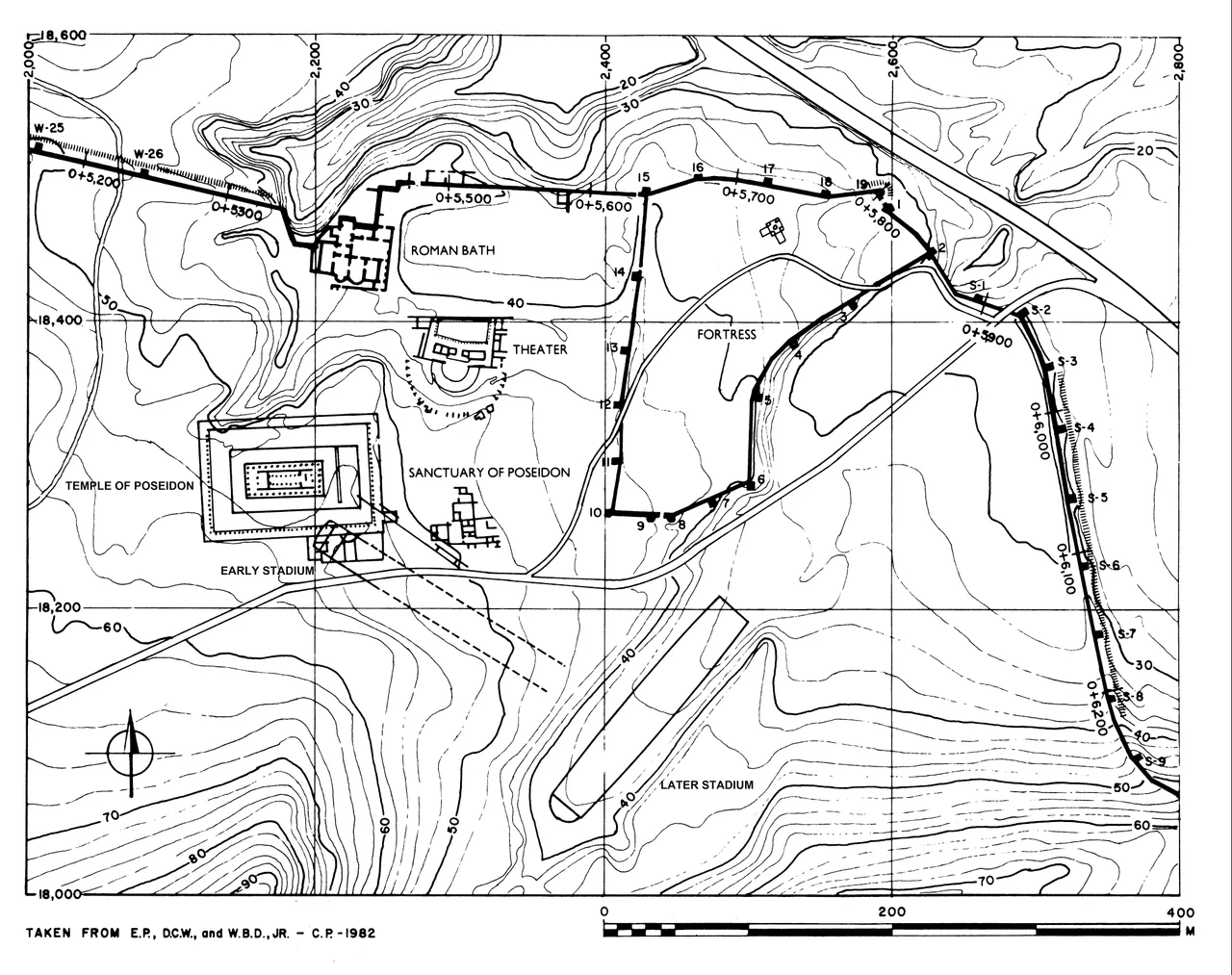
The great Temple of Poseidon at Isthmia, built in the Doric style around 700 BC, was among the earliest monumental Greek temples. Alongside it, the sanctuary contained a theater, Roman baths, and — crucially — the stadium where the Isthmian Games were held. The theater was rebuilt near the end of the 4th century BC with an enlarged semicircular seating area; scholars estimate 1,550 spectators could fit in the lower level alone. The stadium's starting line mechanism was an engineering achievement in its own right: a triangular pavement with sockets for upright posts flanking sixteen lanes, connected by grooves to a single round cutting at the apex where the starter stood. A piece of wood attached to a cord could be swung down to signal the start simultaneously for all runners. Whether the mechanism always worked as intended is uncertain — it was replaced relatively quickly by simpler methods — but its ambition is clear. Later, a Roman temple honoring Palaimon was built within the sanctuary, decorated with Ionic roof ornaments.
Political Theater at the Sanctuary
Isthmia's central location made it something more than a religious site. When the Persian Empire threatened to invade in 481 BC, it became a conference hall for the Greek resistance — a preferred site for the coalition meetings that preceded Thermopylae and Salamis. Its neutrality and accessibility, reachable from both land and sea, made it useful for diplomacy in ways that sanctuaries often were in the ancient world. Then in 196 BC, the Roman general Titus Quinctius Flamininus chose the occasion of the Isthmian Games to make one of the most theatrical announcements in Greek history: he proclaimed the freedom of the Greek states from Macedonian hegemony. The crowd's reaction, according to ancient sources, was so loud that birds fell from the sky. Whatever the ornithological accuracy of that detail, the political impact was real — Isthmia had become the stage on which Rome chose to define its relationship with Greece.
Archaeology and Access
The modern archaeological story of Isthmia begins seriously in the 20th century. Oscar Broneer excavated the temple, theater, dining caves, and stadia under the auspices of the University of Chicago. Elizabeth Gebhard took over the Chicago excavations in 1976 and led new campaigns in 1989, clarifying disputed conclusions and uncovering evidence spanning the Bronze Age to the Roman period. A parallel series of excavations on the northern and eastern parts of the site, begun in 1967 by Paul Clement and later continued by Timothy Gregory of Ohio State University and Jon Frey of Michigan State University, extended the picture. Today the site contains an archaeological museum housing finds from the sanctuary and the surrounding area. A virtual tour of the sanctuary and monuments is available online, extending access beyond those who can make the journey to the Isthmus. The Hexamilion Wall — the late Roman defensive barrier that crosses the Isthmus — runs near the sanctuary, and its remains are visible at the site, adding another layer to a place where nearly every century has left something behind.
From the Air
The Sanctuary of Poseidon at Isthmia lies at approximately 37.92°N, 22.99°E, near the southeastern end of the Isthmus of Corinth, close to the modern village of Isthmia and the eastern entrance of the Corinth Canal. From altitude, the site sits between the Saronic Gulf (southeast) and the lower-lying land toward the Gulf of Corinth (northwest), with the canal's straight cut visible to the west. The Acrocorinth rock is visible to the west-southwest on clear days. Recommended viewing altitude: 1,500–3,000 feet to distinguish the sanctuary grounds from the surrounding terrain; the archaeological site is south of the modern road network at the isthmus. Nearest major airport: LGAV (Athens International Eleftherios Venizelos), approximately 65–70 km east-northeast along the Saronic coast.
Nearby Stories
- Stymfalia 3 km away
- Sanctuary of Asclepius, Epidaurus 4.6 km away
- German Submarine U-133 (1941) 5.9 km away
- Battle of the Trench (1821) 6.7 km away
- 1981 Gulf of Corinth Earthquakes 12 km away
- Aigeira 13 km away
- Agios Thomas, Boeotia 14 km away
- Agios Georgios (island) 36 km away