
Isthmian Games
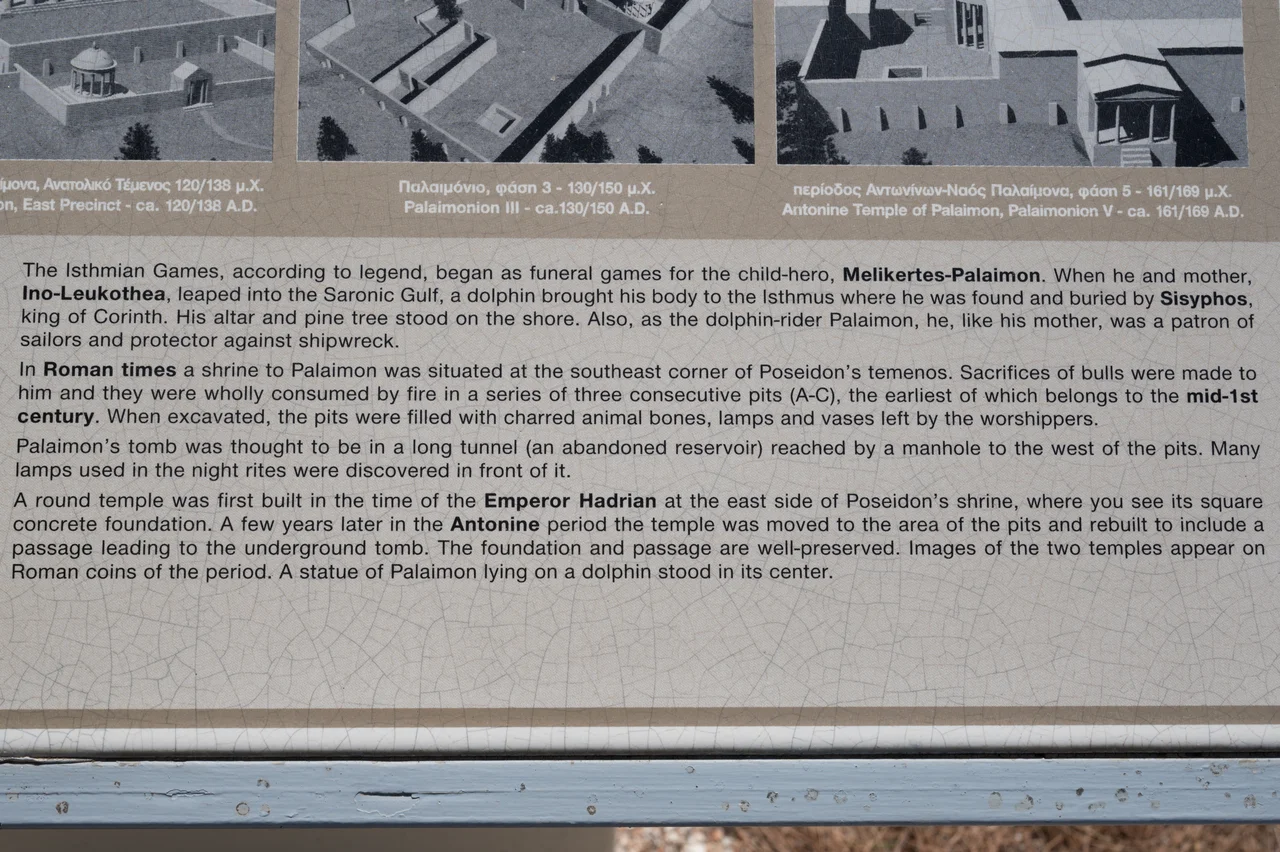
According to one version of the myth, Sisyphus — the legendary founder of Corinth, he of the eternal boulder — discovered the body of a drowned boy named Melicertes on the shore of the Isthmus and buried him there. The funeral games he held in the boy's honor became the Isthmian Games. This is myth, of course, but myths encode geography: Corinth controlled the Isthmus, the Isthmus was where land routes and sea routes converged, and that convergence made the site inevitable as a gathering place. The first historical Isthmian Games were held in 582 BC. They continued, with interruptions, for roughly a thousand years.
The Calendar of Competition
The Isthmian Games were one of four Panhellenic festivals — the others being the Olympics at Olympia, the Pythian Games at Delphi, and the Nemean Games at Nemea. Unlike the Olympics, held every four years, the Isthmian and Nemean Games came around twice in each Olympiad cycle, in the second and fourth years. This made the Isthmus one of the busiest athletic venues in the Greek world. The festival honored Poseidon and was held in spring at his rural sanctuary on the Isthmus, a site easy to reach from both the Greek mainland and the Peloponnese, by land or by sea. Participation was open to all Greeks, and the Athenians were particularly enthusiastic. The Eleans, who hosted the Olympics, boycotted — perhaps unable to admit that any rival festival had merit, or perhaps protecting their games' exclusivity. From 228 or 229 BC onward, Romans were permitted to compete as well.
Crowns of Celery and Pine
These were stephanitic games — competitions where the prize was a crown, not money. At least through the 5th century BC, during Pindar's time, winners of the Isthmian Games received a wreath of wild celery. Later the prize shifted to a wreath of pine leaves, the Isthmian pine (Ἰσθμικὴ πίτυς), reflecting Poseidon's association with the pine-covered coastal hills. The prestige value was nonetheless real and lasting. Victors could be honored with an ode from poets like Pindar himself, whose Isthmian Odes survive as some of the finest athletic poetry in any language. A statue in the victor's home city was another possibility. Athens took the honor economy a step further: the city awarded victorious Athenian athletes 100 drachmas in cash — a substantial sum. The competitions included the athletic events familiar from Olympia: wrestling, boxing, the brutal pankration, chariot races, and horse racing. Musical and poetical contests were also part of the program, and these were among the few events in which women were permitted to compete.
A Stage for History
No ancient festival was politically innocent, and the Isthmian Games were particularly charged. In 196 BC, the Roman general Titus Quinctius Flamininus, fresh from his victory over Macedon, chose the crowded festival to announce the freedom of the Greek states from Macedonian hegemony. The proclamation, read aloud in the stadium, reportedly triggered such a roar from the assembled crowd that birds fell from the sky — a detail passed down through several ancient accounts. A truce was declared before each festival to allow safe passage for athletes across Greek territory. In 412 BC, even though Athens and Corinth were actively at war with each other, the Athenians received their customary invitation and attended under the truce. The games were a space where the normal rules of Greek interstate conflict briefly paused — not from idealism, but because everyone, cities included, needed the festival too much to disrupt it.
Survival, Disruption, and Disappearance
Corinth's catastrophic destruction by Rome in 146 BC disrupted the Games — the city that controlled them no longer existed. Administration passed to nearby Sicyon, which managed the festival while the ruins of Corinth sat vacant. When Caesar refounded Corinth in 44 BC, the city eventually reclaimed ownership of the Games, though the festival was held in the city proper for a time before returning to the Isthmus sanctuary around AD 42 or 43. The games persisted into the 4th century at least: Libanius mentions cultic activity continuing at the Isthmus into the mid-4th century, and polytheistic cult practices at Corinth continued into the 6th century despite increasing imperial pressure against pagan religion. The exact moment the Isthmian Games ended is unknown. What is known is that Kleitomachos of Thebes won wrestling, boxing, and pankration on a single day — an achievement the sources record with a kind of awed respect that crosses two millennia without losing its force. Plato, too, is said to have competed here, in wrestling. The Isthmus gathered everyone.
From the Air
The Isthmian Games were held at the Sanctuary of Poseidon at Isthmia, located at approximately 37.92°N, 22.99°E, near the southeastern end of the Isthmus of Corinth. From altitude, the site occupies the low ground between the Saronic Gulf to the southeast and the narrow Isthmus crossing to the northwest, with the Corinth Canal now cutting straight through the land the ancient athletes and spectators would have crossed. The Acrocorinth is visible to the west-southwest. Recommended viewing altitude: 2,000–4,000 feet to take in the full isthmus geography that made the festival's location so natural; lower passes allow the modern town of Isthmia and the canal eastern entrance to be distinguished. Nearest major airport: LGAV (Athens International Eleftherios Venizelos), approximately 65–70 km east-northeast along the Saronic coast.
Nearby Stories
- Stymfalia 3 km away
- Sanctuary of Asclepius, Epidaurus 4.6 km away
- German Submarine U-133 (1941) 5.9 km away
- Battle of the Trench (1821) 6.7 km away
- 1981 Gulf of Corinth Earthquakes 12 km away
- Aigeira 13 km away
- Agios Thomas, Boeotia 14 km away
- Agios Georgios (island) 36 km away