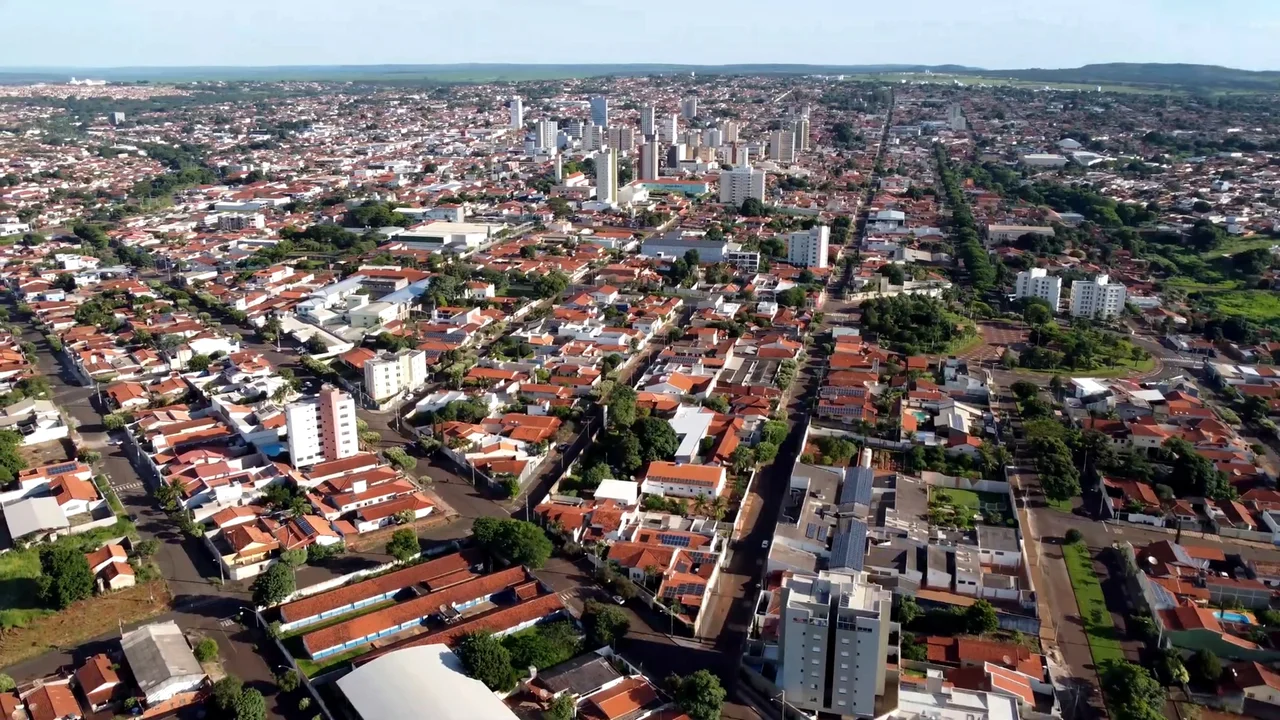

Ituiutaba
The story begins with a birthday party. On April 2, 1951, Demetrio Silva da Costa (known to everyone as Cyzicus) invited his father, his brother, and a handful of friends to honor his wife Geralda on her birthday the only way he knew: with drums, with dancing, with the rhythms of Mozambique that their African ancestors had carried across the ocean centuries earlier. Word reached Ana Carolina Ribeiro — Cyzicus's cousin, known as Dona Rosa — and she saw in that backyard gathering something the town had been missing. A few years and one midnight march later, Ituiutaba would have a Congado again. Getting there would require five o'clock fireworks, a parish priest's reluctant blessing, and the stubborn refusal of Afro-Brazilian worshippers to be told where they could and could not pray.
Out of the Triangle
Ituiutaba sits in the Triângulo Mineiro, the western wedge of Minas Gerais that points toward the rivers of Goiás. The first colonial settlers arrived in 1820, when Joaquim Antonio de Morais and José da Silva Ramos crossed into this territory and forced out the Caiapó, who had lived on these lands for generations. The colonists named their settlement Arraial de São José do Tijuco, a patchwork of chapel, roads, and grazing lands. In 1901 it became a municipality as Vila Platina, then in 1917 took its current Tupi-derived name — Ituiutaba, often interpreted as "river of black stones." The red earth here receives rain generously and drains well, and by the early twentieth century the town had become a cattle capital in a region already famous for its cattle. It remains so: nearly 200,000 head graze the municipal pastures, and one in two farms runs a tractor through fields of sugarcane, corn, and soybeans.
The Drums That Wouldn't Stop
Congado is a Brazilian devotional tradition born in the shadow of slavery — Catholic saints venerated through drums, dance, and regalia that traveled across the Atlantic with enslaved Africans. Across Minas Gerais, Congado has always existed in a negotiated space: embraced by the faithful, tolerated uneasily by the institutional church. In Ituiutaba, early festivals happened on farms outside town, far from anyone who might object. When the tradition migrated into the city, the parish priest refused to allow the Congadeiros — the practitioners — near the church, arguing their beliefs were not truly Catholic but rooted in something older and foreign. The ban held for years. Then came Cyzicus's birthday party, then Dona Rosa's organizing, then the priest's repeated refusal. In 1952, the newly formed group decided to stop asking. They dressed in their suits and walked through downtown at five in the morning.
Fireworks at Dawn
They set off fireworks in front of the courthouse. They carried their banners down Rua 22. They knocked on the forum's doors until a judge acknowledged their right to celebrate in public. Then they walked to São José Church and went inside for morning mass. Nothing stopped them. Nobody arrested them. The festival had arrived in town, and Ituiutaba's Congadeiros kept marching every year afterward without church recognition, supported only by devotees and neighbors. It took until 1956 for Father João Ave to negotiate. His price was steep: the Congadeiros had to be baptized, confirmed, and married within the Catholic faith, and twelve couples — remembered as "The Twelve Apostles," Marciano Silvestre da Costa and Clarimundo Geraldo da Costa among them — had to found a formal brotherhood. They paid that price. On May 13, 1957, the Brotherhood of São Benedito was formally blessed by the same priest who had barred the door five years earlier.
What Was Kept
The church tried to erase the African roots of what the Congadeiros did. The Congadeiros learned the catechism, attended mass, took communion — and quietly kept their ancestral practices alive behind the liturgical fabric. Today the Brotherhood has more than 600 members, up from a founding hundred. It owns the land where the Church of São Benedito was built with money raised through the congregation itself. Seven distinct suits (performance groups) now perform during the annual festival in honor of St. Benedict and Our Lady of the Rosary, joined by visiting Congadeiros from cities across the region. What began as a backyard birthday party became a negotiated truce, and the truce became a tradition woven so tightly into Ituiutaba's cultural fabric that the town can no longer be imagined without the drums.
The Working Town
Outside festival season, Ituiutaba is a prosperous working city of roughly 100,000 people, ranked near the top of Minas Gerais for economic and social development. The 2007 snapshot records 128 doctors, 170 lawyers, and 14,365 automobiles — unusual density for a mid-sized interior city. Sugarcane, corn, and soybeans fill the fields over a thousand hectares each. Five television stations and seven radio stations operate from town. Life expectancy is 76 years, literacy reaches 89 percent, and urban sewerage coverage approaches 99 percent. None of that appears in the festival drums, but it all appears in the same square where the Congadeiros once marched at dawn.
From the Air
Coordinates: 18.97°S, 49.47°W. Recommended viewing altitude: 5,000-8,000 feet AGL for views of the Triângulo Mineiro cattle country and the sprawl of the city across rolling red-earth plateaus. Nearest airports: Tito Teixeira Airport (SBIT) serves Ituiutaba; Uberlândia (SBUL) lies approximately 85 km northeast with commercial service. Clear dry-season skies (May-September) offer the best visibility.
Nearby Stories
- Itumbiara 30 km away
- Quirinópolis 60 km away
- São Simão, Goiás 66 km away
- Araguari 77 km away
- Caldas Novas 102 km away
- Frutal 107 km away
- Uberaba 118 km away
- Votuporanga 141 km away