
Caldas Novas
In 1722, a bandeirante named Bartolomeu Bueno da Silva Filho turned off his father's trail and stumbled into steam. His father - nicknamed Anhanguera, "Old Devil," by the Indigenous people he hunted - had crossed this country years before without finding what the son found now: water rising warm from the ground, a thermal spring where the Rio Quente would later be traced. Three centuries on, the son's discovery has grown into the largest hydrothermal resort complex in the world. Caldas Novas, in the state of Goias, pumps 1,200 cubic meters of hot water an hour from 86 active wells, and at Carnival some 300,000 visitors crowd into a town whose permanent population is a fraction of that.
Bandeirantes and Boiling Water
The springs that made the town were found in 1777 by Martin Coelho de Siqueira, another bandeirante, who came upon a second hot-water source beside the Lavras brook and named it Caldas Novas - the New Hot Springs - to distinguish it from the Caldas de Pirapetinga he had found nearby. Coelho built the Fazenda das Caldas on the left bank of the river. The main house still stands today. After Coelho's death, his son Antonio inherited the property. In 1818, the French naturalist Auguste de Saint-Hilaire visited during his Brazilian expeditions, cataloging the region's plants and peoples. When Antonio died, the farm passed to Jose Domingos Ribeiro, who donated land for the Church of Our Lady of Exile - consecrated as the Parish of Caldas Novas in 1853, with the vicar Olinta Jose da Silva presiding.
Finding Its Name
The settlement evolved slowly. In 1880, Caldas Novas split from Santa Cruz and joined the municipality of Vila Bela de Morrinhos, today simply called Morrinhos. By 1893 it had become a district. On July 5, 1911 the municipality itself was created, its headquarters elevated to village on October 21 of the same year - the date Caldas Novas celebrates as its anniversary. City status came on June 21, 1923. The hot springs predated all these administrative names by centuries. The people bathing in them had been doing so long before Portugal sent anyone to find them, and long after bureaucrats in Goiania drew new lines on maps.
The Warm Water Economy
The town has become an economy built on one physical fact: water temperatures between 34 and 57 degrees Celsius, rising through quartzite aquifers to the surface under pressure, without needing any fuel to heat them. The best path in from Goiania is the BR-352, 165 kilometers past Bela Vista de Goias, turning onto the GO-139 after Cristianopolis. From Brasilia, it is 290 kilometers through Luziania. The "classic" route via BR-153 and Morrinhos runs 190 kilometers, a little longer than the shortcut but easier to follow. Once you arrive, the car becomes less useful. The town itself is walkable, though moto taxis - cheap, fast, and universally available - shuttle between thermal hotels and pool complexes when heat makes walking less appealing.
Next Door at Rio Quente
The Hot Park in the sister town of Rio Quente, 31 kilometers west, draws the second wave of visitors - those who have come for Caldas Novas but want a themed water park in addition to the thermal pools at their hotel. An intermunicipal bus handles the route inexpensively. Rio Quente itself feeds one of the largest hot-water resort complexes in the world, spread across 500 square kilometers, with seven hotels and a convention center that together receive more than a million tourists annually. The geothermal system that supplies both towns has been studied for decades - early theories invoked a volcano, now dismissed; modern science points to rainfall stored in quartzite, pushed upward in a 600-meter column by pressure in the deep rock.
Carnival and Quiet Seasons
Caldas Novas runs a famous street Carnival that fills the town to capacity, though visitors tired of thermal bathing have options. Fishing trips lead to Buriti Alegre, 86 kilometers away near Marzagao, or to Itumbiara and Cachoeira Dourada 181 kilometers south via BR-153, or to Tres Ranchos 151 kilometers southeast via Catalao. Brasilia sits 262 kilometers away, Goiania 169. In the walkable downtown, vendors sell locally made beachwear and bottles of wildflower honey harvested from the cerrado. The banks - Bradesco, Banco do Brasil, Itau, Caixa, HSBC - cluster along Avenida Coronel Bento de Godoy. Between Carnivals, the town drops back to a slower pace, steam still rising from pool edges in the early morning cerrado cool, as it has since Martin Coelho found the Lavras brook.
From the Air
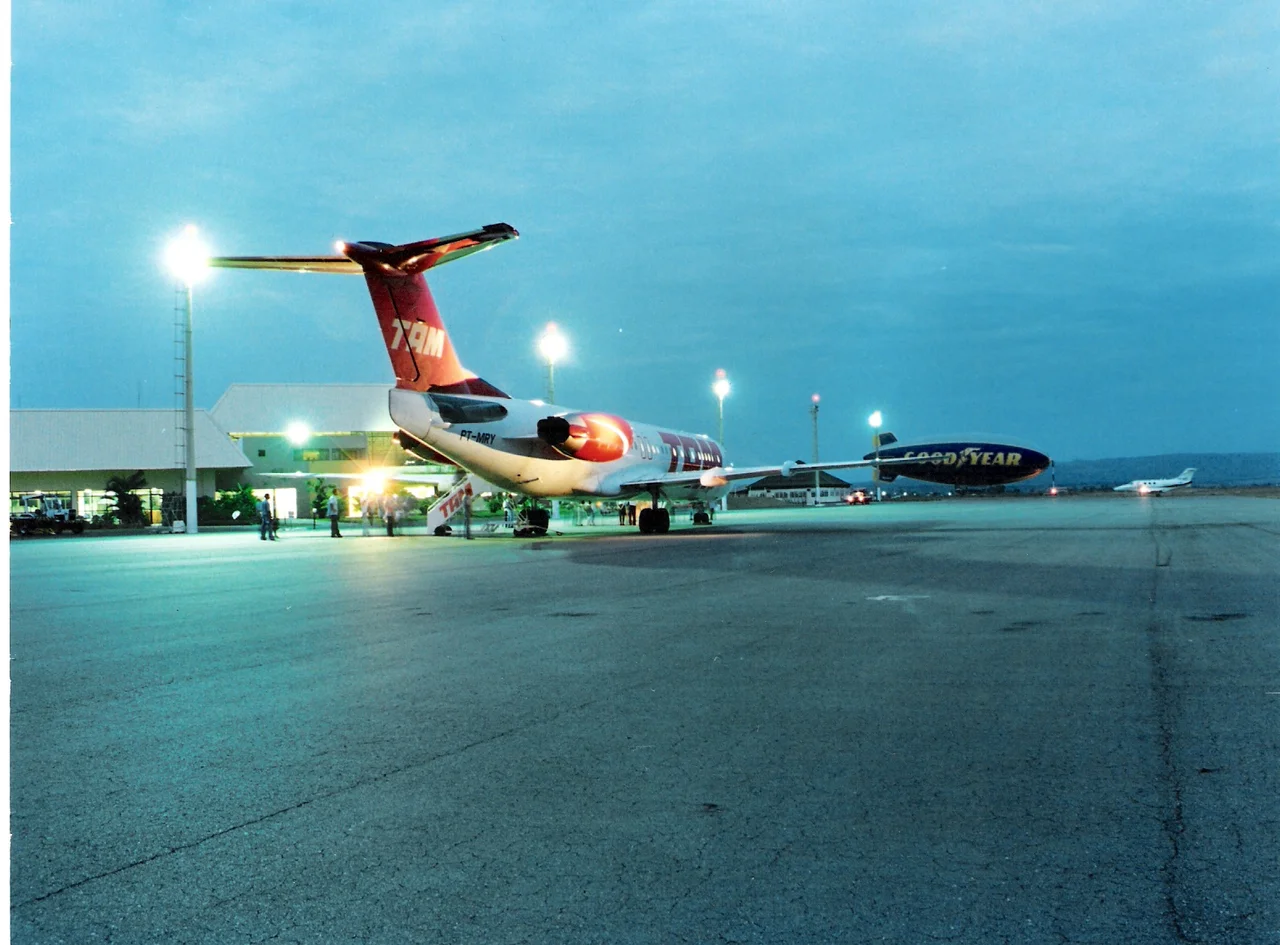
Located at 17.74 degrees S, 48.63 degrees W in south-central Goias state. Elevation around 700 meters. Nearest airport is Caldas Novas Airport (Nelson Ribeiro Guimaraes Airport, SWCN) for regional flights; major connections through Goiania (SBGO), 169 km northwest, and Brasilia (SBBR), 262 km northeast. Best viewing altitude 2,000-4,000 feet to see the town's compact footprint against the Serra de Caldas plateau and the thermal spring country extending west toward Rio Quente.
Nearby Stories
- Ipameri 6.2 km away
- Goiatuba 17 km away
- Catalão 36 km away
- Pires do Rio 45 km away
- Aparecida de Goiânia 65 km away
- Itumbiara 78 km away
- Cristalina 92 km away
- Goiânia 110 km away