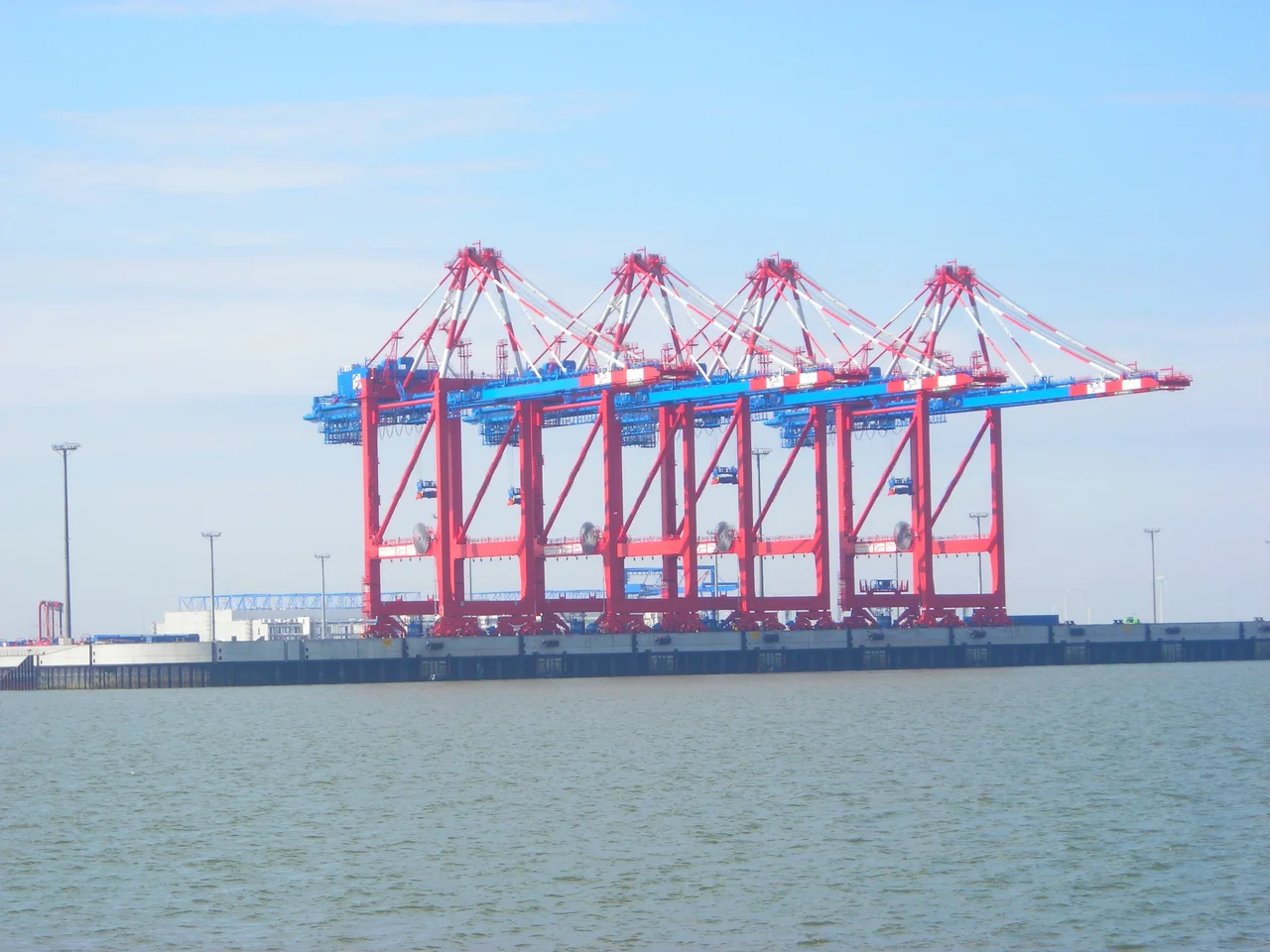

JadeWeserPort
The timing could not have been worse. On 21 September 2012, two German state governments cut the ribbon on a brand-new container port at Wilhelmshaven, built at a cost of roughly 1 billion euros, designed to handle 2.7 million containers a year and to serve as Northern Europe's eastward gateway for the biggest ships afloat. The world they had imagined for it was a world in which global container traffic kept growing at 7% a year. The world they actually got was the one that arrived after Lehman Brothers. In its first full year of operation, JadeWeserPort handled almost nothing at all.
What 18 Meters Buys You
JadeWeserPort exists because of the Jade Bight - specifically, because the narrow neck of the bay holds the only natural channel along Germany's North Sea coast deep enough for the largest container ships in the world to enter at any state of the tide. The port has a natural water depth of over 18 meters. A vessel 430 meters long with a 16.5-meter draught can call without waiting for high water - a guarantee no other German port can make. Hamburg, by far Germany's largest container port, is up the Elbe; ships there have to wait on the tide. Bremerhaven is on the Weser; same problem. JadeWeserPort, alone, has open ocean in front and unrestricted depth beneath. That is the entire business case. That is also why two German states - Lower Saxony with a 50.1% stake and Bremen with 49.9% - were willing to spend a decade building it.
Two Decades of Planning
The idea of a deepwater container terminal at Wilhelmshaven took shape in 1993, when local commercial associations first sketched out a four-berth proposal that later grew to six. Legal and administrative challenges - largely environmental objections from the Wadden Sea conservation lobby - delayed construction repeatedly. A court ruling on 8 March 2008 finally cleared the way. Between then and January 2012, contractors flushed millions of cubic meters of sand into the construction site to build up the quay. Sixteen of the world's largest container cranes at the time were erected, each tall enough to handle ships with 25 parallel rows of containers stacked across their decks. In August 2012 port authorities moved into their offices. A month later, the port opened.
A Slow Start, a Steady Climb
And then nothing happened. The Great Recession had hollowed out global container demand. Shipping lines were not deploying their new mega-ships to a port nobody had heard of. The promised 7% annual growth rate had become single-digit declines. Critics in Bremen and Lower Saxony asked whether 1 billion euros had just been buried in the sand. The numbers were grim: 60,000 TEU in 2014 against a capacity of 2.7 million. But slowly the port found its place. By 2021, throughput had reached 712,953 TEU - still well below capacity, but real, growing, and serving a route Hamburg and Bremerhaven could not match. The electrification of the Wilhelmshaven-Oldenburg rail link was finished in December 2022, finally giving the port a competitive hinterland connection. Russia's invasion of Ukraine and the energy crisis that followed brought a new wave of business: LNG terminals went up beside the container quays.
A Port Without a City Behind It
JadeWeserPort's central problem has never been the water. It has been the land. Hamburg has a massive German industrial hinterland feeding it; Wilhelmshaven has a small Lower Saxon coastal town. Most cargo arriving at JadeWeserPort has to leave again immediately - by feeder ship to Scandinavia, Russia, or the Baltic, or by rail and road south. The port is a transit point more than a destination. The dream sketched in the 1990s was that the largest ships in the world, increasingly too big for the Elbe, would funnel through Wilhelmshaven and feed everywhere else. That dream is becoming, slowly, real. It is just taking longer than the planners imagined - and the patience required has been almost as deep as the channel itself.
From the Air
JadeWeserPort sits at approximately 53.59°N, 8.14°E on the western shore of the Jade Bight just north of central Wilhelmshaven. The container quay runs roughly 1,725 meters north-south, with the marshalling yard at its northern end. Recommended viewing altitude FL040-FL080 for the full port layout and ship traffic; lower altitudes reveal individual cranes. Nearest airport: Wilhelmshaven-Mariensiel (EDWI), 8 km south. Approach corridors may be active for the port's traffic - check NOTAMs.
Nearby Stories
- Broetje-Automation GmbH 4.4 km away
- Taktisches Luftwaffengeschwader 71 "Richthofen" 5.1 km away
- German Trawler V 1101 Preussen 6.6 km away
- Jümme 7.4 km away
- Großer Knechtsand 7.8 km away
- Worpswede 10 km away
- Stalag X-B 25 km away
- Lilleø 214 km away