
Jakarta Cathedral
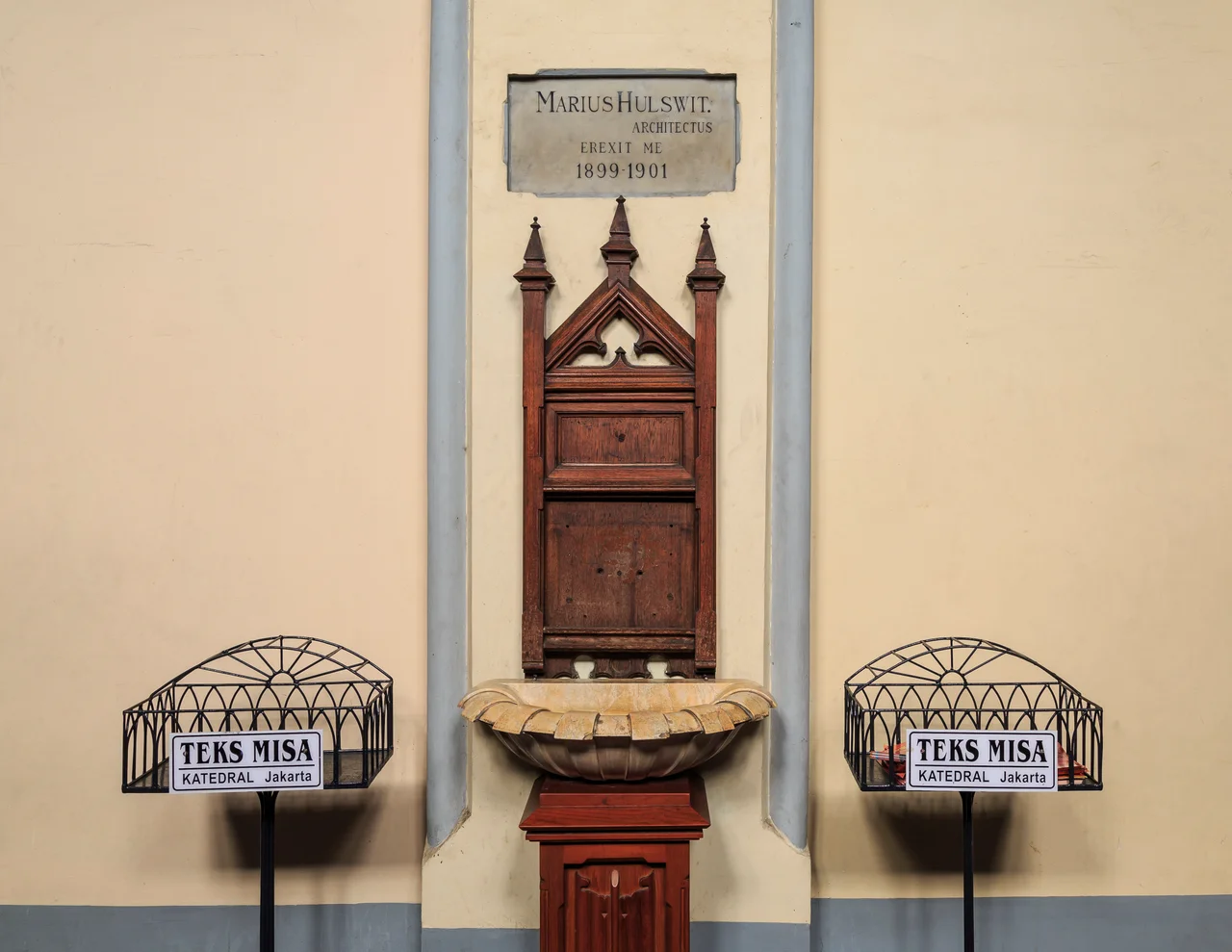
The portal inscription reads like a boast carved in stone: "Marius Hulswit Architectus erexit me 1899-1901." Marius Hulswit built me. Not God, not a bishop, not the colonial governor -- the architect claimed this church for himself, and the building has earned the vanity. Jakarta Cathedral rises in white neo-Gothic spires above the dense, humid sprawl of Central Jakarta, standing just meters from the Istiqlal Mosque, the largest mosque in Southeast Asia. The proximity is not accidental. It is a deliberate piece of urban theology, two faiths facing each other across a narrow street in a nation that enshrines religious pluralism in its constitution. But the cathedral's story begins long before interfaith symbolism -- it begins with a ban.
Forbidden Faith
When the Dutch East India Company established its foothold in Batavia in 1619, it brought Protestantism and a suspicion of Rome. The Catholic Church was banned across the Dutch East Indies, its practice restricted to the remote islands of Flores and Timor, far from the centers of colonial power. For nearly two centuries, there was no Catholic mass in Jakarta. The reversal came from an unlikely direction: Napoleon. When France absorbed the Netherlands during the Napoleonic Wars, Napoleon installed his Catholic brother Louis as King of Holland in 1806. Suddenly, the prohibition dissolved. Catholicism could operate freely in the Dutch East Indies for the first time. The commissioner-general of Batavia, Leonard du Bus de Gisignies, provided land for the first Catholic church, and on November 6, 1829, Monseigneur Prinsen blessed and inaugurated the Church of Our Lady of the Assumption in the Weltevreden district -- the first Catholic church in Jakarta in over two hundred years.
Collapse and Resurrection
The original church lasted sixty years. After a renovation in 1859, it stood for three more decades before collapsing entirely on April 9, 1890. The replacement needed to be grander and more durable, but also practical -- Jakarta in the 1890s had no shortage of ambition but a scarcity of trained construction workers. Enter Marius Hulswit. The Dutch architect simplified an earlier design by Dijkmans, making it buildable by laborers without specialized masonry training. His solution was ingenious: cast-iron spires instead of carved stone, a material that could be assembled rather than sculpted. The result is a cathedral in the shape of a cross, 60 meters long and 10 meters wide, with 5-meter aisles on each side. The main entrance faces west, as European cathedral tradition demands. At the portal's trumeau stands a statue of Our Lady, and above it, a line from the Magnificat: "Beatam Me Dicentes Omnes Generationes" -- All generations shall call me blessed. The church was consecrated on April 21, 1901.
Light Through Glass, Sound Through Pipes
Step inside and the tropical heat relents. The nave draws the eye upward toward Gothic vaults, and above the entrance, a large round stained-glass window -- the Rosa Mystica, the Mystical Rose, a symbol of Mother Mary -- filters Jakarta's equatorial light into blues and golds. The cathedral houses a pipe organ with two manuals and a pedalboard, its stoplist reading like a inventory of devotional sound: Gamba and Bourdon on Manual I, Open Diapason and a four-rank Mixture on Manual II, Subbass and Open Wood on the pedals. A trumpet stop on the first manual cuts through the humid air during feast days. The cathedral also contains a museum documenting the history of Catholicism in Indonesia, staffed largely by volunteers -- a quiet testament to the faith's enduring, if minority, presence in a nation of 270 million people where roughly three percent are Catholic.
The Neighbor Across the Street
Jakarta Cathedral's most striking feature is not architectural but geographic. Directly across the street stands the Istiqlal Mosque, completed in 1978, its massive dome dwarfing the cathedral's twin spires. The juxtaposition was designed by President Sukarno to embody Pancasila, Indonesia's founding philosophy of religious tolerance. During Christmas, the mosque offers its parking lots to cathedral worshippers overwhelmed by holiday crowds. During Eid al-Fitr, the favor is returned. In 2021, a pedestrian tunnel was completed connecting the two buildings -- the Terowongan Silaturahmi, the Tunnel of Friendship. When Pope Francis visited in September 2024, he signed the Istiqlal Declaration at the mosque before crossing to the cathedral, walking the physical distance between Islam and Christianity in under five minutes.
Enduring and Adapting
The cathedral underwent a major renovation between 1988 and 2002, updating its infrastructure while preserving Hulswit's neo-Gothic framework. It remains the seat of the Archbishop of Jakarta and continues to serve an active parish. Inside, a Pieta echoes Rome. In one corner, a statue of the Virgin Mary and Baby Jesus dressed in Betawi traditional costume -- the indigenous culture of Jakarta -- grounds the European architecture in local identity. During the COVID-19 pandemic, the cathedral adapted again: donation collections shifted from woven baskets to QR codes, a small detail that captures the building's 125-year habit of absorbing whatever modernity throws at it. The memorial stone to Marius Hulswit still stands at the holy water stoup near the entrance, marking the spot where worshippers dip their fingers before making the sign of the cross -- a gesture that was once punishable in this city, and now happens daily, a few steps from the largest mosque in Southeast Asia.
From the Air
Located at 6.17S, 106.83E in Central Jakarta, immediately east of Merdeka Square. From the air, look for the twin white neo-Gothic spires standing adjacent to the massive dome and single minaret of Istiqlal Mosque -- the two structures are unmistakable side by side. The National Monument (Monas) obelisk dominates Merdeka Square to the west. Nearest major airport is Soekarno-Hatta International (WIII), approximately 25 km northwest. Halim Perdanakusuma Airport (WIHH) is about 12 km southeast. Best viewed at 2,000-3,000 feet where the cathedral-mosque pairing is clearly visible.
Nearby Stories
- The King's Footprints in the River 2.8 km away
- Rawagede Massacre 6.4 km away
- The Cruiser That Wouldn't Stop Fighting 14 km away
- Four Minutes Over the Java Sea 14 km away
- The Scholar's Mosque 21 km away
- Through the Cidepong Hills 37 km away
- Ujung Kulon National Park 97 km away
- The Islands That Vanished from Sight 352 km away