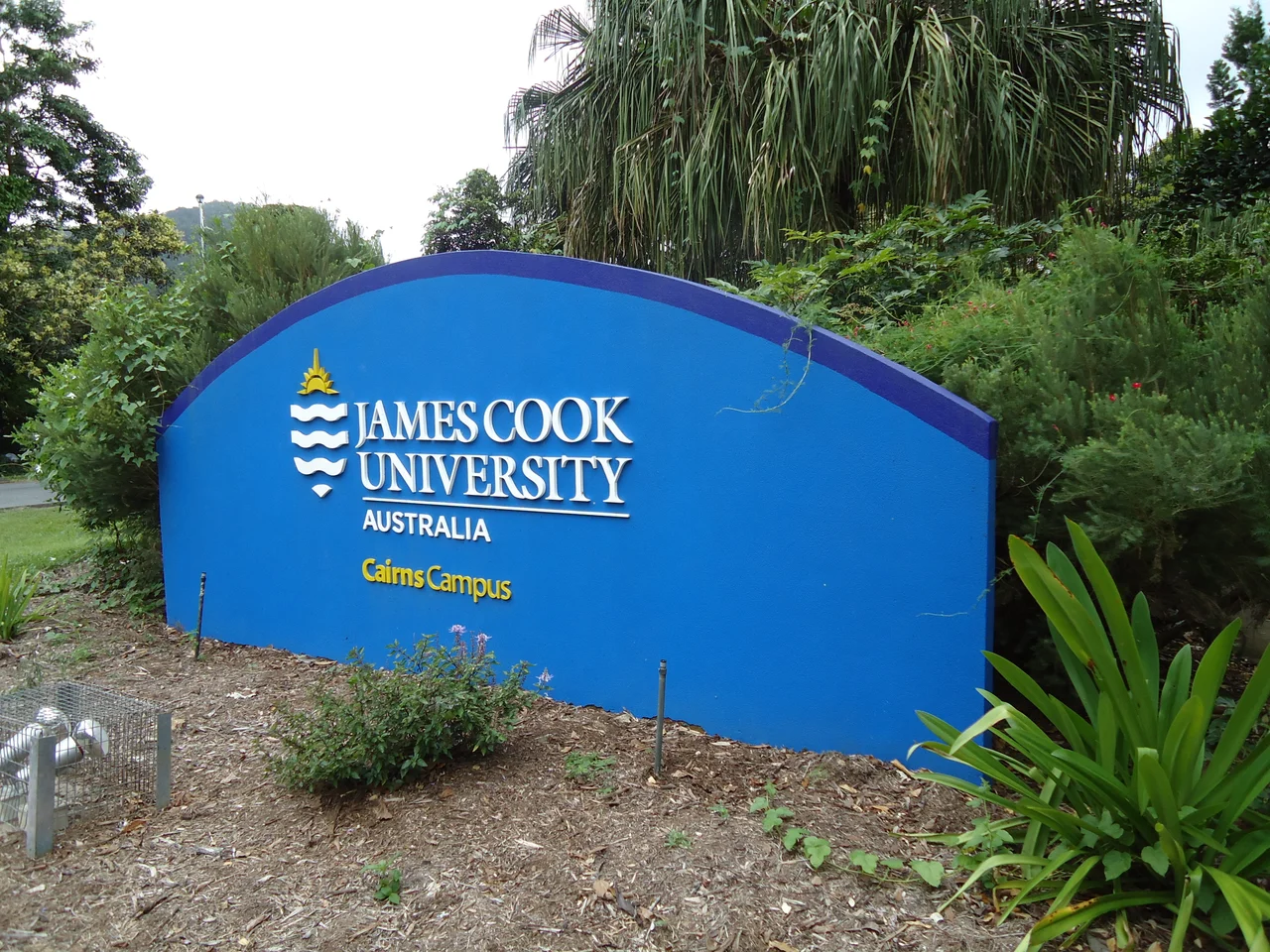

James Cook University
On 20 April 1970, Queen Elizabeth II stood in tropical North Queensland and gave royal assent to an act of the Queensland Parliament, then declared a new university open. It was a striking honour for an institution in Townsville, a port city nearly fifteen hundred kilometres from the state capital, where for generations any young person wanting a degree had to leave for Brisbane. James Cook University changed that. Queensland's second-oldest university, it grew from a single college into a research powerhouse anchored to one defining idea: that the tropics are not a backdrop but a subject, worth studying on their own terms, from the coral offshore to the cyclones overhead.
A University for the North
The idea took shape in 1957, when John Douglas Story, vice-chancellor of the University of Queensland, argued that the people of North Queensland deserved higher education without a thousand-kilometre exodus south. The University College of Townsville opened in 1961 as an outpost of Brisbane's university, and within a decade it had outgrown the arrangement. Its 1970 elevation to a full, independent university, with the Queen presiding, marked the moment the north claimed an academic institution of its own. A twelve-minute film of that royal ceremony survives in the university's archives, the monarch arriving, the official party assembling, a small city's quiet pride caught on celluloid. The main campus eventually settled in the suburb of Douglas, on 386 hectares in the lee of Mount Stuart, beside what is now the Townsville Hospital.
The Reef as a Classroom
Few universities sit so close to their best laboratory. The Great Barrier Reef lies just offshore, and JCU made the most of it, building a global reputation in marine biology and tropical ecology. Its research now ranges across environmental and biological sciences, earth sciences, and the agricultural and veterinary fields that matter in a hot, wet climate. The connection to the reef runs deep in the institution's bones: the same site at Cape Pallarenda that once quarantined ships briefly housed the founding staff of the Australian Institute of Marine Science before JCU and its partners built out the region's research network. To study at JCU is to have the most diverse marine ecosystem on Earth within an afternoon's reach.
Cyclones, Medicine and the Hot World
Some of the university's work was forged in disaster. A year after JCU's founding, Cyclone Althea battered Townsville, and in 1974 Cyclone Tracy flattened much of Darwin. Out of those catastrophes came the Cyclone Testing Station, begun in 1977 under Professor Hugh Trollope, where buildings are stress-tested against the winds that periodically threaten northern Australia. The same tropical focus shaped its health faculties. JCU took its first medical students in 2001, added veterinary science in 2006 and dentistry in 2009, and built a research culture around the diseases and health challenges of hot, often remote regions, the medicine of a world that much of the temperate academy overlooks.
Naming, in Two Languages
The university carries the name of Captain James Cook, the British navigator who in 1770 became the first European to chart Australia's eastern coast, and its coat of arms bears his ship, the Endeavour, in full sail. But on its fiftieth anniversary in 2020, JCU set other names alongside that one. To honour the Aboriginal and Torres Strait Islander peoples whose country it occupies, the university gave Indigenous names to its campuses: the Townsville campus became Bebegu Yumba, 'Place of Learning' in the Birri-Gubba language, and the Cairns campuses took names from the Yirrganydji dialect of Djabugay. Its library honours Eddie Koiki Mabo, the Torres Strait Islander whose landmark legal case overturned the fiction that Australia belonged to no one before British arrival. The motto, adopted back in 1963, reads Cresente Luce, light ever increasing.
From the Air
James Cook University's main Townsville (Bebegu Yumba) campus sits at 19.328°S, 146.757°E, sprawling across 386 hectares in the suburb of Douglas, in the lee of Mount Stuart (584 m) to the south. The campus is identifiable by its large landscaped grounds beside the Townsville Hospital and the nearby Lavarack Barracks army base. Castle Hill (286 m) rises about 8 km to the northeast, marking the city centre and coast. Townsville Airport (IATA TSV, ICAO YBTL) lies roughly 9 km north of the campus; arrivals from the south pass over the Douglas area and Mount Stuart. The Great Barrier Reef and Magnetic Island lie offshore to the northeast. Clear dry-season conditions give the best visibility; wet-season afternoons bring cloud over the inland ranges.
Nearby Stories
- Ayr 13 km away
- SS Yongala 34 km away
- Great Palm Island 35 km away
- Bindal People 50 km away
- Cardwell UFO Festival 83 km away
- Hinchinbrook Island 113 km away
- Porcupine Gorge 215 km away
- Samarai 998 km away