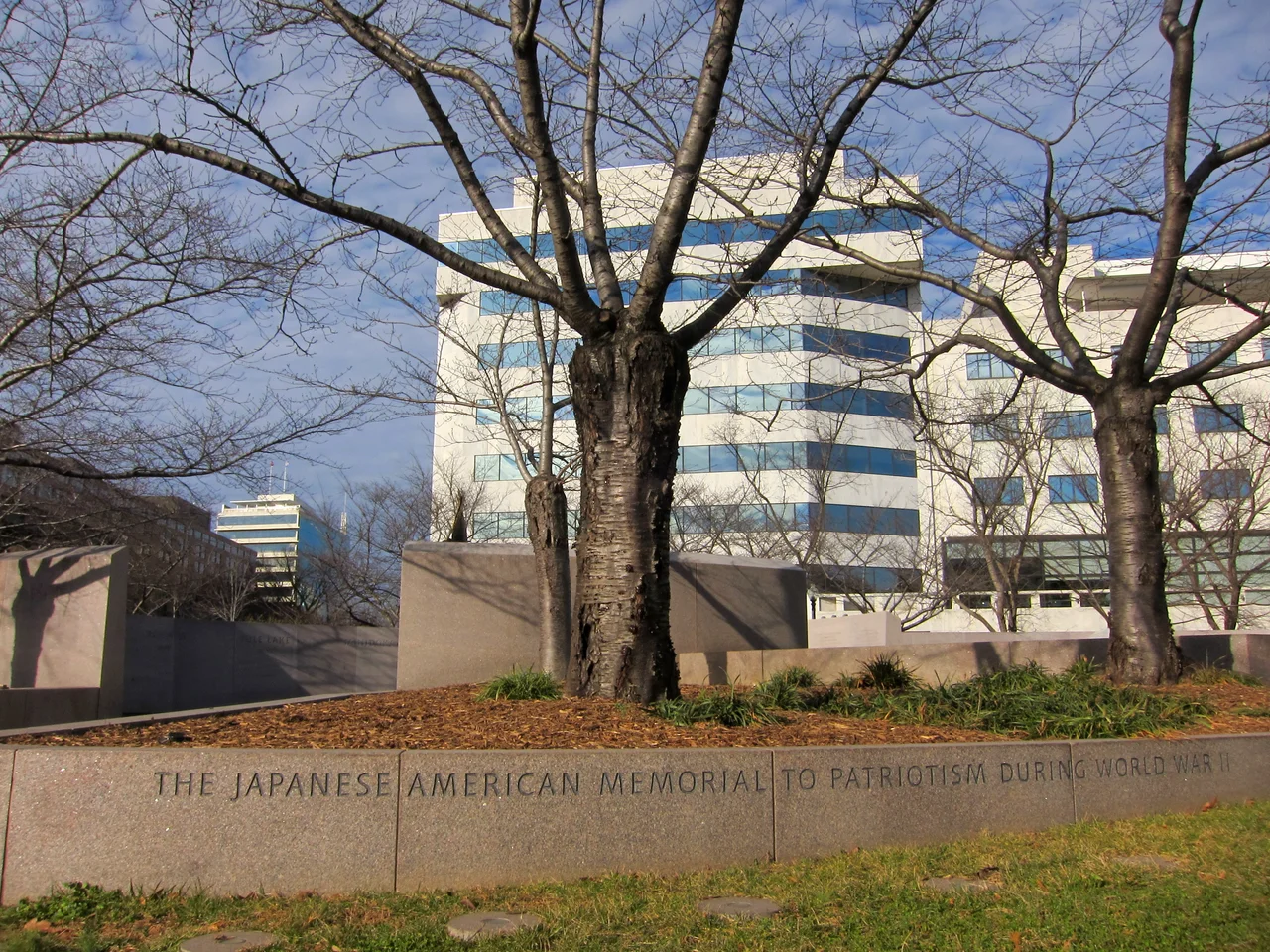

Japanese American Memorial to Patriotism During World War II
Two bronze cranes strain against barbed wire, wings angled in opposite directions, bodies pressed together for support. They sit atop a stone pedestal scored with the marks of quarry drill cores - the same kind of stone the United States government once used to build the barracks that held more than 120,000 Japanese Americans during World War II. The cranes are trying to escape. They are also holding each other up. Tucked between the U.S. Capitol and Union Station, on a triangular plot at Louisiana Avenue and D Street, this is one of the smaller monuments in Washington. It carries some of the heaviest weight.
Golden Cranes Rising
Sculptor Nina Akamu traveled to the International Crane Foundation in Baraboo, Wisconsin, to study Japanese cranes before designing the centerpiece bronze. What she returned with became known as Golden Cranes - two birds caught in wire, wings mirroring each other in opposing arcs. One wing points up, the other down, a deliberate evocation of the duality woven through East Asian thought. The birds press against one another as they push against the wire. The message is not simply about escape. It is about the impossibility of escaping alone. Akamu placed them on a tall square pedestal cut with vertical grooves that echo the cylindrical drill cores used to extract granite from quarries. Rising above the curved granite wall that surrounds them, the cranes are visible from beyond the memorial - the point being that confinement, however total it seems, is never the final word.
Ten Camps, Ten Names
Carved into the semi-circular granite wall are the names of the ten major incarceration camps where Japanese Americans were held: Manzanar, Tule Lake, Topaz, Heart Mountain, Minidoka, Gila River, Granada, Poston, Rohwer, and Jerome. Beside each name appears the number of people confined there. The total reached over 120,000. The geography of the camps was deliberate - desert flats in California and Arizona, plains in Wyoming, swamp in Arkansas, places isolated from the country that had imprisoned its own citizens. The numbers reveal another truth, harder to fit into the simple narrative of wartime fear. Of the nearly 160,000 people of Japanese descent living in Hawaii - the territory that had actually been attacked - fewer than 2,000 were confined. The mainland incarcerations were not about military necessity. They were about who looked like the enemy.
The Honor Wall
Inside the memorial, a central Honor Wall lists the names of more than 800 Japanese Americans in the U.S. Armed Forces who died in service during the Second World War. Many of them served in the 100th Infantry Battalion and the 442nd Regimental Combat Team - units made up of Nisei soldiers, some of whom had family still behind the wire at Manzanar or Heart Mountain while they fought in Italy and France. Their motto was Go for Broke. On October 5, 2010, President Barack Obama signed legislation awarding the Congressional Gold Medal collectively to these units. Some of the soldiers honored on this wall helped liberate Nazi concentration camps in Europe while their parents remained imprisoned by their own government. The contradiction is the point. So is the patriotism that survived it.
Drizzle and Tears
When the memorial was dedicated on November 9, 2000, around 2,000 people gathered in light rain. The U.S. Department of Defense Armed Force Press Service described the scene plainly: drizzling rain was mixed with tears streaming down the faces of Japanese American World War II heroes and those who had spent the war years imprisoned in isolated camps. Attorney General Janet Reno read a letter from President Bill Clinton. Its language carried no qualifications. We are diminished, the president wrote, when any American is targeted unfairly because of his or her heritage. The memorial and the camp sites themselves, he added, were reminders that stereotyping and racism had no place in this country. The work had begun twelve years earlier, when the Go For Broke National Veterans Association Foundation first proposed the monument in 1988 - the same year President Reagan signed the formal apology and reparations act. Groundbreaking came on October 22, 1999. The U.S. government took ownership in 2002, placing it under the care of the National Park Service.
Why It Stands Where It Stands
The siting matters. Many of Washington's memorials cluster on the National Mall, where the city's monumental axis aligns them with the Capitol and the Washington Monument. This one sits a few blocks north, in the triangular wedge between Louisiana Avenue and D Street, closer to the Capitol than the Lincoln Memorial. It is small enough that visitors easily walk past without noticing. The placement insists that this story belongs near the seat of government rather than off in the symbolic distance. The decisions made in those nearby buildings - Executive Order 9066, the upholding of Korematsu v. United States - reached across the continent to displace families from their homes. The cranes face that history without flinching.
From the Air
The Japanese American Memorial sits at 38.8945 N, 77.0105 W, on a triangular plot at Louisiana Avenue and D Street NW, three blocks north of the U.S. Capitol and one block southwest of Union Station. Best viewed from 1,500 to 2,500 feet AGL. The Capitol dome lies immediately to the south as the dominant visual reference; Union Station's barrel-vaulted roof anchors the northeast. Reagan National (KDCA) sits five nautical miles south across the Potomac. The Washington Special Flight Rules Area and Flight Restricted Zone prohibit GA overflight - this site can only be viewed from outside the FRZ or by approved operations. Visibility is generally excellent year-round; haze is most common in summer afternoons.
Nearby Stories
- Gunston Hall 1.1 km away
- 2023 Baltimore Shooting 4.9 km away
- Battle of Middleburg 6.6 km away
- Crownsville Hospital Center 10 km away
- Battle of Loudoun Heights 13 km away
- First Battle of Rappahannock Station 20 km away
- Howard County, Maryland 21 km away
- Harriet Tubman Underground Railroad 50 km away