
Japanese cruiser Kako
On the morning of 10 August 1942, Kako was sixty-eight nautical miles from a cup of coffee in Kavieng harbor. The Imperial Japanese Navy heavy cruiser had spent the previous night helping to execute one of the most complete naval victories of the war - the First Battle of Savo Island, where four Allied heavy cruisers had been sunk or scuttled in roughly half an hour of point-blank gunfire - and now she was steaming home to New Ireland with her three sisters, their decks scorched, their ammunition low, and their crews beginning to believe they had gotten away with it. At 08:10 a spread of four torpedoes from an old American submarine found Kako's hull. Within five minutes she rolled over on her starboard side. When seawater hit her boilers, she exploded. Sixty-eight of her men did not come home. Captain Takahashi and 649 others were pulled from the oil-slicked sea by Aoba, Furutaka, and Kinugasa, and the three remaining cruisers continued into Kavieng carrying their survivors, their dead, and the news that the night's victory had come with a bill after all.
Born on the Inland Sea
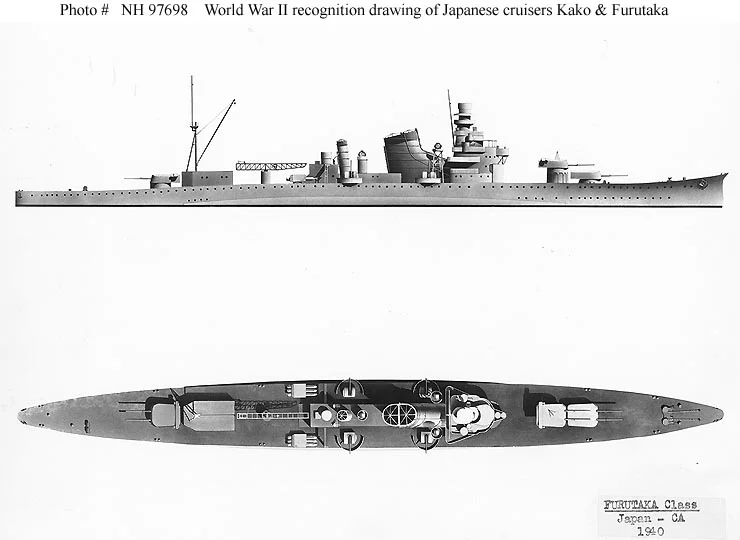
Kako was launched into a different world. She was completed at Kawasaki Shipbuilding in Kobe on 20 July 1926, named - per Japanese naval tradition - after the Kako River that runs through Hyogo Prefecture. With her sister Furutaka she represented Japan's first generation of high-speed heavy cruisers, designed to chase down US Navy scout cruisers and to match the heavy cruisers of the Royal Navy. Through the late 1920s and early 1930s she cruised Japanese and Chinese waters with the Fifth Squadron, participating in fleet maneuvers and operations off the China coast. A major refit in 1929 and 1930 improved her machinery. She appeared at the Yokohama naval review in August 1933 and then, for a while, slipped into reserve. In July 1936 she entered Sasebo Navy Yard for an extensive reconstruction, emerging in December 1937 with a new main battery: three twin turrets of 8-inch guns replacing the six single mounts she had carried before. The ship that went to war in 1941 was, in several significant ways, already her second self.
The First Nine Months of War
When the bombs fell on Pearl Harbor, Kako was half an ocean away, providing support for the Japanese invasion of Guam. Her cruiser division, the Sixth, fought at Wake - first the failed assault in December, then the successful second landing - and returned to Truk in the Caroline Islands. January 1942 brought her to the invasions of Rabaul on New Britain and Kavieng on New Ireland, the twin anchors of what would become Japan's southern bastion. Through March and April she covered landings at Buka, Shortland, Kieta, Manus, the Admiralty Islands, and Tulagi. On 6 May 1942 at Shortland, four US Army Air Forces B-17 Flying Fortresses attacked her unsuccessfully. She continued on, working the sea lanes of the Solomons and the Bismarcks as part of Rear Admiral Aritomo Goto's division. For nine months she moved between forward bases and invasion beaches, doing the unglamorous work that made the war possible.
A Night Off Savo
The First Battle of Savo Island, fought in the dark hours of 8-9 August 1942 in the waters between Guadalcanal and Florida Island, was a catastrophe for the Allies. Japanese cruisers including Kako caught the American and Australian screening force off guard and sank four heavy cruisers - USS Astoria, USS Quincy, USS Vincennes, and HMAS Canberra - with the loss of more than a thousand Allied sailors. It remains, by most accounting, the worst open-water defeat the United States Navy ever suffered. The Japanese withdrew north through the night with Kako at speed, pleased with the outcome but also drawn out of position, strung along the long run back to Kavieng through waters that American submarines had already begun to watch.
Five Minutes Off Simbari
USS S-44 was an old boat, commissioned in 1925, not much faster than the big cruisers she was chasing but, that morning, in the right place. Off Simbari Island, with Kako nearly home, four torpedoes ran true. Two hit the cruiser forward, one amidships, one aft. Within five minutes she was capsizing to starboard. When seawater reached her boilers the ship exploded, and at 0715 - by the Japanese account, 0810 in some Allied logs - Kako disappeared bow-first into roughly 130 feet of water. The survivors in the sea were men who had been laughing the night before. Sixty-eight of their friends were not with them when the screws of Aoba and the others pulled them aboard. Captain Takahashi made it. Most of his crew made it. The ship did not. She was removed from the Imperial Japanese Navy list on 15 September 1942.
What the Sea Keeps
Kako rests today in roughly 40 meters of water off Simbari Island, in the waters between New Ireland and the Papua New Guinea mainland - not far from where she helped put a generation of Allied ships on the bottom a few hours earlier. The men who went down with her were sons, husbands, fathers, and brothers, most of them in their twenties. Their names are harder to find in English-language accounts than the names of the Australian and American sailors who died off Savo the night before, but they are no less real for that. Wars make ledgers of ships and decks and guns. What sinks, in the end, is always people. Kako's five-minute death is recorded in the tabular histories maintained by naval historians like Bob Hackett and Sander Kingsepp, who have spent decades making sure the crews on both sides of the Pacific are not simply subtracted.
From the Air
Located at 2.47 degrees S, 152.18 degrees E, off Simbari Island in the waters between New Ireland and mainland Papua New Guinea, approximately 110 km southwest of Kavieng. The wreck lies in about 40 meters of water and is not visible from altitude, but the surrounding archipelago - the southern tip of New Ireland, Simbari, and the approaches to Kavieng - provides dramatic scenery. Best viewed at 3,000 to 6,000 feet in clear morning conditions. Nearest airport is Kavieng Airport (AYKV) to the northeast. Port Moresby Jacksons International (AYPY) on the mainland provides onward connections. Expect tropical convective weather with afternoon cumulus.
Nearby Stories
- New Ireland Province 21 km away
- New Ireland 58 km away
- Kavieng 80 km away
- Landing on Emirau 182 km away
- USS John A. Bole 253 km away
- Battle of the Green Islands 280 km away
- USS ABSD-4 517 km away
- Raikoke 5623 km away