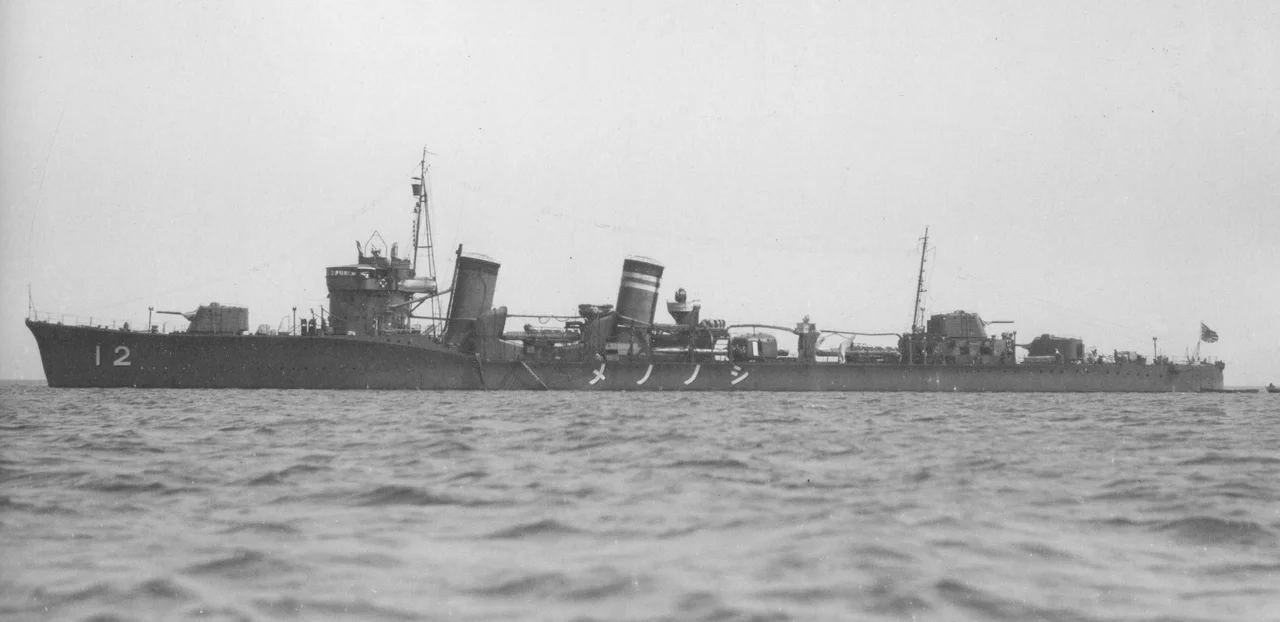

The Ghost Ship of Miri
Somewhere beneath the waters between Seria, Brunei, and the city of Miri lies a warship that no one can find. The Japanese destroyer Shinonome went down on 17 December 1941, ten days after Pearl Harbor, taking Commander Hiroshi Sasagawa and all 228 of his crew with her. She was the first Fubuki-class destroyer lost in the Second World War -- sunk not by a fleet engagement or a submarine ambush, but by a single Dutch flying boat dropping five bombs in a tropical dawn. Wreck hunters have searched for her since 2004. A 2023 expedition, aided by Dutch researchers, came up empty. The sea off Borneo has kept its secret.
A Ship Designed to Frighten
The Fubuki class changed what a destroyer could be. When the Imperial Japanese Navy authorized their construction in 1923, the intent was to build a vessel that could match foreign light cruisers in firepower while outrunning anything afloat. Twenty-four ships of the class were built, and they delivered on the ambition. At roughly 1,750 tons standard displacement, they carried six 127mm guns in three enclosed, weatherproof turrets -- unprecedented for destroyers -- and nine 610mm torpedo tubes capable of launching the devastating Type 93 "Long Lance" torpedo. Their engines produced 50,000 shaft horsepower, pushing the ships to 35 knots. The world's navies took notice. These were not the small, fragile torpedo boats that "destroyer" had previously implied. They were designated Tokugata -- Special Type -- because nothing like them had existed before. Shinonome, the sixth hull in the class, was laid down at Sasebo Naval Arsenal on 12 August 1926, launched on 26 November 1927, and commissioned on 25 July 1928.
The Prewar Years
Commissioned as Destroyer No. 40 before receiving her name, Shinonome was assigned to Destroyer Division 12 under the IJN 2nd Fleet. Through the 1930s, she served in the routine cycles of fleet exercises and patrols that occupied the Japanese navy between wars. When the Second Sino-Japanese War broke out in 1937, she was assigned to patrol the southern coast of China. In 1940, she participated in the Invasion of French Indochina, helping Japan establish control over what is now Vietnam, Laos, and Cambodia. By December 1941, Shinonome had been reassigned to Destroyer Division 12 of Destroyer Squadron 3 under the IJN 1st Fleet. She deployed from the Kure Naval District to the port of Samah on Hainan Island, positioning herself for the coming storm.
Ten Days After Pearl Harbor
Between 4 and 12 December 1941, Shinonome screened the Japanese landings at Kota Bharu on the Malay Peninsula -- the operation that actually preceded the Pearl Harbor attack by several hours due to the time zone difference. On 16 December, she was reassigned to cover Operation B, the invasion of British Borneo. Japan needed Borneo's oil. Miri's fields and the nearby Lutong refinery were primary objectives, and the invasion fleet required destroyer escorts to ward off any Allied response. But the response came from above. On the morning of 17 December, a single Dornier Do 24K-1 flying boat, designated X-32, took off from Tarakan in the Dutch East Indies. It belonged to GVT-7, the 7th Air Group of the Royal Netherlands Naval Aviation Service. The pilot found the Japanese invasion fleet off Miri and released five 200-kilogram bombs. Two struck Shinonome directly, and a near-miss detonated close alongside. The aft magazine exploded. The destroyer broke apart and sank with all hands.
228 Men, No Survivors
Every soul aboard Shinonome perished. Commander Sasagawa, his officers, and 228 crew members went down with the ship in what was one of the earliest catastrophic losses of the Pacific War. On 15 January 1942, the Imperial Japanese Navy formally struck Shinonome from its register. The sinking demonstrated a harsh truth that the war would confirm repeatedly: even the most advanced warships were vulnerable to air attack. The Fubuki class had been designed to dominate surface engagements, but no amount of torpedo tubes or gun turrets could defend against bombs dropping from a flying boat at altitude. A single aircraft, flown by Dutch naval aviators defending their colonial territories, had destroyed a frontline Japanese destroyer in minutes.
Still Missing
The exact position where Shinonome went down remains unknown. Wartime records place the sinking somewhere in the waters off Miri, in an area stretching north toward Seria, Brunei. The imprecision is unusual -- most warship wrecks from the period have been located and surveyed -- but the shallow, silty waters off northwestern Borneo complicate the search. Shifting mud may have buried the hull. The explosion that sank her may have scattered wreckage across a wide area rather than leaving an intact hull on the seabed. Since 2004, wreck researchers based in Miri, working with Dutch partners who have their own reasons to locate the site, have conducted multiple search expeditions. A 2023 campaign using modern survey equipment returned without a confirmed find. The position, orientation, and condition of the wreck, when finally discovered, may help resolve lingering questions about the exact circumstances of the sinking. Until then, Shinonome remains a ghost ship -- documented in every naval history, present in no diver's logbook.
From the Air
Approximate location: 4.40N, 114.00E, in the waters off Miri, Sarawak, extending north toward Seria, Brunei. The wreck has not been located, so no precise position exists. From the air, the relevant area is the coastal waters between Miri city and the Brunei border. Nearest airports: Miri Airport (WBGR) approximately 10 km south; Brunei International Airport (WBSB) approximately 100 km northeast. Recommended viewing altitude: 5,000-8,000 feet to survey the stretch of coast where the sinking occurred.
Nearby Stories
- The Last Cathedral of Trees 5.8 km away
- The Black Lake and the White Crocodile 15 km away
- The Billion-Dollar Playground That Michael Jackson Opened 33 km away
- Sarawak Chamber 34 km away
- Where the River Meets the Sea 58 km away
- Similajau National Park 95 km away
- Luconia Shoals 170 km away
- Crown Colony of Sarawak 206 km away