
Japanese Occupation of Hong Kong
The phrase that Hong Kong people use to describe it became, in time, a shorthand for suffering itself. 三年零八個月 — three years and eight months. The period from 25 December 1941, when Governor Mark Aitchison Young surrendered the British Crown colony to Imperial Japan at the Peninsula Hotel, to 15 August 1945, when Japan capitulated. Those numbers, carrying the weight of everything that happened within them, became a metonym: not just a duration but a reckoning. Hong Kong people who lived through it measured their lives in relation to it — before, during, after.
Eighteen Days
The Battle of Hong Kong lasted eighteen days. Japanese forces launched their assault on the morning of 8 December 1941, crossing the border from Guangdong into the New Territories and driving south. British, Canadian, and Indian soldiers, supported by the Hong Kong Volunteer Defence Corps, fought to slow the advance — but they were heavily outnumbered and the territory was not designed for prolonged defense. By 18 December, Japanese forces had crossed Victoria Harbour to Hong Kong Island. Fighting on the island was fierce and close; casualties mounted on both sides, and atrocities were committed against wounded soldiers, medics, and civilians. On 25 December, Christmas Day, Governor Young surrendered. The formal document was signed the following day, also at the Peninsula Hotel — now the Japanese military headquarters, renamed the Matsumoto. The city's street names were changing by April 1942. Queen's Road became Meiji-dori. Des Voeux Road became Shōwa-dori.
Under Occupation
General Rensuke Isogai became Hong Kong's first Imperial Japanese governor on 20 February 1942. The military administration imposed martial law, controlled warehouses and food supplies, and fixed exchange rates in ways that systematically extracted wealth from the local population. Famine was not incidental — it was structural. Rice was rationed to 240 grams per person per day. More than 7,000 British soldiers and civilians were held in prisoner-of-war and internment camps, including Sham Shui Po and Stanley. Severe malnutrition was documented at Stanley Internment Camp as late as 1945. Hong Kong's population shrank dramatically during the occupation, falling from roughly 1.6 million before the war to around 600,000 by its end, as people fled, were deported, or died. The Kempeitai — the Japanese military police — ran interrogations at the Central Police Station in which, according to testimony from postwar trials, more than 100 prisoners died from starvation or torture. No judges. No lawyers. No observers.
The Crimes
The record of atrocities committed during the occupation is extensive and documented. On 19 May 1942, approximately 10,000 refugees were detained and loaded onto nineteen ships at Sai Wan. Each person received a jar of rice, two pieces of bread, and ten Hong Kong dollars. They were locked in the bilges. A typhoon struck. Fourteen of the nineteen ships sank. Around 3,000 people drowned. Survivors rescued later were too weak to walk. On 25 September 1942, 1,816 Allied prisoners of war were loaded onto the unmarked freighter Lisbon Maru and transported toward Japan for forced labor. The ship was torpedoed by the USS Grouper off the Zhoushan coast. As prisoners tried to swim free, Japanese soldiers on adjacent vessels shot them in the water. Approximately 1,000 died. In July 1944, around 400 refugees were abandoned on Beaufort Island with almost no food or water. Residents on a nearby headland could hear screaming from the island. Skeletons were found across the island afterward. Between Japan's surrender on 15 August 1945 and the formal British reoccupation on 16 September, fifteen Japanese soldiers executed approximately 300 villagers on Lantau Island in what became known as the Silver Mine Bay massacre.
Resistance and Survival
Ordinary life under occupation did not stop — it contracted, adapted, and in places pushed back. The Tung Wah and Kwong Wah hospitals, though stripped of medicine and funds, continued limited services: food, clothing, burial assistance. Po Leung Kuk took in orphans. The East River Column, a guerrilla force operating in the countryside, provided aid to shot-down Allied pilots and gathered intelligence; twenty American pilots owed their lives to this network. Inside the city, small acts of daily resistance continued alongside the grinding difficulty of staying alive. People found ways to maintain community — through clan associations, through hospitals, through the informal networks that every city develops under pressure. When Japan surrendered, Franklin Gimson, Hong Kong's colonial secretary, walked out of his internment camp and declared himself acting governor before British forces had even arrived. He understood that the speed of the British return would matter.
What the Three Years and Eight Months Left Behind
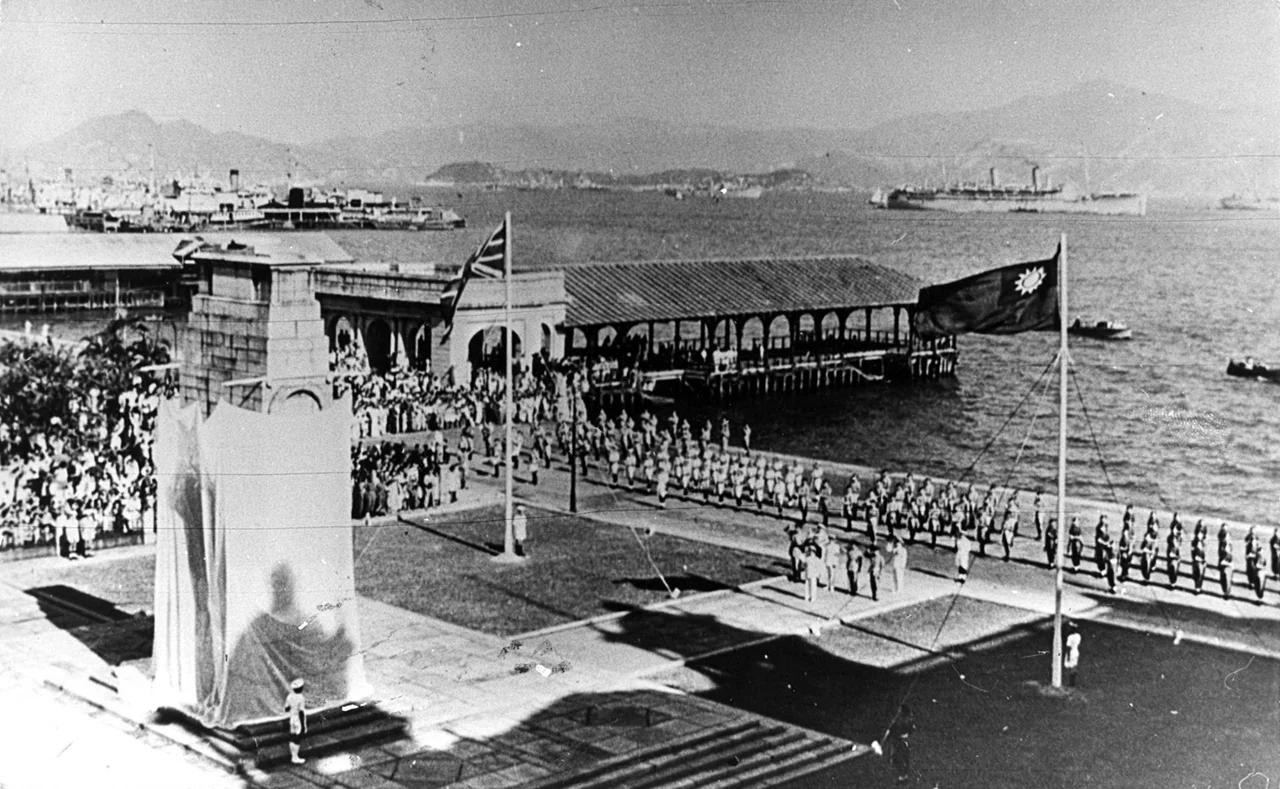
Hong Kong's post-war recovery was rapid by any measure. By November 1945, government controls were lifted and free markets restored. The population rebuilt. The city rebuilt. In 1997, sovereignty passed to the People's Republic of China under the terms of the 1984 Sino-British Joint Declaration, and Liberation Day — the annual public holiday marking 30 August 1945, when the Royal Navy entered Victoria Harbour — was quietly removed from the calendar. The occupation does not dominate Hong Kong's public memory in the way that comparable events dominate the histories of other places, perhaps because Hong Kong moved so quickly, and so deliberately, toward its economic future. But the phrase remains. Three years and eight months. The number that carries everything that cannot be easily said.
From the Air
The events of the occupation played out across virtually the entire territory of Hong Kong, centered at approximately 22.28°N, 114.17°E. Victoria Harbour — the body of water that Japanese forces crossed on 18 December 1941 in their assault on Hong Kong Island — is clearly visible from the air, separating Hong Kong Island to the south from Kowloon to the north. The Peninsula Hotel, where the surrender was signed, stands on the Tsim Sha Tsui waterfront at the southern tip of the Kowloon Peninsula. Stanley, on the south side of Hong Kong Island, was the site of the Stanley Internment Camp. Lantau Island, scene of the Silver Mine Bay massacre, is visible to the west. Hong Kong International Airport (VHHH) occupies reclaimed land at Chek Lap Kok on Lantau's north coast.
Nearby Stories
- Lok Ma Chau Loop 2.3 km away
- Portas do Cerco 2.3 km away
- Kweilin Incident 17 km away
- Wanshan Archipelago Campaign 34 km away
- Nanxiong Formation 115 km away
- Battle of Nanpeng Island 148 km away
- Heyuan 169 km away
- Cape Maobitou 632 km away