
Jarrow Hall
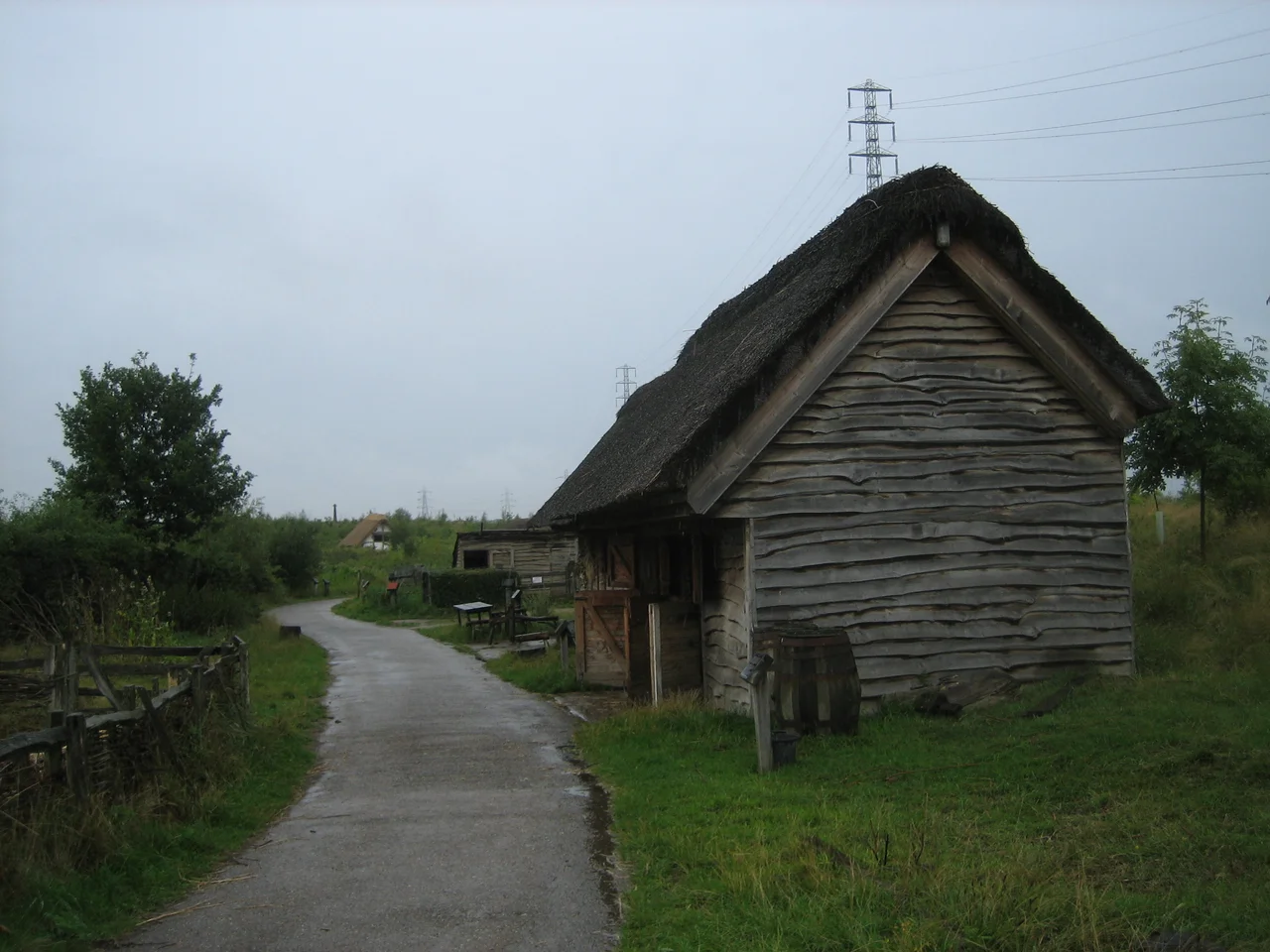
Smoke drifts from a small fire pit inside a thatched timber hall, the smell threading through animal hides and oak beams the way it would have done thirteen hundred years ago. This is Gyrwe, pronounced Yeerweh, the Old English name for Jarrow, and the people tending the wattle and daub walls are dressed for the eighth century on purpose. Just over the path lie the ruins of the monastery where the Venerable Bede wrote the Ecclesiastical History of the English People. Jarrow Hall is the rare museum that tries to hand you not the artefacts of Bede's world, but the climate of it.
Living in the Age of Bede
The reconstructed Anglo-Saxon farm is the heart of the site. Three timber buildings rise from the ground based on archaeological evidence from Northumbria. Thirlings Hall is the largest, with animal hides and household objects scattered as they would have been. A grubenhaus, a sunken building used as a cold store, sits beside a small monk's cell. All three are thatched and built using traditional techniques. The animals are smaller, less specialised breeds chosen to mimic the cattle and sheep of Anglo-Saxon England before selective breeding rewrote their bodies. Ancient strains of wheat and vegetables have been grown on site, the same crops the monks of St Paul's would have tasted at their refectory tables. The effect is not a diorama but a working farm where someone is always tending something.
The Bede Museum
Inside the purpose-built Bede Museum, the Age of Bede exhibit gathers excavated fragments from the monastery itself: pieces of imported pottery, coins, stone carvings, and slivers of stained glass that once filtered light onto a Northumbrian altar. Bede was a monk who almost never left this place, yet from this corner of England he wrote a history that defined how the English would understand their own origins. The exhibits trace his life and works, the daily routine of a Benedictine monastery, and the wider Kingdom of Northumbria that briefly held the largest library north of the Alps. Just beside the museum lie the actual ruins of St Paul's monastery, a scheduled monument that survived Vikings, Henry VIII's dissolution, and the centuries of erosion that came after.
From Bede's World to Jarrow Hall
The museum's modern history is its own story of near-loss. The site opened in 1993 as Bede's World, an 11-acre Anglo-Saxon attraction built at a cost of almost £10 million. It pulled 70,000 visitors a year and still went under, closing in February 2016 when the finances simply ran out. The broadcaster Melvyn Bragg used his slot on BBC Radio 4's Broadcasting House to contrast the closure with the millions being poured into London's eventually-cancelled Garden Bridge. The protest worked. By August 2016 the charity Groundwork had stepped in, and after over £100,000 of investment and a soft opening that October, Jarrow Hall fully relaunched on 8 April 2017. The Georgian house that gives the museum its name was renovated with help from Durham University, and the medieval herb garden behind it now grows over 200 species.
Flight Context
Coordinates 54.98 N, 1.47 W on the south bank of the River Tyne in South Tyneside. Recommended viewing altitude 1,500 to 3,000 feet. Look for the cluster of timber Anglo-Saxon buildings on an open green site just south of the river and west of the Jarrow Slake. The nearest ICAO airport is Newcastle International (EGNT), about 9 nautical miles west-northwest. Durham Tees Valley (EGNV) lies 22 nautical miles south. The Tyne curls north and east of the site toward the coast at Tynemouth.
From the Air
Coordinates 54.98 N, 1.47 W on the south bank of the Tyne in South Tyneside. Viewing altitude 1,500 to 3,000 feet AGL. Nearest ICAO airport is Newcastle International (EGNT) about 9 nautical miles west-northwest; Durham Tees Valley (EGNV) is 22 nautical miles south. Look for the cluster of timber Anglo-Saxon buildings on an open site just west of Jarrow Slake.
Nearby Stories
- Cresswell Lifeboat Station 5.2 km away
- Auckland Castle 5.7 km away
- Battle of Otterburn 7.1 km away
- Saltburn Pier 11 km away
- Hadrian's Wall Path 11 km away
- Battle of Stainmore 18 km away
- Saltburn-by-the-Sea 39 km away
- Alexander L. Kielland (Platform) 296 km away