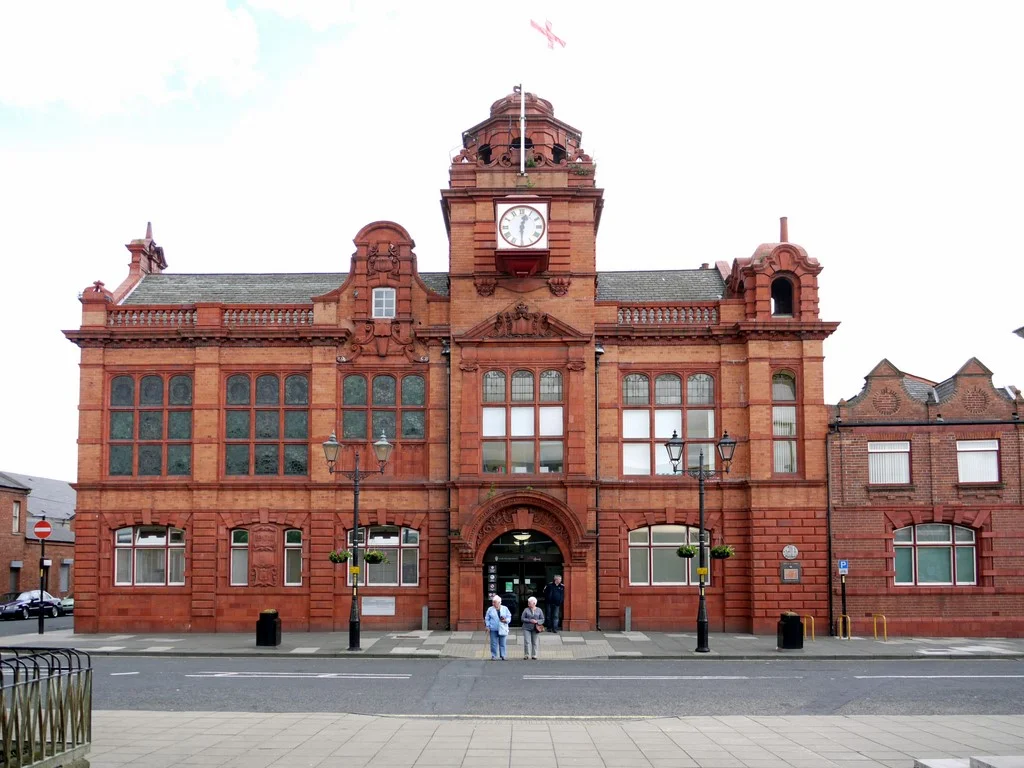
.jpg)
Jarrow
On 5 October 1936, two hundred men set out from this town on the south bank of the Tyne to walk 280 miles to London. Each had been vetted by a doctor. Each carried a petition. Each was unemployed. Their MP, Ellen Wilkinson, marched at the head of the column in a red coat. By the time they reached Westminster a month later, Parliament refused to receive them. Wilkinson would later write a book about her constituency and call it The Town That Was Murdered. Jarrow is that book's subject, and that march is only its second most famous story.
The Fen Dwellers
The name itself comes from the Gyrwe, an Anglian tribe whose name means fen dwellers, perhaps a reference to the now-drained wetland called Jarrow Slake where the Tyne meets the Don. Norman tongues hardened the soft Old English consonant into a J, the same way they turned Yesmond into Jesmond just up the river. By the eighth century the Monastery of St Paul stood here, half of the twin foundation of Monkwearmouth-Jarrow Abbey, and at its heart sat the monk who would shape how the English understood themselves. Bede wrote his Ecclesiastical History of the English People in this place. Along with its sister at Wearmouth, the monastery held the largest library north of the Alps, the fruit of Benedict Biscop's repeated journeys to Rome. One wall of the present-day church of St Paul contains stained glass dating from about AD 600, said to be the oldest surviving in the world.
Codex Amiatinus
Around 692 the abbot Ceolfrid commissioned three full Latin bibles to be produced here, an undertaking of staggering ambition for any monastery of the period. One of those bibles survives. It travelled south as a gift intended for Pope Gregory II, ended up at the Abbey of the Saviour on Monte Amiata in Tuscany, and from there passed in 1786 to the Laurentian Library in Florence, where it lives still. The Codex Amiatinus is the oldest complete copy of the Latin Bible in existence, and it was produced on this scrap of land where a chemical works and a shipyard would later stand. The Vikings spotted Jarrow early. They sacked Lindisfarne in 793. The following year they came for Jarrow.
The Town That Was Murdered
For most of its modern life Jarrow was a shipbuilding town. Sir Charles Mark Palmer founded Palmer's Shipbuilding and Iron Company in 1852 and became the first armour-plate manufacturer in the world. The yard built warships, the cargo ships that became the standard model for the trade, and finally the half-demolished hulk of RMS Olympic, the sister ship of Titanic, towed away in 1937 for final scrapping in Scotland. Between those bookends came the closure. National Shipbuilders Securities, a body set up to cut British shipyard capacity, bought Palmer's in 1934 and shut it down. The town that depended on the yard collapsed. Life magazine called Jarrow cursed. The march in 1936 was the answer, and so was Wilkinson's furious book three years later. Historians still argue about whether the Jarrow March changed any policy. What it changed was the way Britain talked about its abandoned places.
Flight Context
Coordinates 54.98 N, 1.49 W on the south bank of the Tyne, about 5 miles east of Newcastle city centre. Recommended viewing altitude 2,000 to 4,000 feet. The southern portal of the Tyne Tunnel sits on Jarrow's northern edge; from above the town reads as a riverside grid pressed against the curving Tyne. The Anglo-Saxon ruins of St Paul's monastery and the adjacent Jarrow Hall museum lie on the eastern side near the Slake. Nearest ICAO airport Newcastle International (EGNT) is 8 nautical miles west-northwest. Durham Tees Valley (EGNV) is 21 nautical miles south.
From the Air
Coordinates 54.98 N, 1.49 W on the south bank of the River Tyne about 5 miles east of Newcastle. Viewing altitude 2,000 to 4,000 feet AGL. Nearest ICAO airport Newcastle International (EGNT) is 8 nautical miles west-northwest; Durham Tees Valley (EGNV) is 21 nautical miles south. Look for the southern portal of the Tyne Tunnel on the town's northern edge and the curving Tyne to the north.
Nearby Stories
- Cresswell Lifeboat Station 5.2 km away
- Auckland Castle 5.7 km away
- Battle of Otterburn 7.1 km away
- Saltburn Pier 11 km away
- Hadrian's Wall Path 11 km away
- Battle of Stainmore 18 km away
- Saltburn-by-the-Sea 39 km away
- Alexander L. Kielland (Platform) 296 km away