
Jawne
In 1933, the year Hitler took power, the director of a Cologne Jewish school named Erich Klibansky stopped pretending. "To which school do I send my child?" he wrote. "This question is today decided. One cannot answer that we should not take ourselves back into the ghetto, because the process of exclusion by the German people towards us Jews is in full swing." He had been director of the Jawne for only four years. He would have nine more to prepare his students for whatever was coming. He used them to teach English and modern Hebrew - to prepare children, with brutal clarity, for a life that would not be lived in Germany.
A School Named for Exile
The Jawne took its name from Yavne, the town near Tel Aviv where, after the Romans destroyed Jerusalem in 70 CE, the rabbis of the Sanhedrin tried to keep Jewish learning alive when the temple was gone. The name was a kind of promise. Rabbi Emanuel Carlebach founded the school in Cologne around Easter 1919 as the first - and only - Jewish secondary school in the Rhineland. By 1925 the state recognized it as a Real-Progymnasium and Lyzeum. By 1928 the Cologne Jewish community was funding it. The building was completed in 1921. For students arriving in the 1920s, it was simply the school they walked to, the place where they sat for German and Hebrew and mathematics, where they fell in love and got in trouble and graduated.
Klibansky's Calculation
In the 1930-31 school year, the Jawne had 103 boys and 75 girls. By 1936-37, total enrollment had reached 410 - swollen because Jewish students had been pushed out of other schools all over Cologne. Klibansky watched this happen and made a decision few other educators dared make: he assumed the worst-case future and built the curriculum around it. English lessons were intensified. So was modern Israeli Hebrew, then called Ivrit, the language of a Palestine that Britain still controlled. He was teaching children the languages of escape. The teachers who taught alongside him understood what they were doing. Many had only those years left, and they used them to give their students a chance at the world beyond Germany.
The Kindertransport
After Kristallnacht in November 1938, Klibansky did not write more letters. He organized. He planned to evacuate the entire school to the United Kingdom and turned to the Kindertransport network, which moved Jewish children from Nazi-occupied Europe to Britain by train and ship. The catch was unbearable: children went without their parents. A mother or father would put a son or daughter on a train and not see them again, sometimes for years, sometimes ever. Klibansky succeeded in getting at least 130 Jewish children from Cologne out. They survived the war. Many of their parents did not.
The Train East
When the Second World War broke out in September 1939, the routes to England closed. The children left behind in the Jawne had no more escape lanes. In 1942 the Nazis deported Klibansky, his wife, his sons, and the students who remained, along with more than a thousand other Cologne Jews. The trains went east to the Maly Trostinets killing site near Minsk. There were no selections, no work camp, no survivors from that transport. Klibansky was murdered with his family. The teachers who had stayed to teach to the end were murdered. The children whose parents had not been able to bring themselves to send them away alone were murdered. The school building did not survive the war either.
The Fountain with the Names
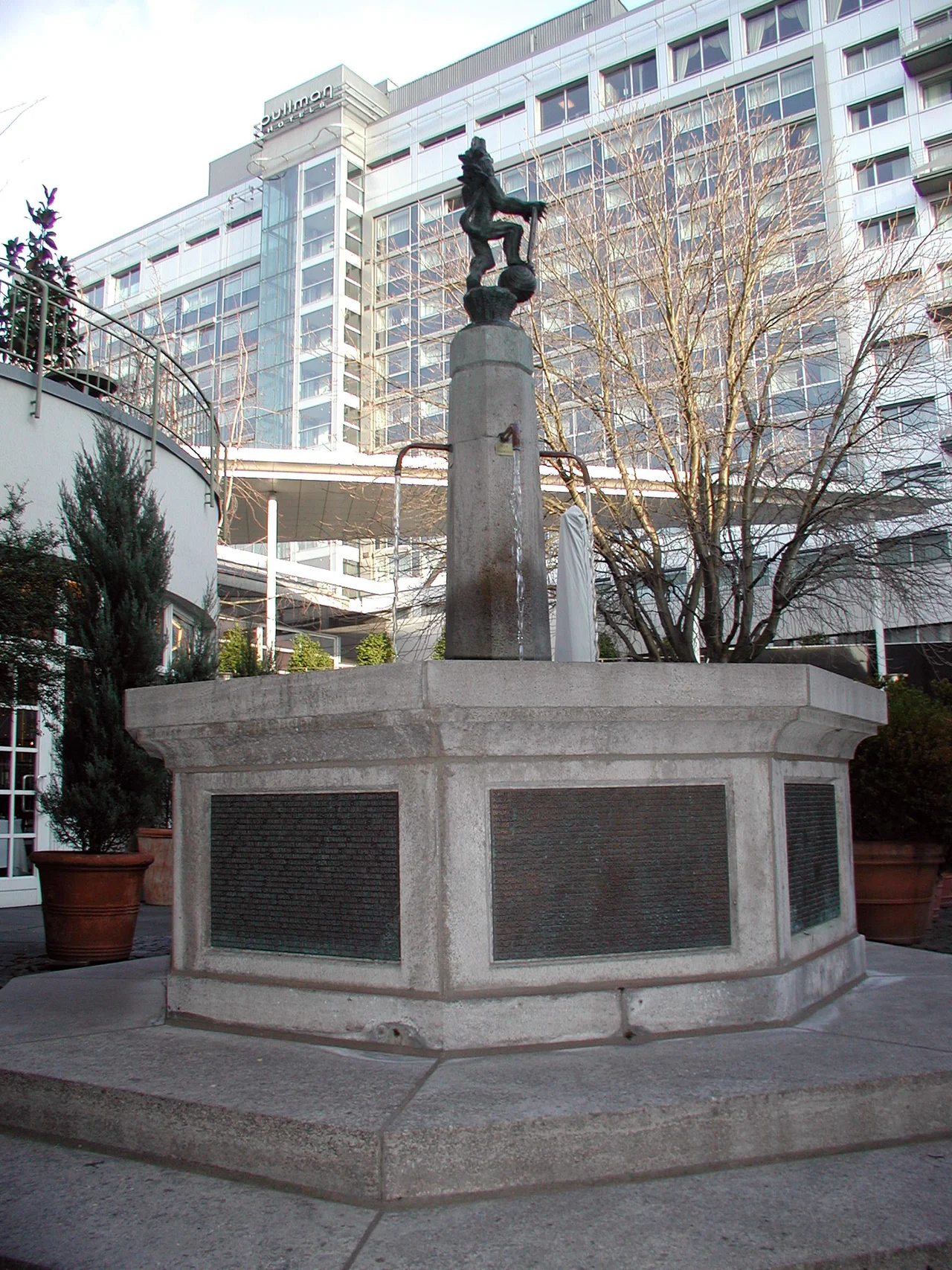
It took until 1990 for the square where the Jawne stood to be officially renamed Erich Klibansky Platz. The push came from Cologne citizens who refused to let the school vanish into the city's grid. In the small square is the Löwenbrunnen, the Lions' Fountain, designed by Hermann Gurfinkel - a former Jawne student who survived, became a sculptor, and came home to make the memorial. The fountain lists the names of the children who were killed. Inside the Jawne Memorial and Educational Center, an exhibition opened in 2007 by historian Cordula Lissner carries the title "The children from the other schoolyard." That is what they were. Not abstractions. Not statistics. The children from the other schoolyard, who learned English so they could live, and most of whom never got the chance to use it.
From the Air
50.94N 6.94E. Erich Klibansky Platz lies in central Cologne, just south of the cathedral district. Nearest airport: Cologne/Bonn (EDDK), 15 km southeast. The memorial square is small and easily missed from the air; the surrounding Innenstadt grid and the Rhine to the east are the orienting features. The memorial center operates in conjunction with the EL-DE Haus, Cologne's Nazi-era documentation center, a short walk away.
Nearby Stories
- Diamond Interchange: How a Simple Idea Reshapes Towns Like Julich 2.8 km away
- Dusseldorf-Unterbach 6.1 km away
- Baumwollspinnerei Ermen & Engels 11 km away
- RAF Bruggen 15 km away
- Hagen Open-air Museum 21 km away
- Belgium 130 km away
- Marcinelle Mining Disaster 173 km away
- Zwingenberg Castle 178 km away