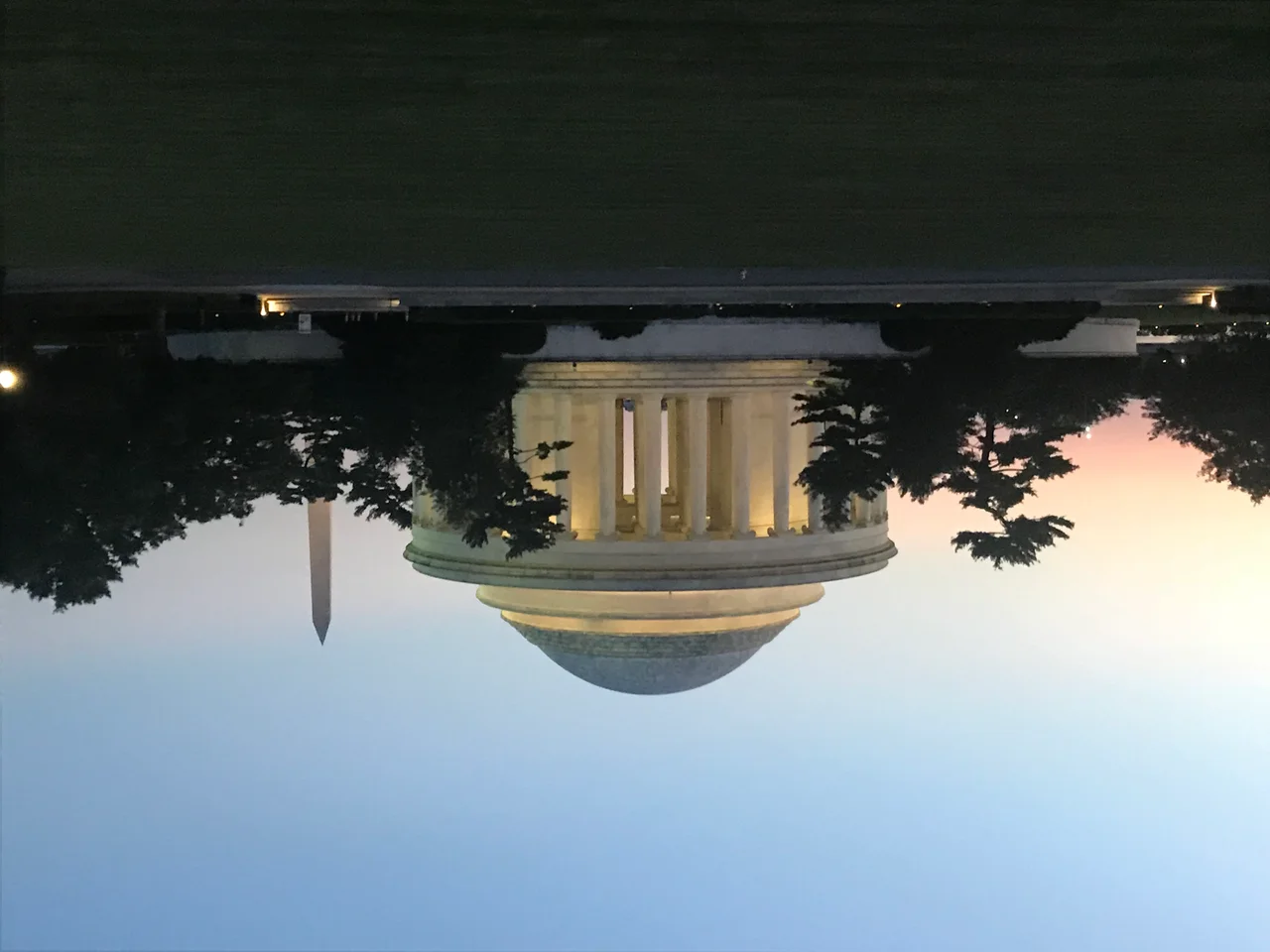

Jefferson Memorial
In November 1938, a group of Washington women chained themselves to cherry trees to stop the construction crews. The crews were clearing ground for a memorial that did not yet have a final design, did not yet have approval from the Commission of Fine Arts, and did not yet have a statue. Franklin Roosevelt sent word that the women would be unchained and removed. The trees came down. Five years later, on the bicentennial of Thomas Jefferson's birth in April 1943, Roosevelt dedicated the rotunda that rose from that disputed ground - a marble dome on the Tidal Basin, facing the White House across the water. The statue inside would not arrive for another four years.
A Pantheon on Filled Ground
The land itself is an invention. In the late nineteenth century, the spot now occupied by the Jefferson Memorial was a beach on the Potomac, slowly built up by dredging and fill. Architect John Russell Pope, the New York-based designer of the National Archives Building, drew on two specific references when he sketched the memorial: the Pantheon in Rome - completed under the emperor Hadrian around 125 AD - and Jefferson's own design for the Rotunda at the University of Virginia, which itself had borrowed from the Pantheon. The result is a circular colonnade of Vermont marble around a domed interior of Georgia white marble. Cost: about three million dollars. Philadelphia contractor John McShain, who would later build the Pentagon, won the construction job. The cornerstone, set by Roosevelt on November 15, 1939, contained fifteen volumes of Jefferson's writings. The ground around the memorial has sagged steadily ever since - by 2007 the sinking was alarming enough for new alarms, and by the 2020s, high tides regularly washed over the seawall.
Four Walls, Four Quotations
The interior holds four inscribed panels, each carved into the marble like an argument made permanent. The most famous, on the southwest wall, opens with We hold these truths to be self-evident, taking the Declaration's preamble straight through to we mutually pledge our lives, our fortunes, and our sacred honor. The inscription uses the word inalienable, as Jefferson originally drafted it, rather than unalienable, which appeared in the final document. On the northwest wall: a stitched-together quotation from the 1777 Virginia Statute for Religious Freedom and an 1789 letter to James Madison - Almighty God hath created the mind free. On the northeast wall, the inscription is harder. It begins God who gave us life gave us liberty, then continues into territory the curators chose deliberately: Commerce between master and slave is despotism. Nothing is more certainly written in the book of fate than that these people are to be free. Jefferson, who held more than six hundred enslaved people across his lifetime, wrote those words. The memorial places them on the wall.
A Statue Delayed by War
When the memorial opened in April 1943, the statue at its center was made of plaster. World War II had cut off the metal needed for bronze. Rudulph Evans, chosen from 101 entries in a 1939 sculptors' competition, had completed his design - a nineteen-foot Jefferson standing in a long coat, head slightly tilted - but the bronze could not be cast. The plaster cast served as a placeholder for four years. In 1947, with the war over, Roman Bronze Works in New York finally cast the figure, and the statue traveled south to take its place under the dome. Adolph A. Weinman's pediment relief above the entrance, showing the Committee of Five at work on the Declaration, was completed on schedule. The memorial as visitors see it now - statue, walls, dome - was complete only after the war that delayed it ended.
Axis and Distance
Pierre L'Enfant's original plan for Washington did not anticipate a memorial in this spot. The city's monumental axis ran east-west from the Capitol through the Washington Monument to the Lincoln Memorial. The Jefferson Memorial breaks that grammar deliberately. It sits exactly south of the White House on a north-south axis that was supposed to converge with the east-west axis at the Washington Monument. Supposed to. The Washington Monument was actually built farther east, because the ground at the intersection point was too soft to bear the obelisk's weight. So the geometry never quite resolves. The memorial looks straight up Maryland Avenue across the Tidal Basin, and looks back across at the White House. Roosevelt ordered cherry trees pruned to keep the sightlines open. The 1912 trees from Japan that survived the construction now bloom around the basin every spring - the cherry blossoms that draw a million visitors became, by accident, the memorial's annual frame.
Pantheon for a Contradiction
Jefferson wrote the Declaration that announced all men are created equal. He held people in bondage for his entire adult life. The memorial built in his honor places his words about slavery's wrongness on the same wall as his words about liberty's sacredness - words he never lived out. The American Institute of Architects ranked the memorial fourth on its 2007 list of America's favorite architecture, behind the Empire State Building, the White House, and the National Cathedral. The dome on the Tidal Basin remains a quieter memorial than the Lincoln, less crowded than the Washington Monument. Visitors who walk in early morning often have the rotunda almost to themselves. The statue looks out toward the White House. The cherry trees, when they bloom, frame the columns. The contradictions stay where Jefferson left them - written on the walls, weighing on the ground that keeps sinking under their weight.
From the Air
The Jefferson Memorial sits at 38.8814 N, 77.0367 W, on the south shore of the Tidal Basin in West Potomac Park. Best viewed from 1,500 to 2,500 feet AGL. The white marble dome is unmistakable against the basin's water; the Washington Monument sits a half mile north and the Lincoln Memorial about a mile northwest. Reagan National (KDCA) lies two nautical miles south. The entire site is inside the Washington Flight Restricted Zone and Special Flight Rules Area - GA overflight prohibited; aerial views require approved operations or vantage from outside the FRZ. The Tidal Basin cherry blossoms in late March or early April provide the most distinctive aerial appearance.
Nearby Stories
- Gunston Hall 1.1 km away
- 2023 Baltimore Shooting 4.9 km away
- Battle of Middleburg 6.6 km away
- Crownsville Hospital Center 10 km away
- Battle of Loudoun Heights 13 km away
- First Battle of Rappahannock Station 20 km away
- Howard County, Maryland 21 km away
- Harriet Tubman Underground Railroad 50 km away