.jpg)
Jiadong
On October 11, 1895, the correspondent James W. Davidson rode into what he described as a village "surrounded by a low stone wall loop-holed for rifle fire," a body of water nearly encircling it. He was there to witness or report what happened next: Japanese forces attacked Jiadong as part of their systematic conquest of Taiwan, set several houses on fire, and won. The battle lasted long enough to mark the historical record but not long enough to turn the tide. The Republic of Formosa — the short-lived state that had declared independence to resist the Japanese takeover — had already lost its capital. Jiadong was one more step in a foregone conclusion.
Katangkha: The First Name
Before the Hakka farmers arrived, before the Japanese renamed everything, before the Republic of Formosa existed as even an idea, this place was called Katangkha. It was the home of the Makatao people, one of the Pingpu tribes — the plains-dwelling indigenous peoples of western Taiwan who had lived in these lowland areas for generations before large-scale Han Chinese immigration transformed the island. The Hakka colonists who began arriving from northeastern Guangdong in the 18th century established the agricultural settlement that would eventually become Jiadong Township, and in the process the Makatao were absorbed and assimilated into the new community. What that process looked like for the Makatao themselves — what they kept, what they lost, how quickly the change came — is the kind of story that rarely made it into the historical record. What survived is the original name, remembered now mainly by historians and the descendants of those who lived it.
The Battle of Chiatung
The Battle of Chiatung on October 11, 1895, was a small engagement in a large tragedy. The Treaty of Shimonoseki had ceded Taiwan to Japan earlier that year, and a group of Taiwanese officials and citizens had responded by declaring the Republic of Formosa — an act of resistance that was always more symbolic than strategic. Japanese forces moved methodically southward through the island, defeating the Republic's forces in a series of engagements. Jiadong was one of them. Davidson's description of the village — the stone wall, the loopholes, the surrounding water — captures a community that had tried to fortify itself against what was coming. The loopholes in the wall were for rifle fire: the defenders expected to fight. They did fight, briefly. Then the houses burned. The Japanese victory here was part of the broader pacification of Pingtung County, and within months all organized resistance on the island had ended.
Twelve Villages, One Township
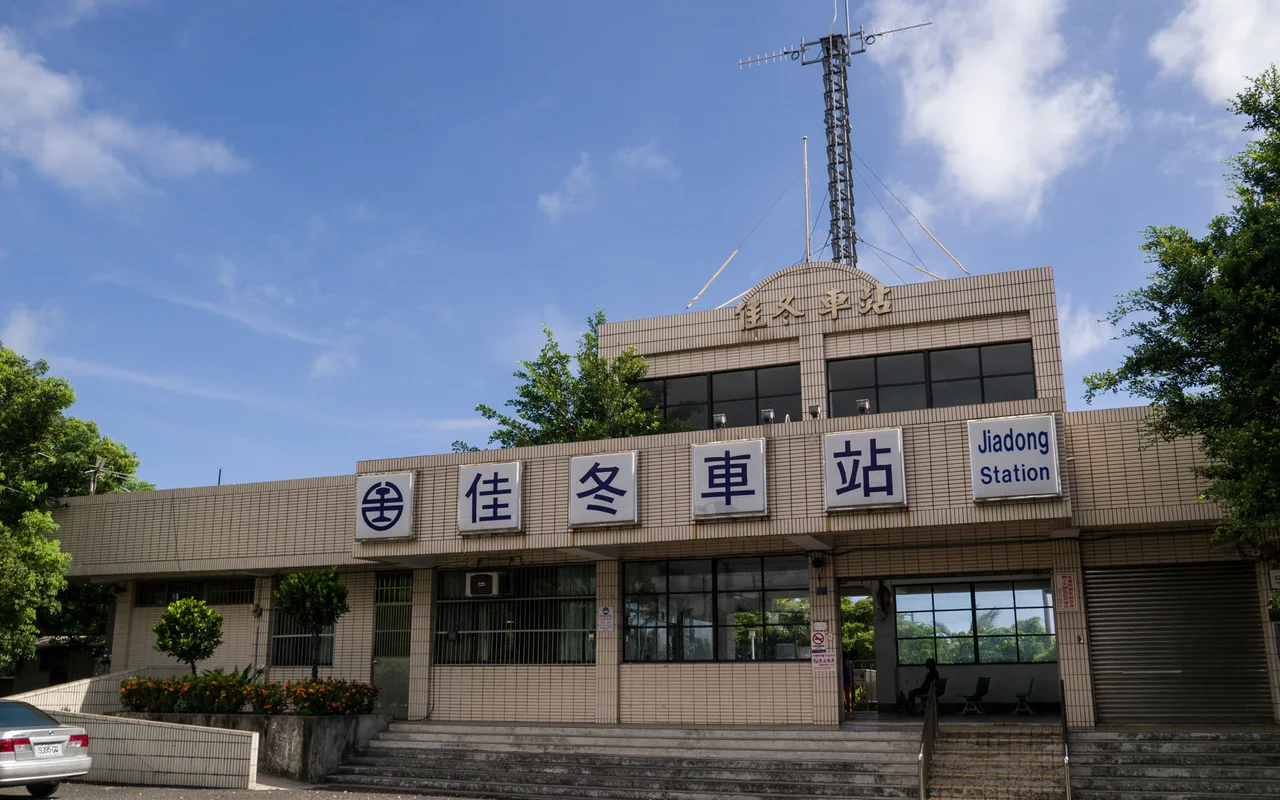
Today Jiadong Township is a quiet rural place in eastern Pingtung County, its 31 square kilometers divided among 12 villages: Changlong, Datong, Fenglong, Jiadong, Laijia, Liugen, Qiangyuan, Shiguang, Wanjian, Wenfeng, Yanwen, and Yuguang. Its population of roughly 17,838 makes it a modest community by any measure, built on the same agricultural base that Hakka settlers established centuries ago. The Old House of Siiao Family and the Yang Family Ancestral Hall are the township's main heritage sites — both reflecting the Hakka tradition of substantial family compounds that served as the social and religious center of the extended family. The Taiwan Railway's Jiadong Station connects the township to the broader Pingtung Line, a reminder that even small rural places were integrated into the island's transportation network during the Japanese colonial period.
A Director's Hometown
Jiadong's most internationally recognized native son is Chung Mong-hong, the film director, screenwriter, and cinematographer whose work has brought him recognition across the Taiwanese film industry and beyond. Chung's films are known for their meticulous visual construction — not surprising for a director who also works as his own cinematographer — and for an interest in the texture of contemporary Taiwanese life. The township that shaped him is not a famous place; it lacks the dramatic harbor of Donggang or the monumental temple ceremonies that draw crowds from across Taiwan. What it has is the particular quietness of a rural Pingtung community: rice fields, family compounds, a small train station, the ordinary weight of a history that includes displacement, colonization, and the long, slow work of rebuilding after each rupture. It is exactly the kind of place from which a filmmaker with an eye for unspectacular truth might come.
From the Air
Jiadong Township sits at 22.430°N, 120.547°E in the eastern part of Pingtung County, further inland than the coastal towns of Donggang and Linbian. From the air at 2,500 feet, the flat agricultural patchwork of the Pingtung Plain stretches in all directions — rice paddies, fish farms, and scattered villages. The Central Mountain Range rises to the east, its peaks dominating the horizon. The nearest major airport is RCKH (Kaohsiung International), approximately 40 kilometers to the northwest. The Pingtung Line railway is visible as a thin corridor running north-south through the township, connecting Jiadong Station to the broader network.
Nearby Stories
- Zhiben Hot Spring 8.7 km away
- Fo Guang Shan 8.8 km away
- Duoliang Station 11 km away
- Checheng Fu'an Temple 32 km away
- Orchid Island 62 km away
- Dongji Island 68 km away
- South Penghu Marine National Park 96 km away
- Hong Kong 12 548 km away