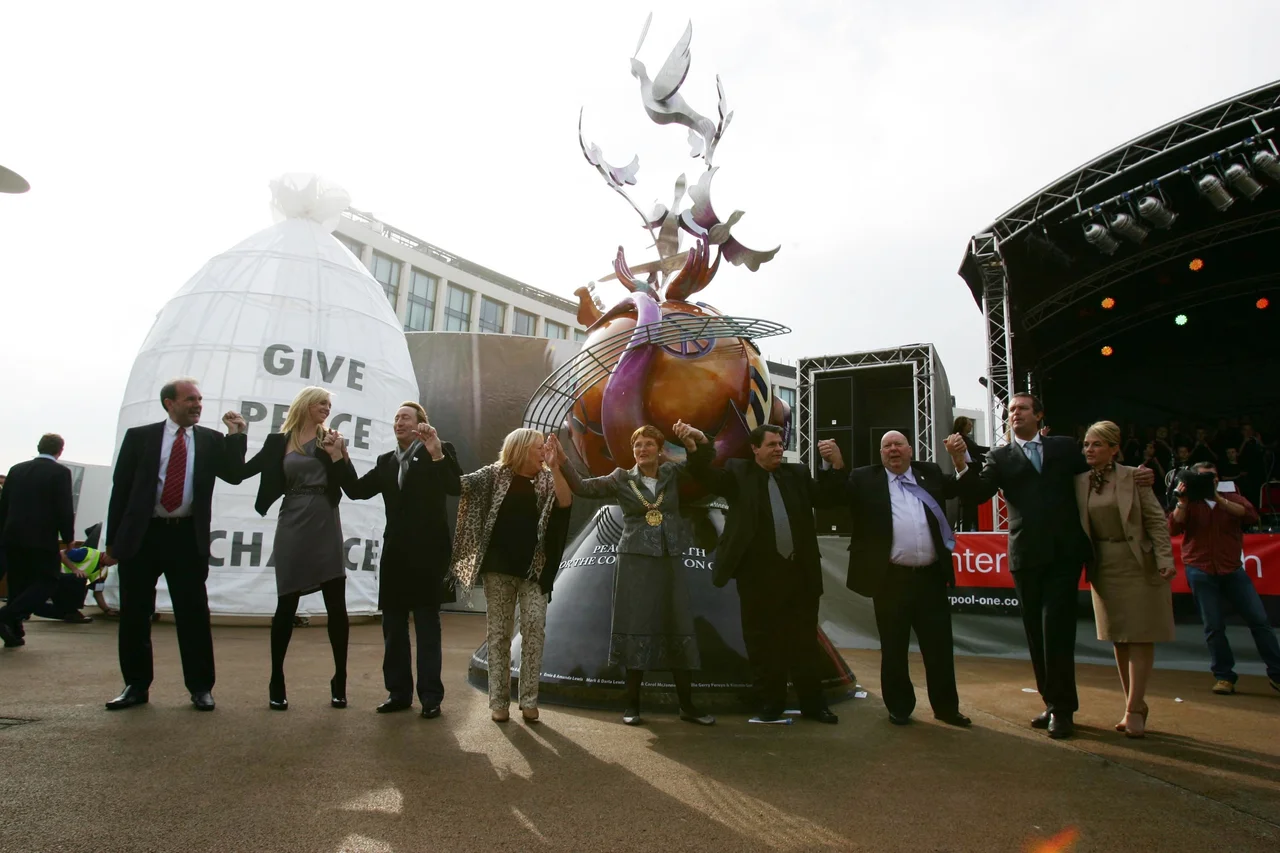

John Lennon Peace Monument
On 9 October 2010, Julian Lennon and Cynthia Lennon stood on a grass slope in Chavasse Park, Liverpool, on what would have been John Lennon's 70th birthday. A blue sheet came off an 18-foot painted metal sculpture, topped with a white glass feather, called Peace & Harmony. The crowd around them included European ambassadors, the former Beatles drummer Pete Best, and several hundred Liverpudlians who had simply walked down from the city centre because the announcement had been in the morning paper. The artist, a 19-year-old American called Lauren Voiers, watched from the side. It was the first major peace monument to John Lennon in his hometown.
A Painting Made into Metal
The sculpture began as one of Lauren Voiers's paintings, called Peace & Harmony, made when she was still a teenager in Ohio. The Global Peace Initiative, an organisation that had set itself the task of placing peace sculptures on every continent, commissioned Voiers to translate the painting into a three-dimensional form. The fabrication was done by Lyle London and Shannon Owen at Art in Metal USA in Tempe, Arizona, where the painted metal piece was built section by section to Voiers's specifications. The form is dynamic, suggesting waves of music rolling upward; the surface is hand-painted; the crowning element is a single white feather made of glass. "There are a lot of healing powers to music," Voiers later said, "and Lennon captured that through his whole career and in dedicating himself to peace and bringing people together."
The White Feather
The feather has a story that runs back into Lennon's private life. Julian Lennon, John's son with Cynthia, explained at the unveiling that his father had once told him: "Dad once said to me that should he pass away, if there was some way of letting me know he was going to be OK - that we were all going to be OK - the message would come to me in the form of a white feather." The conversation had taken place years before Lennon's murder in New York on 8 December 1980, when Julian was 17 years old. The white glass feather above the sculpture is the artist's gift to that promise. Julian Lennon has spent much of his adult life on humanitarian projects; the feather has become a recurring symbol in the foundation he runs, the White Feather Foundation, which works on environmental and indigenous-rights projects.
From Chavasse Park to the Waterfront
The sculpture's first home was Chavasse Park, a five-acre green space on the edge of the Liverpool ONE shopping development, named for Captain Noel Chavasse, the only person twice awarded the Victoria Cross in the First World War. The park is in the heart of central Liverpool, but the monument was eventually moved to a more prominent and more peaceful position: the waterfront alongside ACC Liverpool at Kings Dock, where it now sits with the Mersey behind it and the open sky above. Visitors find their way to it on most days, often laying flowers or feathers at its base. On 8 December 2010, two months after the unveiling, fans came to Liverpool to mark the 30th anniversary of John Lennon's death with a candlelit vigil at the monument. The vigil has been repeated in subsequent years.
Second of Several
Peace & Harmony is the second peace monument that the Global Peace Initiative has gifted to a major city. The first, intended for Asia, was installed in Singapore. The Liverpool sculpture represents Europe. A third, for South America, was planned. The Initiative's stated goal of placing a sculpture on every continent is the kind of ambition that does not lend itself to neat completion, but the sequence has begun. Liverpool was chosen for the European piece for what may be obvious reasons: it is the city Lennon was born in, sang about, came back to in his songs even after he had stopped coming back to it in person. The crowd at the unveiling included the people who knew him best in the world. Julian was one of them. So was Cynthia, his mother, who had been Lennon's first wife, his teenage girlfriend at the Liverpool College of Art, and who would die five years later.
Standing at the Edge
Stand at the monument today, with the Mersey at your back and the wind off the water, and the sound that defines the spot is the rigging slap of small boats moored at Kings Dock, the gulls, and the occasional ferry horn. The sculpture is not large. It is not solemn in the way that war memorials are solemn. Painted in bright colours, holding its glass feather up against the sky, it is closer in spirit to a song than to a tombstone. Children walk around it. Tourists photograph it. Fans leave flowers. Cynthia Lennon spoke briefly at the unveiling. Pete Best was there, the drummer who had been replaced before the band became famous, who never sang Imagine to a crowd of millions, and who had outlived the boy who did. The monument is many things to many people. The white feather above it is one promise being kept.
From the Air
The John Lennon Peace Monument stands on the Liverpool waterfront at Kings Dock, alongside the ACC Liverpool arena and convention centre, at 53.40°N, 2.99°W. It is just south of the Royal Albert Dock and the Three Graces on the Pier Head. Best viewed from 1,500-3,000 ft. Liverpool John Lennon Airport (EGGP) is 7 nm south-southeast. Look for the modern arena buildings on the waterfront south of the Albert Dock complex, with the monument on the green space alongside.
Nearby Stories
- RAF Wrexham 3.3 km away
- Birkdale Palace Hotel 3.7 km away
- Turton Tower 4.1 km away
- Tatton Park 5.6 km away
- Abergele Rail Disaster 9.6 km away
- Diglake Colliery Disaster 13 km away
- Ysbyty Ifan 16 km away
- Celtic Array 62 km away