
John Melton Black
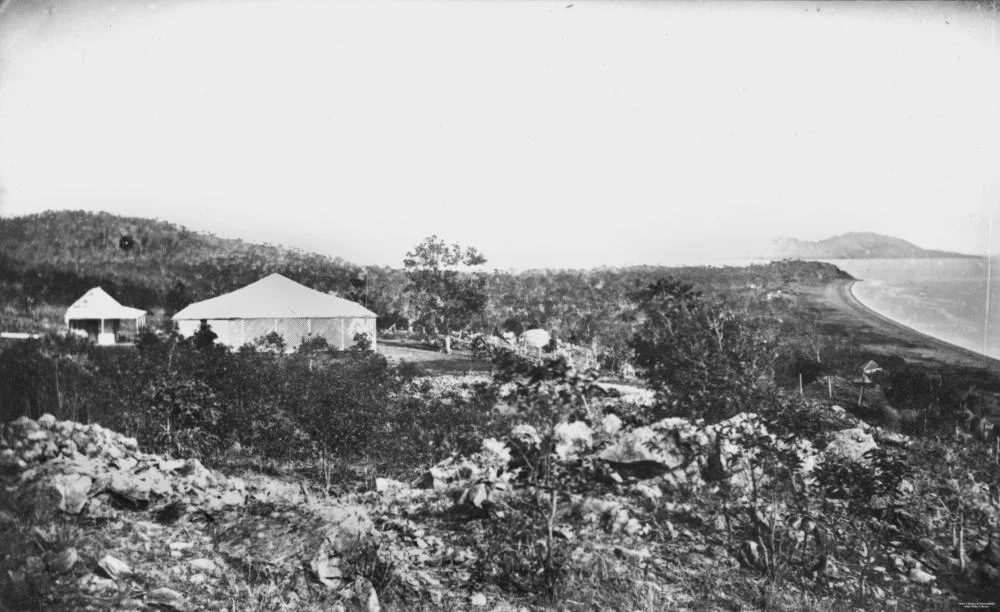
A glance at the map made the decision. John Melton Black sat at Woodstock Station, hauling supplies the long, troublesome road from Bowen, and noticed that the coast was barely twenty miles east. So in 1864 he sent two men, Andrew Ball and Mark Watt Reid, to find a way to the sea. They came back having found Ross Creek, a sheltered inlet on Cleveland Bay, and on its banks Black laid out the port and town that would become Townsville. He named it not for himself but for his employer, the Sydney merchant Robert Towns, and in doing so wrote himself into the second line of the city's story rather than the first.
North to the Burdekin
Black was born in Scotland in 1830 and drawn, like so many of his generation, by the raw promise of the new colony of Queensland. In 1861 he pushed north with a small party and founded Fanning Station near Bowen, and he was reputedly the first man to drive flocks and herds across the Burdekin River, a feat in country that punished newcomers. By the end of 1863 he had taken up a vast run he called Woodstock. But the land was harsher than the dream. Drought and mounting mortgage debt forced Black, like many others, to surrender his holdings to the banks. At thirty-four, broke but capable, he took a job managing the northern pastoral empire of a far wealthier man.
The Wealth Behind the Town
That man was Robert Towns, and his money came from sources the city's name does not advertise. Towns ran cotton ventures in Queensland worked by South Sea Islander labourers, men recruited from Pacific islands under a system that ranged from deception to outright abduction. His ship the Don Juan landed seventy-three Islanders in Brisbane in August 1863, and hundreds more followed to his Townsvale plantation. This trade in human beings, later known as blackbirding, underwrote the pastoral interests Black now managed from Woodstock. The town that grew up at Ross Creek was, in that sense, founded on capital wrung from people whose names history mostly failed to record, and whose descendants still live in Queensland today.
Ruined by a Magnificent Theatre
Black served two terms as Townsville's mayor and became its first municipal manager, but his financial undoing had come earlier, in Melbourne, before he ever set foot in North Queensland. He had poured an extraordinary sixty thousand pounds into the construction of the Theatre Royal on Bourke Street, Melbourne, a building praised as magnificent and grand, capable of holding more than three thousand people. Magnificence did not pay the bills. The cost bankrupted him, and it was partly that bankruptcy which sent him north to start over managing Robert Towns's pastoral empire. In late 1867 he left Townsville for good, his departure mourned by North Queensland residents who hastily arranged gifts of an illuminated address and a gold cup, having neglected to hold a proper farewell. From Sydney he sailed to Europe, toured widely, and eventually settled in London, where he ran a printing business until his death in 1919.
A Name Scattered Across the City
Black left no grand estate, but Townsville kept his name in pieces. Melton Hill, the modest fifty-metre rise in the city centre where his house once stood, carries his middle name and hosted the first land sale in the new town. Black River, both the watercourse and the suburb, remembers him too. The road running out to Townsville Airport is John Melton Black Drive, so that arrivals by air still pass his name without knowing it. A centenary monument in Anzac Memorial Park, between the fountain and the bandstand, lists him among the four men credited with the city's founding. It is a quiet kind of immortality for the man who chose the spot but kept the spotlight off himself.
From the Air
John Melton Black's Townsville centres on Ross Creek and Cleveland Bay at roughly 19.255°S, 146.823°E. Melton Hill, the small CBD rise where his home stood, sits just inland of the harbour near the heritage core of the city, dwarfed by Castle Hill (286 m) immediately to the south. Black founded the port at Ross Creek, still the working heart of the Port of Townsville. John Melton Black Drive runs to Townsville Airport (IATA TSV, ICAO YBTL), about 5 km northwest of the city centre. Approaches over Cleveland Bay give a clear read of the creek mouth, the harbour, and the headland forts that later guarded it. Clear, calm mornings offer the best visibility before tropical afternoon cloud develops inland.
Nearby Stories
- Ayr 13 km away
- SS Yongala 34 km away
- Great Palm Island 35 km away
- Bindal People 50 km away
- Cardwell UFO Festival 83 km away
- Hinchinbrook Island 113 km away
- Porcupine Gorge 215 km away
- Samarai 998 km away