
Johnnie Walker
He never drank the stuff. John Walker was fourteen years old and freshly orphaned when his late father's trustees handed him £417 and a grocery shop on the High Street of Kilmarnock. He was a teetotaller. And yet the spirits he learned to blend for his customers, behind that small Ayrshire counter in 1820, would eventually be poured in nearly every country on Earth, name-dropped in songs from ZZ Top to Elliott Smith, and stocked on Winston Churchill's morning sideboard. The most-sold Scotch whisky in history began with a boy who didn't drink.
The Grocer's Bet
Walker's farmer father died in 1819, the family sold their land, and the trustees invested the proceeds in an Italian warehouse and wine-and-spirits shop on the High Street in Kilmarnock. By 1825 the young proprietor was selling rum, brandy, gin and whisky alongside the groceries. Two things favoured him. The Excise Act of 1823 had slashed the punishing taxes on legal distillation, opening the door for legitimate Scotch to flourish. And blending at source was still banned, which meant a careful grocer could quietly mix grain and malt whiskies to a customer's taste, behind the counter, on demand. Walker was that careful grocer. He had no brand of his own yet, but he had a palate and a method. By his death in 1857 the shop had a reputation that travelled further than he ever did.
The Square Bottle and the Tilted Label
Walker's son Alexander turned a method into a machine. In 1860 he introduced two innovations that would outlast him by more than a century. The square bottle packed more tightly into a crate and broke less often on a long sea voyage. The label, applied at twenty-four degrees rather than straight across, gave the brand more room for type and made it stand out at a glance on a crowded shelf. The Walkers were thinking globally before global meant anything. Under John, whisky was eight percent of the firm's income. By the time Alexander handed the company to his sons, whisky made up between ninety and ninety-five percent. The Striding Man, sketched by cartoonist Tom Browne in 1908, gave the brand a face: a dapper Regency figure marching forward with cane and monocle, accompanied by the slogan "Born 1820, still going strong."
The Coloured Hierarchy
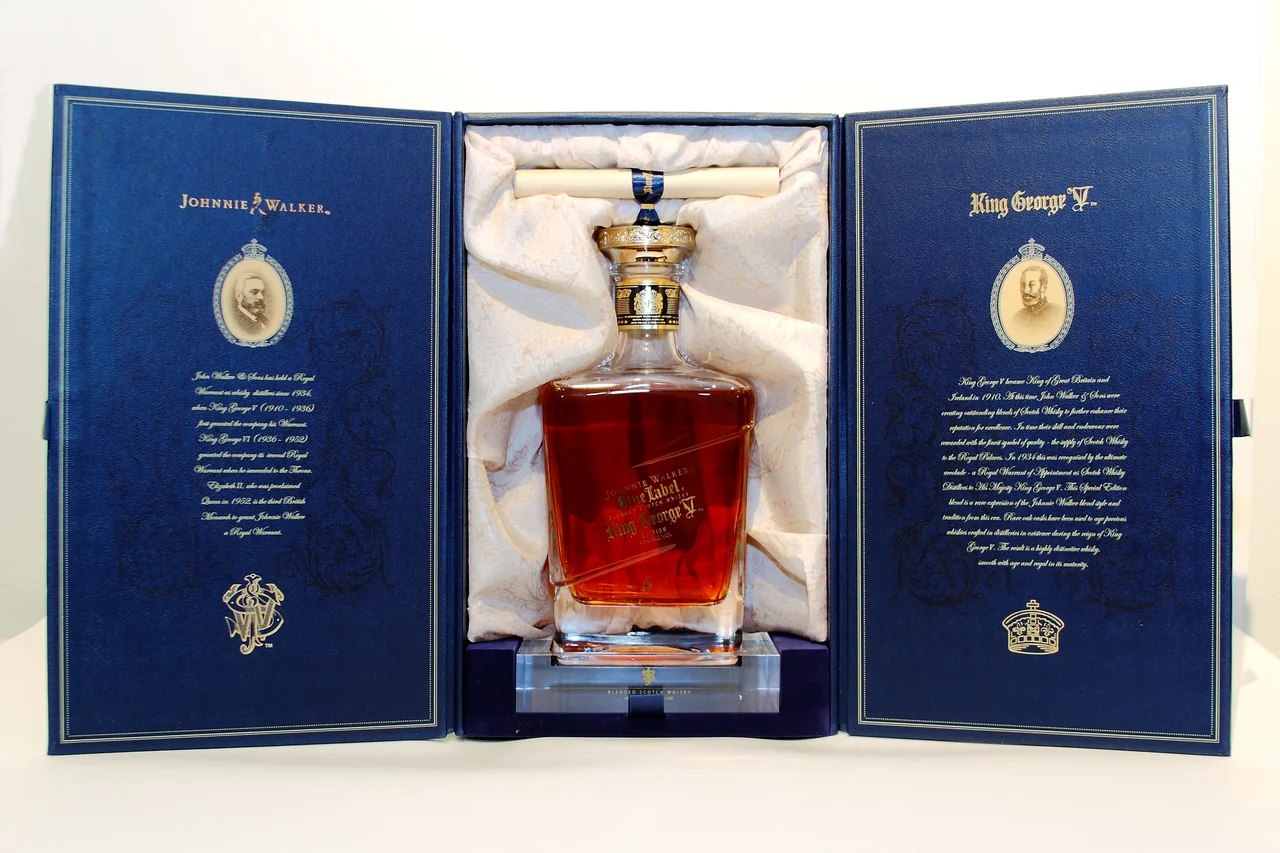
In 1909 the company rebranded its blends to match common colour names, codifying a hierarchy that whisky drinkers still navigate today. Red Label came in at ten years old, became the world's best-selling Scotch by 1945, and earned its place at funeral teas, pub counters and Christmas stockings across Scotland. Black Label, aged twelve, was the upgrade for richer relatives or better evenings. Above it, in time, came Gold, Green, Platinum and Blue, the last of which first appeared in 1992 under the name Johnnie Walker Oldest, blended to evoke nineteenth-century whiskies and bottled with a numbered certificate of authenticity. The company bought distilleries to secure supply for its blends, starting with Cardhu in 1893 and adding Mortlach in 1923. The recipes were secret. The ambition was not.
Diageo Closes the Door
In July 2009, Diageo announced that all Johnnie Walker operations in Kilmarnock would shut by 2012. The decision broke a 190-year link between town and brand. Local people, politicians and Alex Salmond, then First Minister of Scotland, fought the closure with petitions, public meetings and a large march through the town. None of it changed Diageo's mind. The Hill Street plant, once the largest bottling plant in the world, closed its doors in March 2012, and the buildings came down a year later. Blending and bottling moved east to Shieldhall in Glasgow and Leven in Fife. The Ayrshire College Kilmarnock campus and the HALO Urban Regeneration project now occupy the cleared site. The whisky still strides across the planet. The grocer's shop that started it all is gone.
Still Going Strong
The brand continues to reinvent itself from offices far from the High Street. In 2021, Diageo opened Johnnie Walker Princes Street in Edinburgh, a £35 million visitor experience occupying the old House of Fraser building, which has welcomed over a million guests. That same October, the company introduced Jane Walker, a label honouring Dr Emma Walker, the first woman to serve as the brand's master blender. By September 2024 the company was trialling a 700 ml bottle made of ninety percent paper for Black Label, sixty percent lighter than glass. Across two centuries the marketing has shifted from Browne's striding figure to Robert Carlyle's monologue in The Man Who Walked Around the World, but the slogan still works: born 1820, still going strong.
From the Air
Kilmarnock and the former Hill Street bottling site sit at 55.61°N, 4.50°W in Ayrshire, southwest Scotland. Best viewed from 3,000-4,000 feet, with the town tucked between the M77 and the rolling farmland of the Irvine Valley. Nearest airports: Glasgow Prestwick (EGPK) about 12 nm southwest, and Glasgow (EGPF) about 22 nm north. Look for the distinctive masonry arches of the Kilmarnock railway viaduct cutting through the town centre as your main visual landmark.
Nearby Stories
- Clydebank 0.4 km away
- Dunoon 5.5 km away
- HMS Dasher (D37) 6.1 km away
- New Lanark 6.3 km away
- Falkirk Wheel 11 km away
- Drumlanrig Castle 11 km away
- Ailsa Craig 18 km away
- Maybole Castle 18 km away