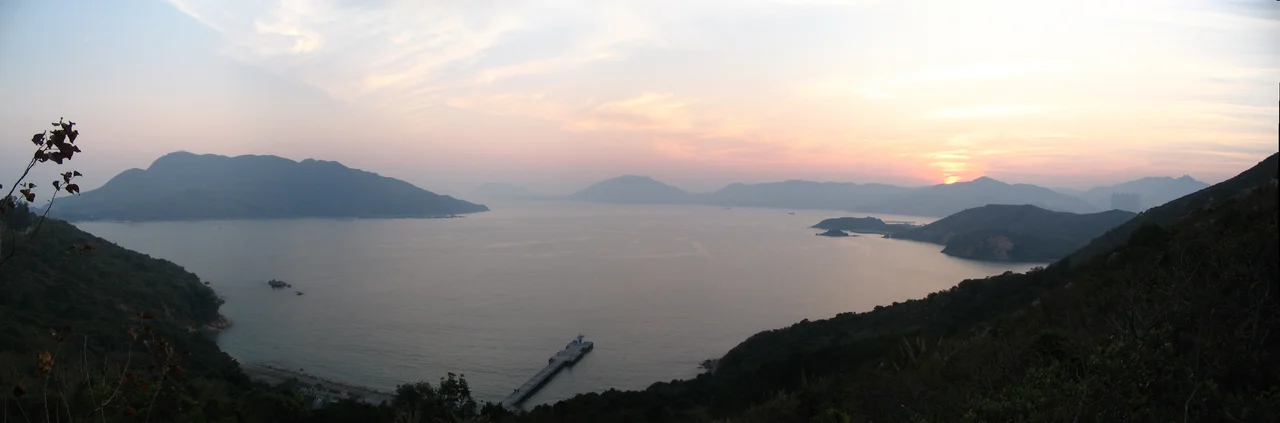

Joss House Bay
Carved into the granite shoreline at the southern tip of the Clear Water Bay Peninsula, Joss House Bay carries two names that tell the same story. The English calls it a joss house bay — a bay of incense, of offering, of prayer. The Cantonese calls it Tai Miu Wan: the bay of the great temple. Both names point to the same thing: a temple that has stood here since 1266, drawing worshippers across seven centuries of South China Sea weather, dynastic upheaval, and urban transformation. On the Tin Hau Festival each year, thousands of pilgrims still board ferries from North Point and sail out to this quiet cove. The temple hasn't changed its purpose once.
The Oldest Temple on the Water
Tin Hau is the goddess of the sea, patron of fishermen, and one of the most widely venerated figures in Hong Kong's religious life. Her temples dot every fishing village and harbour along the coast — but the one at Joss House Bay is the oldest and the largest in the territory, earning it the simple title of the Big Temple. Founded in 1266 by the Lam family from former Po Kong in Kowloon, it sits near the Fat Tong Mun channel, the narrow passage between the peninsula and the island of Tung Lung Chau that served for centuries as one of the main arteries of South China Sea trade. Merchant vessels, fishing junks, and salt-tax boats all passed through that channel. Those aboard would have looked toward this bay and offered prayers. The temple is now a declared monument of Hong Kong — the territory's highest heritage designation, conferred in 2023 — but its significance is not really architectural. It is the continuity that matters: the same goddess, the same bay, the same act of supplication.
Words Cut into Stone in 1274
Partway down the staircase path from the road, before the temple comes into view, a rock inscription stops visitors in their tracks. Cut into the granite face in 1274 AD — in the Jiashu year of the Xianchun reign of the Southern Song dynasty — it is the oldest dated inscription in Hong Kong. The text records a visit by Yan Yizhang, an officer responsible for salt administration, and a companion. They came, they saw the temples on either side of the bay, and they left their names in stone. Eight centuries later, those characters are still legible. The inscription was declared a monument of Hong Kong in 1979, and passing it on the way down to the bay has a particular quality: you are walking the same route that a government official walked in the waning years of the Southern Song, when the dynasty had less than five years left before the Mongol conquest. The salt trade went on. The temple went on. The inscription remained.
The Tin Hau Festival and the Pilgrim Ferries
Once a year, Joss House Bay sheds its quiet and fills with noise, incense smoke, and the sound of ferry engines. The Tin Hau Festival — observed on the twenty-third day of the third lunar month, said to be the goddess's birthday — draws thousands of worshippers who make the journey specifically to this bay. A special ferry service runs from North Point under the regulation of the Transport Department: two designated days, fast boats and ordinary boats, thousands of passengers. The bay, which on ordinary days belongs to fishing enthusiasts and the occasional hiker, becomes a scene of intense devotion. Dragon boats come in through the channel. Firecrackers echo off the hillsides. Then the day ends, the ferries empty, and the bay returns to itself. The regularity of it — this annual surge and withdrawal — reflects something durable about Hong Kong: the modern city and the ancient ritual coexisting without apology.
Getting There, Then and Now
The path down to Joss House Bay hasn't changed in its essentials. You take the green minibus — Route 16 from Po Lam MTR station — and alight at the Tai Miu Wan stop near the entrance of Clearwater Bay Golf and Country Club, a juxtaposition that only Hong Kong could produce. From there, it's a ten-minute walk down a flight of stairs. The rock inscription appears on the descent, set into the hillside on your left. The bay opens below: a small beach, the piers used by festival ferries, the temple tucked at the water's edge. The channel between the peninsula and Tung Lung Chau glitters in the distance. Fishermen set their lines from the rocks. The whole arrangement has the feeling of something preserved not by official decree but by sheer persistence — the persistence of faith, of custom, and of a coastline that never quite got absorbed into the urban sprawl spreading north.
From the Air
Joss House Bay sits at 22.267°N, 114.283°E at the southern end of the Clear Water Bay Peninsula in Hong Kong's New Territories. From the air at 2,000–3,000 feet, the narrow Fat Tong Mun channel separating the peninsula from Tung Lung Chau island is clearly visible. The nearest major airport is Hong Kong International (VHHH) on Lantau Island, about 45 km to the west-southwest. The terrain here is hilly and green, a marked contrast to the dense urban fabric of Kowloon visible to the northwest. Clear Water Bay itself opens to the south.
Nearby Stories
- Shek Pik 1.7 km away
- Tung Ping Chau 4.8 km away
- Hong Kong 12 14 km away
- Wanshan Archipelago Campaign 16 km away
- Pearl River Delta 18 km away
- Battle of Penghu 478 km away
- Penghu Air Raids 487 km away
- Cape Maobitou 596 km away
Sources
- Joss House Bay - Wikipedia
- Tin Hau Temple, Joss House Bay - Wikipedia
- Two historic buildings declared as monuments - Hong Kong Government
- Antiquities and Monuments Office - Joss House Bay Rock Inscription
- Transport Department - Special Ferry Service North Point to Joss House Bay
- New Territories GMB Route 16 - 16seats.net