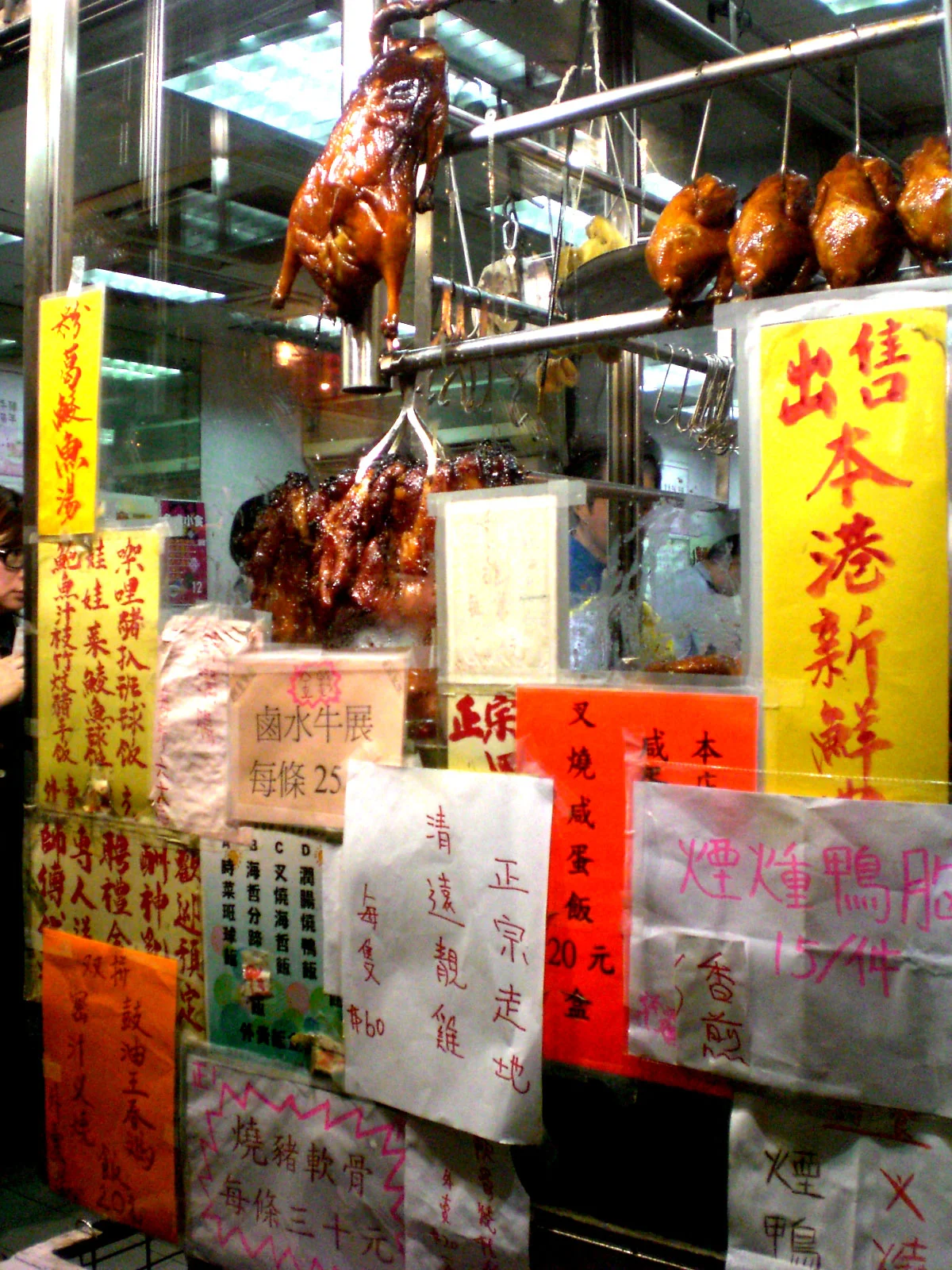

Joy Hing's Roasted Meat
The queue forms before the shop opens. It is there at lunch. It is there in the mid-afternoon lull when most restaurants in Wanchai are quiet. At Joy Hing's Roasted Meat on Heard Street, the wait is the price of admission, and nobody seems to mind. Superstars and construction workers stand in the same line. The char siu — Cantonese barbecued pork, lacquered in red, sticky with honey and five-spice — is why. A Teochew family has been making it since the late Qing Dynasty. The Michelin Guide noticed. The queue was already there.
From Guangdong to Wanchai
The family's story begins in Guangdong province, where they ran what is said to be one of the first Cantonese roasted-meat shops in the region during the dying years of the Qing Dynasty. That dynasty collapsed in 1912; the family had already moved. By the turn of the 20th century, they had crossed the border into Hong Kong and set up on Heard Street in Wanchai as a dai pai dong — the open-air food stalls that were once a defining feature of Hong Kong street life. The cooking style they brought was Cantonese, but the family was Teochew, from the eastern coastal region of Guangdong. That combination — Teochew craftsmanship expressed through Cantonese roasting tradition — may be part of what makes Joy Hing's distinctive, though the family has not been explicit about the recipe.
The Century-Old Chicken Problem
Char siu is the restaurant's fame, but its chicken recipe is where tradition met a genuine crisis. By classical Cantonese standards, the marinated steamed chicken was served medium raw — blood still visible near the bones, the flesh soft-textured and yielding. This is how the dish was meant to be eaten, and for more than a century, Joy Hing's made no compromises on that point. Then, in 1997, avian flu hit Hong Kong. Chickens were culled. Anxiety about undercooked poultry spread across the city. The restaurant faced a choice: modify a recipe kept intact for over a hundred years, or risk the health of its customers. They modified it. The original chicken recipe, unchanged through the fall of dynasties and the Second World War, was slightly altered in response to a viral outbreak. The char siu remained untouched.
What Michelin and OpenRice Agreed On
Joy Hing's Roasted Meat holds a Bib Gourmand award from the Hong Kong Michelin Guide — the guide's recognition for 'good quality, good value cooking,' distinct from the starred restaurants but arguably more meaningful as a measure of everyday excellence. It was also selected as the best char siu restaurant by OpenRice, Hong Kong's influential food review platform. These two endorsements represent very different validation: one from French culinary authority, one from local food culture. The restaurant earned both without softening its approach. No elaborate decor. No frills. Just the queue, the gleaming lacquered meat hanging in the window, and the rice.
A Shop That Doesn't Need Your Opinion
The food critic Chua Lam, a celebrated figure in Hong Kong and Taiwanese food writing, put it plainly in his column: 'This old restaurant, surrounded by a long queue all day long, hardly bothers to flatter food critics like me, and doesn't even care about recommendations from anyone because they know the best at maintaining their quality and keeping their customers.' That is not false modesty. It is the confidence of an institution that has survived regime change, pandemic, and the transformation of Wanchai from a fishing village to a neon-lit entertainment district. Joy Hing's has been on Heard Street for more than a century. The queue is not going anywhere.
From the Air
Joy Hing's Roasted Meat is located at approximately 22.278°N, 114.177°E in Wanchai, on the north shore of Hong Kong Island. From the air, Wanchai sits between Central to the west and Causeway Bay to the east, easily identifiable by the curve of the Wan Chai Convention Centre waterfront. The nearest international airport is VHHH (Hong Kong International Airport, Chek Lap Kok), approximately 28 km to the west. Viewing altitude of 1,500–2,500 ft provides a clear view of the dense urban fabric of the northern Hong Kong Island waterfront. This is a street-level gem — most meaningful from ground level, not the air.
Nearby Stories
- Lok Ma Chau Loop 2.3 km away
- Portas do Cerco 2.3 km away
- Kweilin Incident 17 km away
- Wanshan Archipelago Campaign 34 km away
- Nanxiong Formation 115 km away
- Battle of Nanpeng Island 148 km away
- Heyuan 169 km away
- Cape Maobitou 632 km away